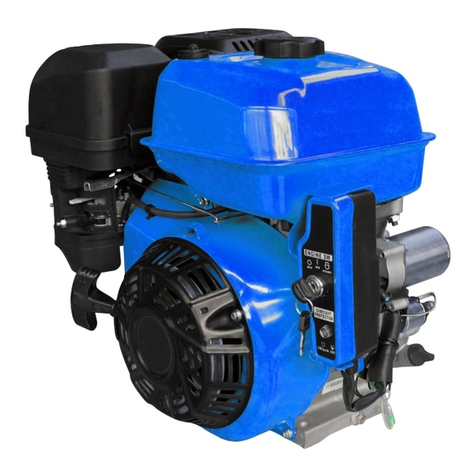
BEFORE STARTING THE ENGINE
Before starting the engine take these precautions:
1. Make sure spark plug, muffler, fuel cap and air cleaner are in place and secured. Do not crank
engine with spark plug removed.
2. Do not start the engine until any spilled fuel evaporates.
STARTING THE ENGINE
WARNING! Do not start or run engine in enclosed area, even if doors or windows are open. Engine
exhaust contains carbon monoxide, an odorless and colorless poison gas.
WARNING! Failure to follow the steps below will result in rapid retraction of the starter cord faster
than the user can let go. This will pull the user’s hand and arm toward the engine, possibly resulting
in serious injury.
CAUTION! Direct-coupled equipment components such as, but not limited to, blades, impellers,
pulleys, sprockets, etc., must be securely attached before the engine is started to avoid injury
or damage.
1. Pull the choke rod out when the engine is cold. This will close the choke and restrict the fuel.
a. As the engine warms, release the choke rod to open the choke.
2. If the equipment that you are connecting the engine to has a flywheel brake, move the flywheel
brake lever (located on equipment) to release the flywheel brake.
3. Pull the starter grip lightly until resistance is felt, then pull briskly.
NOTICE: Do not allow the starter grip to snap back against the engine. Return it gently to
prevent damage to the starter.
4. If your equipment has a flywheel brake, continue to hold the flywheel brake lever (located on
equipment). The engine will stop if you release the flywheel brake lever.
Occasionally you may hear a light ‘spark knock’ or ‘pinging’ (metallic rapping noise) while operating under
heavy loads. This is no cause for concern.
Should the spark knock or pinging continue to occur when the engine speed is steady under a normal
load, consider replacing the fuel. If the sounds continue after changing the fuel, contact Princess Auto
Ltd. for a solution or see a qualified technician.
NOTE: Running the engine with persistent spark knock or pinging can cause engine damage.