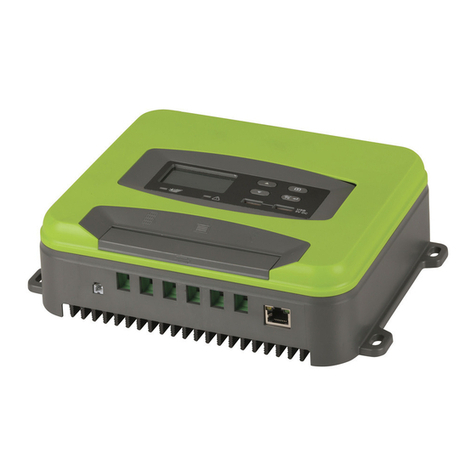
PowerTech MP3768 User manual

Instruction Manual
MPPT Solar Charge
Controller
for Lithium or SLA Batteries
MP3768

1
Table of Contents
Important Safety Instructions 2
Quick Start Guide 3
General Information 4
Overview 4
Characteristics 6
Installation 12
Attention 12
Requirements for the PV array 12
Wire size 14
Mounting 15
Operation 18
Buttons 18
Interface 19
Settings 21
Additional Info 28
Protection 28
Troubleshooting 30
Maintenance 31
Specifications 32

2
IMPORTANT SAFETY INSTRUCTIONS:
Please reserve this manual for future review.
This manual contains all safety, installation, and operation instructions for the
MPPT solar controller (“controller” referred to in this manual).
• Read all the instructions and warnings carefully in the manual before
installation.
• No user-serviceable components inside the controller; please do not
disassemble or attempt to repair the controller.
• Mount the controller indoors. Avoid exposure to the components and
do not allow water to enter the controller.
• Install the controller in a well-ventilated place; the controller’s heat sink
may become very hot during operation.
• It is suggested to install appropriate external fuses/breakers.
• Make sure to switch o all PV array connections and the battery fuse/
breakers before controller installation and adjustment.
• Power connections must remain tight to avoid excessive heating from a
loose connection.
• The entire system should be installed by professional and technical
personnel.
Explanation of Symbols
• To enable users to use the product eciently and ensure personal
and property safety, please read related literature accompanying the
following symbols.
• Please read the literature accompanying the following symbols.
Symbol Definition
TIP TIP: Indicates any practical advice for reference.
!IMPORTANT: Indicates a critical tip during the operation, if
ignored, may cause the device to run in error.
CAUTION: Indicates potential hazards, if not avoided, may
cause the device damaged.
WARNING: Indicates the danger of electric shock, if not
avoided, would cause casualties.
WARNING HOT SURFACE: Indicates the risk of high tem-
perature, if not avoided, would cause scalds.
i
Read the user manual carefully before any operation.

3
QUICK START GUIDE:
1. For best results, use the thickest cable you can aord that will fit in the
connectors.
2. Make sure all screwed connections are as tight as possible.
3. Panel (PV) voltage must be higher than battery voltage.
A 12V battery is OK with a 12V or higher solar (PV) array, a 24V battery
will only work with a 24V or higher solar (PV) array.
4. Maximum open-circuit Panel (PV) array voltage is 100V
5. Ensure battery line has an adequate fuse or circuit breaker.
6. Very Important: Connect battery to controller BEFORE solar panel, and
check that the battery voltage is registering on the display. (Repeatedly
press “select” button until you see “Batt Voltage”).
7. Set your battery type before connecting the solar array to your regulator.
Full instructions for setting the battery type can be found on page 22.
A summary of common battery types can be found below.
SEL = Sealed Lead Acid (SLA, AGM)
GEL = Gel Battery
FLD = Flooded Cell (Lead acid with filler caps, car batteries etc)
LFP4S = 14.8V/12V Lithium Batteries
LPF8S = 29.8V/24V Lithium Batteries
8. Finally connect up the solar (PV) array and check that charging is
actually taking place (in the battery menu).

4
GENERAL INFORMATION:
OVERVIEW
Adopting the advanced MPPT control algorithm, the solar controller can
minimize the maximum power point loss rate and loss time. It makes this
product tracks the PV array's maximum power point and obtains maximum
energy under any situation. Compared with the PWM charging method,
MPPT solar controllers can increase the energy utilization ratio by 10%-30%.
Charging current limit, charging power limit, and high temperature charging
automatic power reduction; these functions fully ensure system stability
when access to excess PV modules and high temperature running. Increase
a professional protection chip for the RS485 port, which further improves the
reliability and meets the dierent application requirements.
Based on a digital control circuit, the controller owns a self-adaptive
three-stage charging mode. It can eectively prolong the battery lifespan
and significantly improve the system's performance. They are equipped
with comprehensive electronic protections to ensure the solar system
more reliable and more durable. This controller can be widely used for RV,
household systems, field monitoring, and many other applications.
Features:
• Advanced MPPT, with eciency no less than 9 9.5%
• Ultra fast tracking speed and guaranteed tracking eciency
• Advanced MPPT control algorithm to minimize the MPPT loss rate and
loss time
• Accurate recognizing and tracking technology of multi peaks maximum
power point
• Maximum DC/DC conversion eciency of 98%
• Automatic limitation of the charging current and charging power
• Wider MPPT working voltage range
• Support the lead acid and lithium batteries voltage parameters can be
set on the controller
• Programmable temperature compensation feature.
• Real time energy statistics function
• High temperature charging automatic power reduction function
• Multiple load work modes
• High quality and low failure rate components of ST or IR to ensure the
service life
• 100% charging and discharging in the environment temperature range
• Standard Modbus communication protocol based on the RS485
communication bus, making the communication distance longer

5
GENERAL INFORMATION:
• A power protection chip, which can provide 5VDC/200mA power
and over current, short circuit protections, is adopted by the
communication interface
• Support monitoring and setting the parameters via the APP or
PC software
• Comprehensive electronic protection
For the BCV, FCV, LVD, and LVR, users can modify them on the local
controller when the battery type is "USE."

6
GENERAL INFORMATION:
CHARACTERISTICS
Figure 1 Product Characteristics
1SELECT button
2RTS interface
3PV terminals
4Battery terminals
5Load terminals
6RS485 port
7Mounting Hole Φ5mm
8ENTER button
9LCD
Suppose the remote temperature sensor is not connected to the controller
or damaged. In that case, the controller will charge or discharge the battery
at the default temperature setting of 25°C (no temperature compensation).

7
GENERAL INFORMATION:
MAXIMUM POWER POINT TRACKING TECHNOLOGY
Due to the nonlinear characteristics of the solar array, there is a maximum
energy output point (Max Power Point) on its curve. Traditional controllers,
equipped with switch charging technology and PWM charging technology,
can't charge the battery at the maximum power point and cannot obtain the
maximum energy available from the PV array. In contrast, the solar charge
controller with Maximum Power Point Tracking (MPPT) Technology can lock
the point to obtain the maximum energy and deliver it to the battery.
The MPPT algorithm continuously compares and adjusts the operating
points to locate the array's maximum power point. The tracking process is
fully automatic and does not need the user's adjustment.
As Figure 1-2, the curve is also the array's characteristic curve; the MPPT
technology will 'boost' the battery charge current through tracking the MPP.
Assuming 100% conversion eciency exist in the solar system, the following
formula is established:
Input power (PPV) = Output power (PBat)
Input voltage (VMpp) x Input current (IPV) =
Battery voltage (VBat) x battery current (IBat)
Normally, the VMpp is always higher than VBat. Due to the principle of energy
conservation, the IBat is always higher than IPV. The greater the dierence
between VMpp & VBat, the greater the dierence between IPV & IBat. The
greater the dierence between the array and the battery will also decrease
the system conversion eciency. Therefore, the controller's conversion
eciency is particularly important in the PV system.
Figure 1-2 is the maximum power point curve, whose shaded area is the
traditional solar charge controller (PWM Charging Mode). It is known that
the MPPT mode can improve solar PV usage.

8
GENERAL INFORMATION:
According to the test, the MPPT controller can raise 20%-30% eciency
compared to the PWM controller. (Specified value may be fluctuant due to
the influence of the circumstance and energy loss.)
Figure 1-2 Maximum Power Point Tracking Technology
In actual application, as shading from cloud, tree, and snow, the panel may
appear Multi-MPP. However, in actuality, there is only one real Maximum
Power Point. As the below Figure 1-3 shows:
Figure 1-3 Mutil-MPP Curve

9
GENERAL INFORMATION:
Suppose the program works improperly after appearing Multi-MPP. In
that case, the system will not work on the real max power point, which
may waste most solar energy resources and seriously aect the system's
normal operation. The typical MPPT algorithm, designed by our company,
can track the real MPP quickly and accurately. It can improve the PV array's
utilization rate and avoid resource waste.
BATTERY CHARGING STAGE
The controller has a three-stage battery charging algorithm, including Bulk
Charging, Constant Charging, and Float Charging. Through the three-stage
charging method, the system can extend the battery's lifespan.
Figure 1-4 Battery charging stage curve
A) Bulk Charging
The battery voltage has not yet reached constant voltage (Equalize or
Boost Charging Voltage). The controller operates in constant current
mode, delivering its maximum current to the batteries (MPPT Charging).
When the battery voltage reaches the constant voltage set point, the
controller will start to operate in constant charging mode.
Table of contents
Other PowerTech Controllers manuals
PowerTech
PowerTech MP3743 User manual
PowerTech
PowerTech MP-3760 User manual
PowerTech
PowerTech ZM9126 User manual
PowerTech
PowerTech MP3743 User manual
PowerTech
PowerTech MP3749 User manual
PowerTech
PowerTech MP-3735 User manual
PowerTech
PowerTech MP3745 User manual
PowerTech
PowerTech MP3755 User manual
PowerTech
PowerTech MP3741 User manual
PowerTech
PowerTech LL00233 User manual
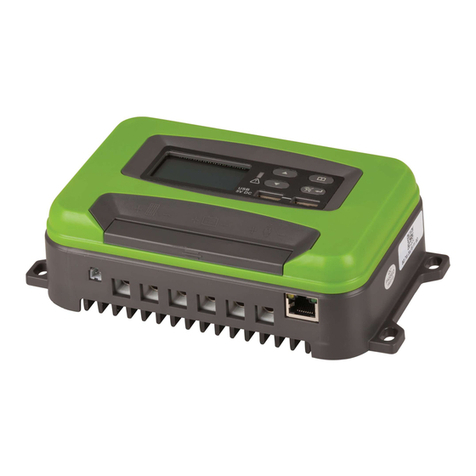
Popular Controllers manuals by other brands
Digiplex
Digiplex DGP-848 Programming guide
YASKAWA
YASKAWA SGM series user manual
Sinope
Sinope Calypso RM3500ZB installation guide
Isimet
Isimet DLA Series Style 2 Installation, Operations, Start-up and Maintenance Instructions
LSIS
LSIS sv-ip5a user manual
Rockwell Automation
Rockwell Automation 1769-L31 installation instructions