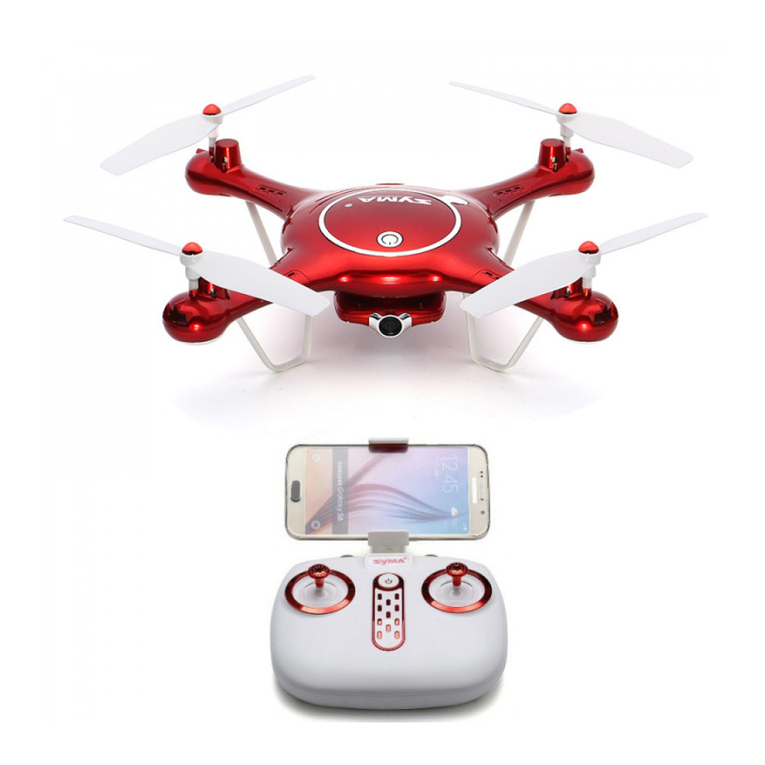
ProFlight ECHO PFBD77 User manual

ECHO
User Manual
Model: PFBD77
Thank you for choosing ProFlight.
Please read this user manual before using this drone and
keep it safe for future reference.

2of 16
CONTENTS
Safety…………………………………………………………………………………3
Battery Charging…………………………………………………………………4
Transmitter Diagram…………………………………………………………..6
Aircraft Diagram………………………………………………………………….7
Fitting Propeller Guards………………………………………………………8
Propeller Installation…………………………………………………………..8
Preparing for First Flight……………………………………………………..9
Binding of Radio Transmitter and Receiver…………………………9
Sensitivity…..………………………………………………………………………9
Flight Instructions………………………………………………………………10
Aircraft Functions & Features…………………………………………….11
Camera………………………………………………………………………………13
App…………………………………………………………………………………….14
Troubleshooting Guide………………………………………………………15

3of 16
SAFETY
Read the entire instruction manual and familiarise yourself with the product
and all its features before operating. Failure to operate the product correctly
can result in damage to the product, surroundings or even serious injury. This
product is not a toy and must be operated with caution and common sense. It
requires some basic mechanical knowledge. This product is not intended for
use by children without direct adult supervision. This manual contains
instructions for safety, operation and maintenance. It is essential to read and
follow all the instructions and warnings in this manual prior to assembly, setup
or use in order to operate correctly and avoid damage or serious injury.
Not intended for use by children under 14 years of age. This is not a toy.
Always operate your drone in open spaces away from vehicles, buildings,
traffic and people.
Always keep out of reach of children.
Avoid exposure to water as moisture can cause damage to the
electronics.
Never operate your drone with low transmitter batteries.
The battery charger included with the drone has been designed to safely
charge the Li-Po battery.
Mishandling of Li-Po batteries can result in a fire, personal injury, and
/or property damage.
By handling, charging or using the included Li-Po battery you assume all
risks associated with lithium batteries.
If at any time the battery begins to balloon or swell, discontinue use
immediately. If charging or discharging, discontinue and disconnect.
Continuing to use, charge or discharge a battery that is ballooning or
swelling can result in fire.
Always store the battery at room temperature in a dry area for best
results.

4of 16
Do not store battery or drone in a car or direct sunlight. If stored in a
hot environment, the battery can be damaged or even catch fire.
Never use any other type of battery charger other than the one supplied
with the drone. Failure to charge the battery with a compatible charger
may cause fire resulting in personal injury and/or property damage.
Never exceed the recommended charge rate.
When a Li-Po battery is discharged below 3.7V, the battery may be
damaged and may no longer accept a charge. The drone will
automatically land and become inactive when the battery reaches this
level, this is to protect the battery.
Battery Charging
Use only the enclosed USB Li-Po charger to charge your battery.
Remove the battery from the battery compartment at the rear of the aircraft.
Press down the release button on the underside of the aircraft and slide it out.

5of 16
Plug the charger into the battery.
Plug the charger into the USB socket before attaching the battery.
When the charger is plugged into the USB slot (with no battery attached) the
LED will illuminate RED. When the battery is charging the LED will go out.
When the battery is fully charged it will illuminate RED. Charging should take
around 90 minutes. DO NOT leave the battery unattended whilst charging.
Remote Control Charging
Turn off the remote control. Connect the USB cable to the remote control.
The GREEN light on the control will illuminate whilst charging. Once charged
the RED light on the USB charger will illuminate.

6of 16
Transmitter Diagram
1. Charging indicator 15. Direction control stick
2. Throttle control stick 16. Power indicator
3. Left/right rotation trim 17. Auto take off/landing
4. Power switch (hold for 3 seconds)
5. Camera lens up 18. Speed select (One
6. Camera lens down beep for low, two for
7. 3D flip (Future firmware update) med, three for high)
8. Charging socket 19. Photo control. (Future
9. Headless mode firmware updates)
10.LED light control switch 20. Return key
11.Backward trim
12.Forward trim
13.Left/right trim
14. Press and hold to before power on
to switch left & right control sticks

7of 16
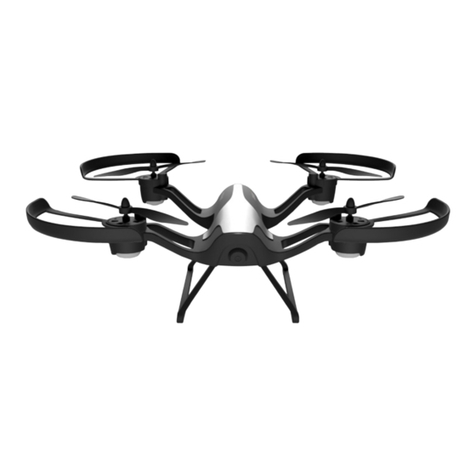
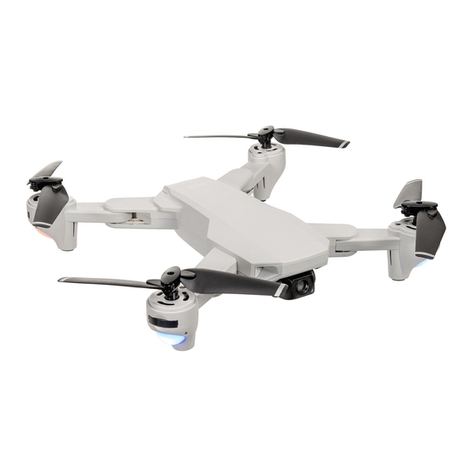
Aircraft Diagram
1. Prop-guards
2. Propeller
3. Power button
4. Camera module
5. Motor
6. Battery module
7. Obstacle avoidance module
8. Landing gear

8of 16
Fitting Propeller Guards
It is recommended that until you are fully comfortable with the controls and
handling of the aircraft that you install the propeller guards. These will protect
the propellers and aircraft in the event of a crash or hard landing.
Place the propeller guard over the outside of
the propeller and attach it with the screw
provided.
The aircraft comes with a collision avoidance
system, but this will only function in Low
speed mode.
Propeller Installation
Insert the propeller over the motor spindle and use a screwdriver to
tighten the screw.
It is important for the correct blade to be placed on the correct
motor or the aircraft will not fly correctly. Each blade is marked with
an A or B to indicate which motor it corresponds to.
The white rotors are positioned at
the front, and the black at the rear.

9of 16
Preparing for First Flight
1. Make sure both the transmitter and aircraft batteries are sufficiently
charged.
2. Find a suitable place to fly the aircraft, away from people, buildings and
vehicles.
3. Make sure the throttle stick is centred before turning on the transmitter.
Binding of Radio Transmitter & Receiver
1. Place the aircraft on a flat surface and insert the battery into the aircraft.
2. Turn on the controller.
3. The lights on the aircraft will flash repeatedly, hold the left stick down
until the transmitter binds with it. At this point the lights will illuminate
and stay on.
4. The aircraft is ready to fly.
The aircraft can be flown using either the radio control supplied or by using the
App on a smart device. For details on flying with the App, see page 14.
Sensitivity
The aircraft has 3 levels of sensitivity –High, Medium and Low. To change the
sensitivity, click the speed button. The controller will beep once when in Low
mode, twice when in medium mode and three times when in high mode.

10 of 16
High
In high sensitivity setting the aircraft will be more agile but more difficult to
control if you are new to flying.
Low
In low sensitivity setting the aircraft will be more docile and easier to control.
Medium
In medium mode the sensitivity will be between high and low.
Flight Instructions
Before your first flight make sure you are familiar with the controls of the
aircraft.
Left Joystick –Throttle & Rudder
Right Joystick –Elevator & Aileron
If the aircraft drifts in a particular direction you can trim the controls using the
trim buttons. Select the trim key opposite the direction of drift.
The aircraft can only take off and land by pressing the take off / land button
(click once to take off and once to land). Once the aircraft is airborne it will
hold a steady hover, you are now in control of the aircraft and can use the left
and right sticks to control it.
Table of contents
Other ProFlight Drone manuals
ProFlight
ProFlight TRACER PFBD97 User manual
ProFlight
ProFlight PFBD303 User manual
ProFlight
ProFlight PFBD103 User manual
ProFlight
ProFlight MAVERICK AIR PFBD200 User manual
ProFlight
ProFlight PFBD303 User manual
ProFlight
ProFlight PFBD301 User manual
ProFlight
ProFlight Wraith PFBD104 User manual
ProFlight
ProFlight ORBIT PFBD201 User manual
ProFlight
ProFlight PFBD302 User manual
ProFlight
ProFlight PFBD101 User manual