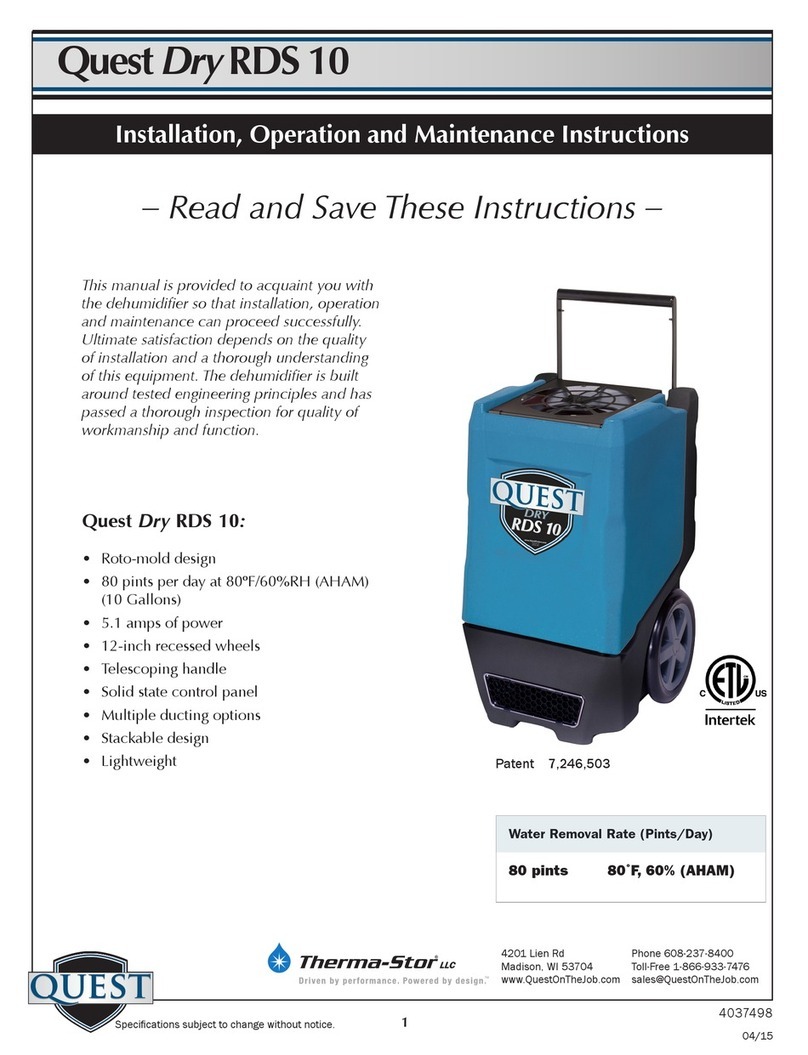
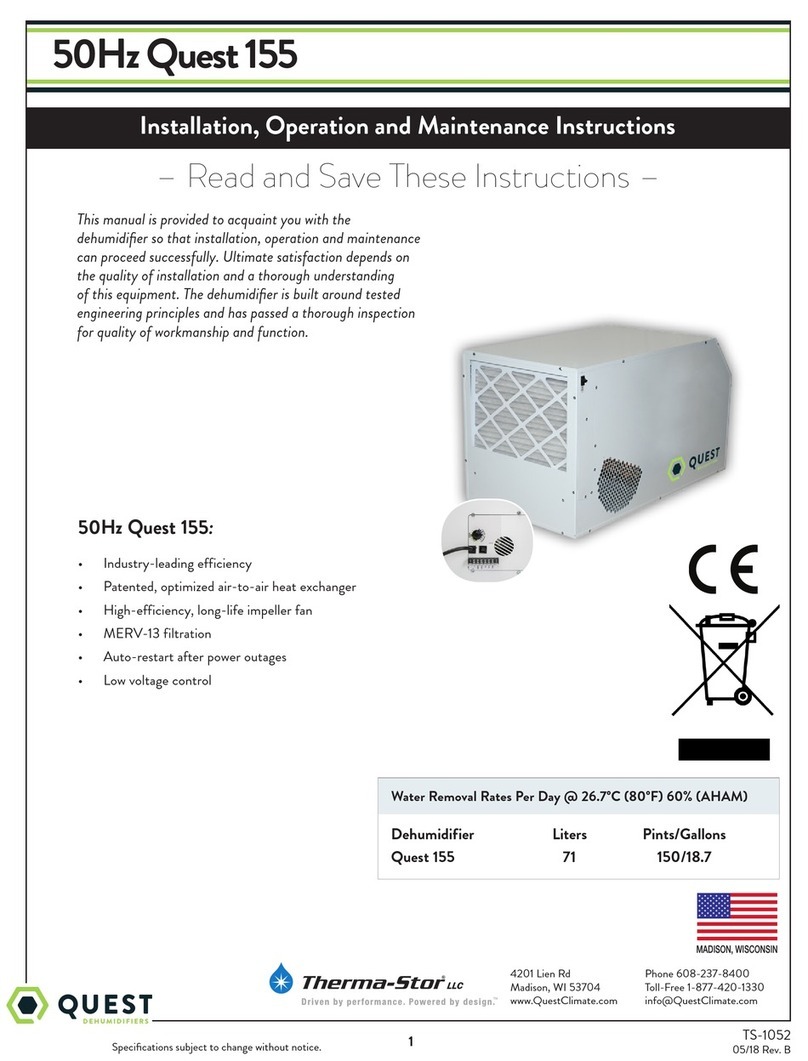
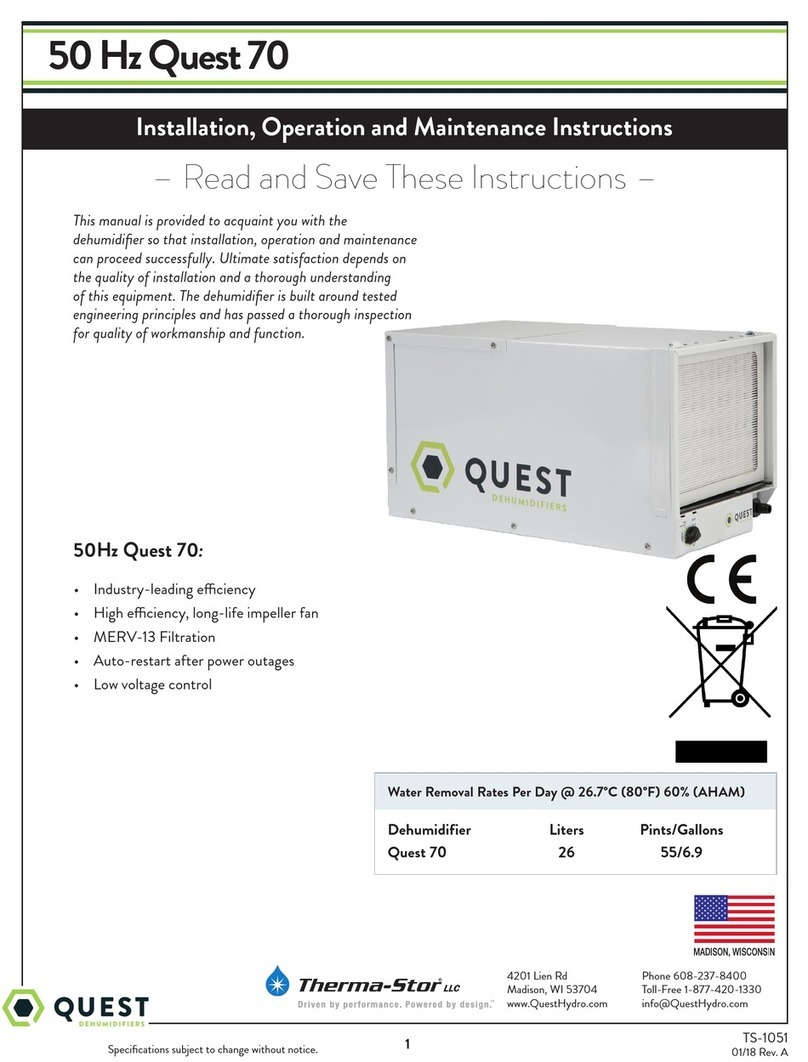
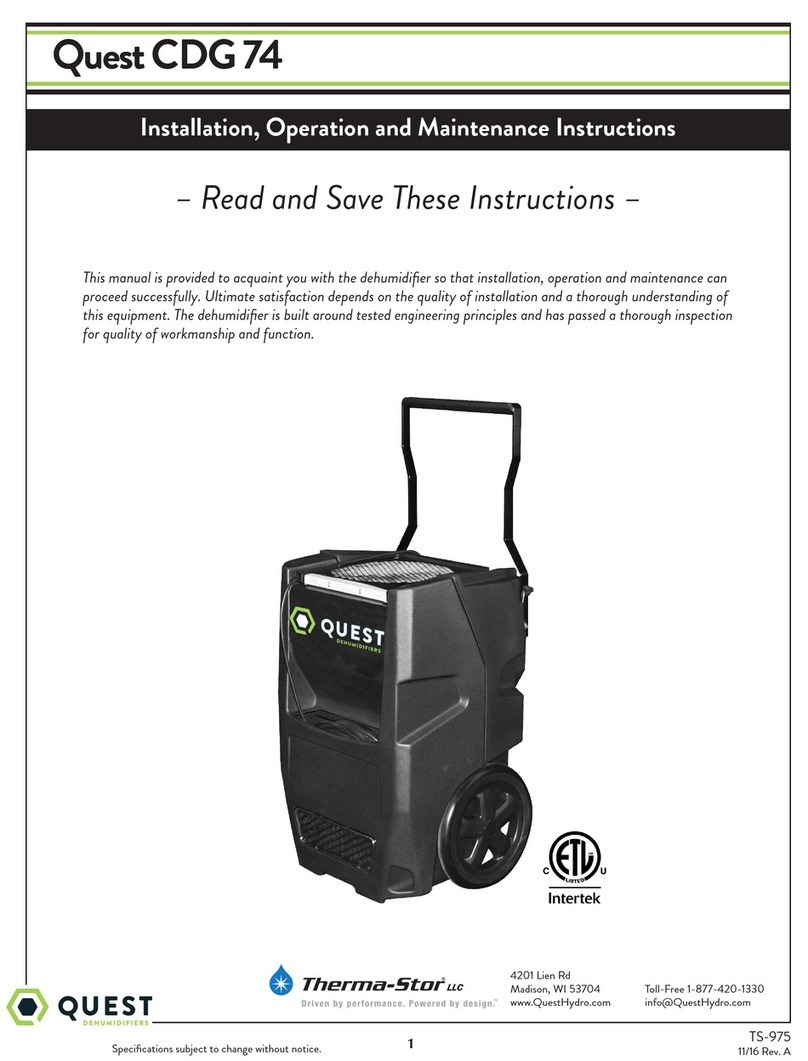
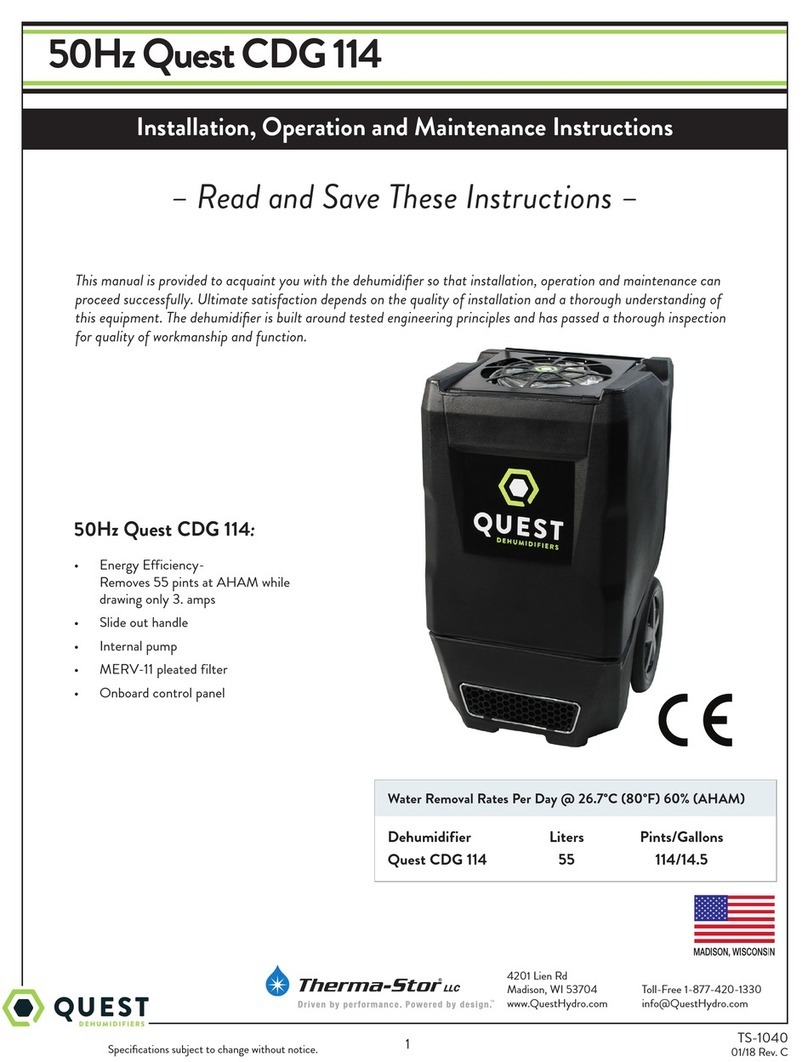
Quest Engineering DRY70 Manual

Installation, Operation and Maintenance Instructions
– Read and Save These Instructions –
This manual is provided to acquaint you with the dehumidier so that
installation, operation and maintenance can proceed successfully.
Ultimate satisfaction depends on the quality of installation and a
thorough understanding of this equipment. The dehumidier is built
around tested engineering principles and has passed thorough internal
and 3rd party inspections for quality of workmanship and function.
Quest DRY150
Installation, Operation and Maintenance Instructions
4201 Lien Rd.
Madison, WI 53704 1-800-533-7533
– Read and Save These Instructions –
Specications subject to change without notice. TS-826
05/15
1
Quest DRY 70
Water Removal Rate (Pints/Day)
65 pints 80˚F, 60% (AHAM)
Quest DRY 70
FEATURES:
• Energy Star Listed
• Large Capacity
• MERV-11 Filtration
• Low Temperature Operation
• Carbon Filtration
• Optional Equipment
– Ducting Kit
– Hang Kit
– Caster Kit
– Condensate Pump
quest
quest

1-800-533-7533
Quest DRY 70 Installation, Operation and Maintenance Instructions
2www.QuestProtect.com
quest
quest
Table of Contents
Introduction .............................................................. 1
Features & Benets ................................................... 1
Safety Precautions .................................................... 3
1. Intended Application ............................................ 4
2. Registrations ......................................................... 4
3. Specications ....................................................... 4
4 . Installation ........................................................... 4
4.1 Installation Checklist ...................................... 4
4.1A Power Accessibility .................................. 5
4.1B Space ....................................................... 5
4.1C Low Voltage Wiring ................................. 5
4.1D Back-Draft Damper ................................. 5
4.1E Support Structure and Suspension ............ 5
4.2 Electrical Requirements .................................. 5
4.3 Condensate Removal ...................................... 6
4.3A Lifting Condensate ................................... 6
4.3B Condensate Pump Kit .............................. 6
4.4 Ducting ......................................................... 6
4.4A Fresh Air/Supply Air ................................. 7
4.4B Ducting for Fresh Air - Option ................. 7
4.4C Installation in a Basement or Crawlspace . 8
4.4D Installation in an Attic ............................. 8
4.4E Installation in a Structure with
No Forced Air HVAC System............................. 9
4.4F Ducting for High Efciency Filtration ........ 9
4.5 Compressor Release and Noise Abatement...... 9
4.6 Controls ....................................................... 10
5. Control Package Diagram Sheet........................... 11
6. Maintenance ...................................................... 12
6.1 High Efciency Air Filter ............................... 12
6.2 Optional Fresh Air Intake .............................. 12
7. Wiring Diagrams ................................................ 13
8. Optional Parts List .............................................. 14
9. Service Parts List ................................................ 14
Routine Maintenance ......................................... 14
10. Service ............................................................. 15
10.1 Technical Description ................................. 15
10.2 Troubleshooting .......................................... 15
10.3 Refrigerant Charging .................................. 16
10.4 Compressor/Capacitor Replacement ........... 17
10.5 Electric Ventilation Damper ........................ 17
Warranty ................................................................ 18

1-800-533-7533
Quest DRY 70 Installation, Operation and Maintenance Instructions
3www.QuestProtect.com
quest
quest
Safety Precautions
Read the installation, operation and maintenance instructions carefully before installing and operating
this device. Proper adherence to these instructions is essential to obtain maximum benet from your
Quest DRY 70.
READ AND SAVE THESE INSTRUCTIONS
• The device is designed to be installed INDOORS IN A SPACE THAT IS
PROTECTED FROM RAIN AND FLOODING.
• Install the unit with space to access the front panel for maintenance
and service. DO NOT INSTALL UNIT WITH THE FRONT PANEL
INACCESSIBLE.
• Avoid directing the discharge air at people, or over the water in pool
areas.
• If used near a water source; be certain there is no chance the unit
could fall into the water or get wet. The unit should also be plugged
into a GFCI (Ground Fault Circuit Interrupt) outlet.
• DO NOT use the device as a bench or table.
• DO NOT place the device directly on structural members.
• A drain pan MUST be placed under the unit if installed above a living
area or above an area where water leakage could cause damage (see
local regularity code for more information).
• Never operate a unit with a damaged power cord. If the power cord is
damaged it must be replaced by the manufacturer, its service agent, or
similarly qualied person in order to avoid a hazard.
• The unit shall be installed in accordance with national wiring
regulations.
• Do not obstruct the air intake and exhaust. Maintain a .3 m (1 ft)
clearance around the air intake and exhaust.
• This appliance is not intended for use by persons (including children)
with reduced physical, sensory or mental capabilities, or lack of
experience and knowledge, unless they have been given supervision or
instruction concerning use of the appliance by a person responsible for
their safety. Children should be supervised to ensure that they do not
play with the appliance.
FOR HVAC INSTALLER AND OWNER

quest
quest 1-800-533-7533
Quest DRY 70 Installation, Operation and Maintenance Instructions
4www.QuestProtect.com
Quest DRY 70 Installation, Operation and Maintenance Instructions
1. Intended Application for Quest Dry 70
For the ideal installation, draw air from the central part of the workspace and return it to isolated areas of the
structure. The ductwork of the existing heating system can be used to supply air to the workspace.
2. Registrations
The Quest Dry 70 conforms to unied standard UL 60335-2-40.
3. Specications
Part Number: 4033750
Blower: 150 CFM @ 0.0" WG
Power: 680 Watts @ 80°F and 60% RH
Supply Voltage: 110-120 VAC – 1phase – 60 Hz
Current Draw: 5.1 Amps
Energy Factor: 2.37 l/kw
Operating Temp.: 33°F to 100°F
Sized for: 1800 Sq. Ft. - Workspace (Max)
Miniumum Performance at 80°F and 60% RH
Water Removal: 65 pints/day
Efficiency: 4.5 Pints/kWh
Air Filter: MERV-11
Efficiency: Standard 70% Efficient
ASHRAE Dust Spot Test
Size: 12" x 12" x 1"
Power Cord: 8', 110-120 VAC, Grounded
Drain Connection: 3/4" Threaded MPT
Drain Hose: 5/8" ID x 8'
Dimensions
Unit Shipping
Width: 12"15 5/8"
Height: 12" 16"
Depth: 28"31 5/8"
Weight: 55 lbs 65 lbs
4. Installation
4.1 Installation Checklist
CAUTION
Prior to installation of the Quest Dry 70, please review the following requirements. The Quest Dry 70 can
be installed in a variety of locations to meet the owner’s needs, and be integrated with existing forced air
systems or existing ductwork if desired. The location choice is contingent on a variety of requirements not
limited to: ease of service, controls access, drainage, ltration, power, fresh-air ventilation (optional), water
damage prevention, and current regulatory codes (ASHRAE, re, etc). Please address all of these issues
before you select the location of the device.
FOR HVAC INSTALLER ONLY

1-800-533-7533
Quest DRY 70 Installation, Operation and Maintenance Instructions
5www.QuestProtect.com
quest
quest
Quest DRY 70 Installation, Operation and Maintenance Instructions
4.1A Power Accessibility
Unit should be located in an area where the cord’s length (8') should easily reach a 110-120 VAC electrical
outlet with a minimum of a 15 A circuit capacity.
4.1B Space
Location should have enough clearance to handle the unit’s overall dimensions as well as the necessary
return/supply ductwork to the unit.
4.1C Low Voltage Wiring
Unit location should be in an area where eld wiring the remote controls (low voltage) to the unit will be
possible.
4.1D Back-Draft Damper (P/N 4023647)
It is recommended that a back-draft damper be used in the discharge duct of the Quest Dry 70, especially
when connecting to the supply ducting system. The back-draft damper prevents supply air from counter
owing through the Quest Dry 70 when it is not operating. The unit location should be chosen to allow
installation of this accessory.
4.1E Support Structure and Suspension
Place the Quest Dry 70 on supports to raise the base of the unit. Do not place the Quest Dry 70 directly on
structural building members without vibration absorbers or unwanted noise may result.
The Quest Dry 70 may be suspended with a hang kit (4028111)
or a suitable alternative from structural members, as long as
the suspending assembly supports the Quest Dry 70’s base in
its entirety. Do not hang the Quest Dry 70 from the cabinet.
Remember to place a drain pan under the unit if it is suspended
above a nished area or above an area where water leakage
could cause damage.
4.2 Electrical Requirements
WARNING!
WARNING: DO NOT ALLOW THE YELLOW
LEAD FROM THE Quest TO CONTACT THE RED
LEAD FROM THE Quest OR DAMAGE TO THE
TRANSFORMER WILL RESULT.
The Quest Dry 70 plugs into a common grounded 115VAC outlet. The device draws 5.1 Amps under normal
operating conditions. If used in an area which may become wet, a GFCI (Ground Fault Interrupt) outlet is
required. Please, consult local electrical codes for any further information.
Therma-Stor LLC offers a family of control devices for use with the Quest Dry 70. The controls are to be
located remotely from the unit and located in the space to be conditioned. The controls are low voltage (24
volt) and should be connected to the Quest Dry 70 with low voltage wire (thermostat or other
appropriate).
CAUTION
Do not install the control panel where it may not accurately sense the relative humidity such
as near HVAC supply registers, near exterior doors, on an outside wall, near a window, or
near a water source.
Hang Kit (4029908) shown suspending a Quest Dry 70.
Available from your dealer or call 1-800-533-7533.
Quest DEH 3000
Digital Control (P/N
4027370)
Call 1-800-533-7533
FOR HVAC INSTALLER ONLY

quest
quest 1-800-533-7533
Quest DRY 70 Installation, Operation and Maintenance Instructions
6www.QuestProtect.com
Quest DRY 70 Installation, Operation and Maintenance Instructions
The installer must supply the wiring between the Quest Dry 70 and the control panel. Be sure to safely route
the control wiring to prevent damage during installation.
CAUTION
Do not cross wires when connecting the Quest Dry 70 and the remote control panel or damage to the
transformer may result. The remote controls of the Quest Dry 70 are powered by a low voltage circuit
(24VAC) and must NEVER contact or be connected to a high voltage circuit.
The control wires leaving the Quest Dry 70 and the remote control panels are numbered and color-coded to
prevent confusion. Some of the control wires leaving the Quest Dry 70 may not be used with certain control
panels and should be left unconnected with wire nuts taped onto the stripped ends for safety. Be sure to
consult the electrical schematic in this manual or inside the access panel of the Quest Dry 70 before making
control connections.
4.3 Condensate (Water) Removal
CAUTION
A trap in the drain line is preferred, but not required for the unit to drain properly. Local codes may require
a trap. Use care to keep the pipe assembly as at to the oor as possible. Kinks and/or humps will prevent
proper drainage.
The Quest Dry 70 generates condensate. Install a 3/4" male nominal pipe thread adapter to the drain pan.
It is necessary to assemble your own drain pipe assembly utilizing 3/4" PVC pipe to get the condensate to a
oor or other drain. Pipe is commonly available in 10’ lengths from building supply, plumbing or hardware
stores. Slope to drain should be at least 1” drop for every 10’ of run.
4.3A Lifting Condensate
A condensate pump may installed if lift is required to dispose of the condensate.
4.3B Condensate Pump Kit (4030113)
A condensate pump kit is available from the factory for use
with the Quest Dry 70 and provides 15' of lift. Condensate is
automatically pumped to a remote location when the water level
in the pump’s reservoir rises to close the oat switch. The pump
also contains a safety oat switch. The white leads from this switch
extend from beneath the pump cover. This switch should be
installed in series with the eld wire that connects the blue (#5)
lead from the Quest Dry 70 to the the control panel. If the pump
fails, this switch opens the compressor control circuit and stops
water production before the reservoir overows. The Quest Dry 70
will continue to ventilate or circulate air as normal, but will not
dehumidify until this switch closes.
4.4 Converting to Vertical Discharge Airow
The QuestDry 70 is shipped from the factory with the exhaust
panel of the cabinet congured for horizontal air discharge. The cabinet can be easily converted to vertical
air discharge. To convert the air discharge from horizontal to vertical, follow these steps:
Condensate Pump Kit (4030113) shown installed. Available
from your dealer or call 1-800-533-7533.
FOR HVAC INSTALLER ONLY

1-800-533-7533
Quest DRY 70 Installation, Operation and Maintenance Instructions
7www.QuestProtect.com
quest
quest
Quest DRY 70 Installation, Operation and Maintenance Instructions
1. Using T-20 Torx Driver, remove three (3) sheet metal screws that attach the exhaust panel from each side
of the Quest Dry 70. There will be a total of six (6) screws. Do not remove the exhaust collar.
2. Remove the exhaust panel.
3. Rotate the exhaust panel so that the exhaust collar is located on the top of the unit. Align screw holes
and snap the panel onto the base.
4. Secure the exhaust panel to the base by replacing the six (6) screws.
For the ideal installation, draw air from the central part of the workspace and return it to the isolated areas
of the workspace like the bedrooms, den, utility room, or family room. The ductwork of the existing heating
system can be used to supply air to the workspace. If the existing supply goes to isolated areas of the
structure, discharge the supply of the Quest Dry 70 into the supply of the existing heating system. Installation
of a separate supply duct to the Quest Dry 70 from a central area is recommended.
FOR HVAC INSTALLER ONLY

quest
quest 1-800-533-7533
Quest DRY 70 Installation, Operation and Maintenance Instructions
8www.QuestProtect.com
4.4A Supply Air
CAUTION
DO NOT draw air directly from the kitchen, laundry, or isolated basement.
You may draw air from a basement that is open to the workspace. All exible ducting connected to the
Quest Dry 70 should be UL listed.
A short piece of exible ducting on all Quest Dry 70 duct connections is recommended to reduce noise and
vibration transmitted to rigid ductwork in the structure. Ducting the Quest Dry 70 as mentioned requires
consideration of the following points:
Duct Sizing: For total duct lengths up to 25', use a minimum 8" diameter round or equivalent rectangular.
For longer lengths, use a minimum 10" diameter or equivalent. Grills or diffusers on the duct ends must not
excessively restrict airow.
Connecting to existing HVAC systems: An optional 8" check backdraft damper is available from the factory
to prevent reverse air ow through the Quest Dry 70. If the Quest Dry 70 is ducted to the supply of an air
handler, the check damper should be placed in the Quest Dry 70 supply duct.
CAUTION
Contact the factory when connecting to a static pressure of greater than or equal to +.5" WG.
4.4B Ducting for Fresh Air — Option
Fresh air may be brought into the structure by connecting an insulated duct from outside the structure to the
6" inlet of the Quest Dry 70. Advantages of this form of ventilation include:
1. Outside air is ltered before entering the building.
2. Outside air will be dehumidied before entering the building if the Quest Dry 70 is running in
dehumidication mode.
3. Drawing air from outside and blowing inside aids in slightly pressurizing the structure. This helps
prevent dirty and humid air from entering elsewhere. It also reduces the potential for carcinogenic
radon gas to enter and provides a small amount of make-up air for open combustion and exhaust
devices like the clothes drier, replace, and water heater.
4. Exhaust fans are recommended in the bath rooms and kitchen.
In cold climates or areas where the outdoor dew point is low at times, ventilation can be used to dehumidify
the structure, making the Quest Dry 70 capable of year-round drying. This is accomplished by bringing
the dry, low dew point air into the structure during these times. This approach is often more economical
than running the dehumidier to remove excess moisture from the structure. In cold climates, adequately
ventilating is critical to reduce the inside moisture content and avoid moisture accumulating in the wall
cavities. TIP: If your house experiences condensation on the interior surface of the windows during the
winter, increasing the amount of ventilation will often solve the problem.
An insulated 6" diameter duct is generally sufcient to provide up to 70 CFM of outside air. Large quantities
of outside air will impact Quest Dry 70 performance positively or negatively, depending upon the inside and
outside air conditions. The outside air duct should be connected to the front of the unit. With a standard tee,
the amount of outside air can be restricted with a blade damper.
FOR HVAC INSTALLER ONLY

1-800-533-7533
Quest DRY 70 Installation, Operation and Maintenance Instructions
9www.QuestProtect.com
quest
quest
Quest Dry 65
Indoor Air
Return
Quest DEH 3000
control
Heating/AC Return Air
Backdraft
Damper
Dry Air to
Basement
Gravity
Damper
Motorized
Damper
Optional
Fresh Air
Intake
4.4C Installation in a Basement or Crawlspace with an Existing Forced Air HVAC System.
Basement Installation: Install a separate 8" return for the Quest Dry 70 in a central area of the structure.
Optional: Duct the supply of the Quest to a 8" x 8" x 8" tee/damper, adjusted to 20% open to the basement.
Duct the other side of the tee to the air supply of the existing HVAC system with a backdraft damper.
Crawlspace Installation: Install a separate return for the Quest Dry 70 in a central area of the structure.
Optional: Duct the supply of the Quest Dry 70 to a 8" x 8" x 8" tee/damper that is 20% open to the crawlspace
if desired. Duct the other side of the tee to the air supply of the existing HVAC system with a backdraft
damper.
Instead of installing a separate return to the Quest Dry 70, and if the existing system has multiple returns, it
is possible to select one to disconnect from the existing forced air system and use it for the dedicated Quest
return. Always select a return from a central location in the structure in an area that is always open to the
rest of the structure. Do not use a return from a room that may have its door closed much of the time or,
alternatively, install a separate return from the open part of the house.
4.4D Installation in an Attic with an Existing Forced Air HVAC System
CAUTION
ALWAYS place a drain pan under the unit if it is suspended above a nished area or above an area where
water leakage could cause damage.
FOR HVAC INSTALLER ONLY

quest
quest 1-800-533-7533
Quest DRY 70 Installation, Operation and Maintenance Instructions
10 www.QuestProtect.com
The preferred method of installation is to create a separate return for the Quest Dry 70 in a central area of
the structure. Duct the supply of the Quest Dry 70 to the air supply of the existing HVAC system.
4.4E Installation in a Structure with No Existing Forced Air HVAC System
When installing the Quest Dry 70 in a structure that does not have a forced air HVAC system, a single return
for the Quest Dry 70 should be installed in central open area of the structure. DO NOT locate the return
in a bathroom or a kitchen. The supplies of the Quest Dry 70 should be located in the remote areas of the
structure (such as bedrooms, den, etc.). By ducting this way, the air inside the structure will circulate through
the Quest Dry 70 to be ltered and dehumidied. A 6" diameter duct is recommended for branches to the
bedrooms. A 8" diameter duct is recommended for branches to larger areas.
4.4F Ducting for High Efciency Filtration
The Quest Dry 70 is equipped with a high efciency MERV 11 media lter (P/N 4027158). For optimal
performance it is recommended that the lter be replaced every 3-6 months.
4.5 Noise Abatement
A length of 10 feet or more of ex ducting on the outlet of the Quest Dry 70 will reduce air noise from the
fan. A length of exible ducting on all Quest Dry 70 duct connections is recommended to reduce noise
transmitted to rigid ductwork in the structure.
FOR HVAC INSTALLER AND OWNER
Quest
Indoor Air Return
Quest
Air Supply
Heating & A/C Unit
Indoor
Air
Return
Indoor Air Supply
Backdraft
Damper
Motorized
Damper
Optional
Fresh Air
Intake
Quest DEH 3000
control
This manual suits for next models
2
Table of contents
Other Quest Engineering Other manuals