manuals.online logo
Brands
  1. Home
  2. •
  3. Brands
  4. •
  5. ReadyNet
  6. •
  7. Wireless Router
  8. •
  9. ReadyNet LTE500 User manual

ReadyNet LTE500 User manual

Other ReadyNet Wireless Router manuals

ReadyNet WRT-500 User manual

ReadyNet

ReadyNet WRT-500 User manual

ReadyNet WR300NQ User manual

ReadyNet

ReadyNet WR300NQ User manual

ReadyNet LTE520 User manual

ReadyNet

ReadyNet LTE520 User manual

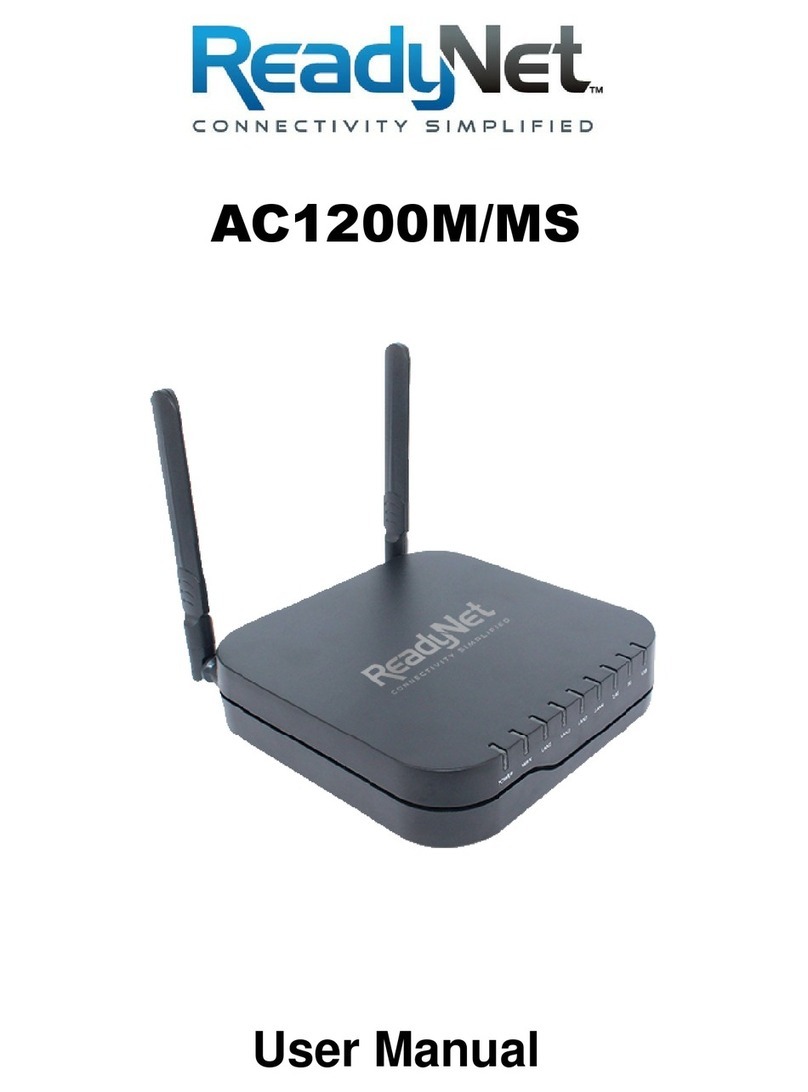
ReadyNet AC1200MS User manual

ReadyNet

ReadyNet AC1200MS User manual

ReadyNet wrt300n-rn User manual

ReadyNet

ReadyNet wrt300n-rn User manual

ReadyNet AC1300MS User manual

ReadyNet

ReadyNet AC1300MS User manual

ReadyNet LTE520 User manual

ReadyNet

ReadyNet LTE520 User manual

ReadyNet LTE520 User manual

ReadyNet

ReadyNet LTE520 User manual

ReadyNet WRT-500 User manual

ReadyNet

ReadyNet WRT-500 User manual

ReadyNet WRT150N User manual

ReadyNet

ReadyNet WRT150N User manual

ReadyNet WR300NQ User manual

ReadyNet

ReadyNet WR300NQ User manual

ReadyNet WRT300N-DD User manual

ReadyNet

ReadyNet WRT300N-DD User manual

ReadyNet AC1000M User manual

ReadyNet

ReadyNet AC1000M User manual

ReadyNet AC1200M User manual

ReadyNet

ReadyNet AC1200M User manual

ReadyNet QX300 Installation and user guide

ReadyNet

ReadyNet QX300 Installation and user guide

ReadyNet AC1100MSF User manual

ReadyNet

ReadyNet AC1100MSF User manual

ReadyNet WRT300N-D6 User manual

ReadyNet

ReadyNet WRT300N-D6 User manual

Popular Wireless Router manuals by other brands

NETGEAR Zing user guide

NETGEAR

NETGEAR Zing user guide

Proroute GEM420 user manual

Proroute

Proroute GEM420 user manual

ICP DAS USA WF-2000 Series Faq

ICP DAS USA

ICP DAS USA WF-2000 Series Faq

SMC Networks 7904WBRA-N FICHE user guide

SMC Networks

SMC Networks 7904WBRA-N FICHE user guide

Hamlet HRDSL300N user manual

Hamlet

Hamlet HRDSL300N user manual

Icidu NI-707517 Quick installation guide

Icidu

Icidu NI-707517 Quick installation guide

Hawking HWRGM1A user manual

Hawking

Hawking HWRGM1A user manual

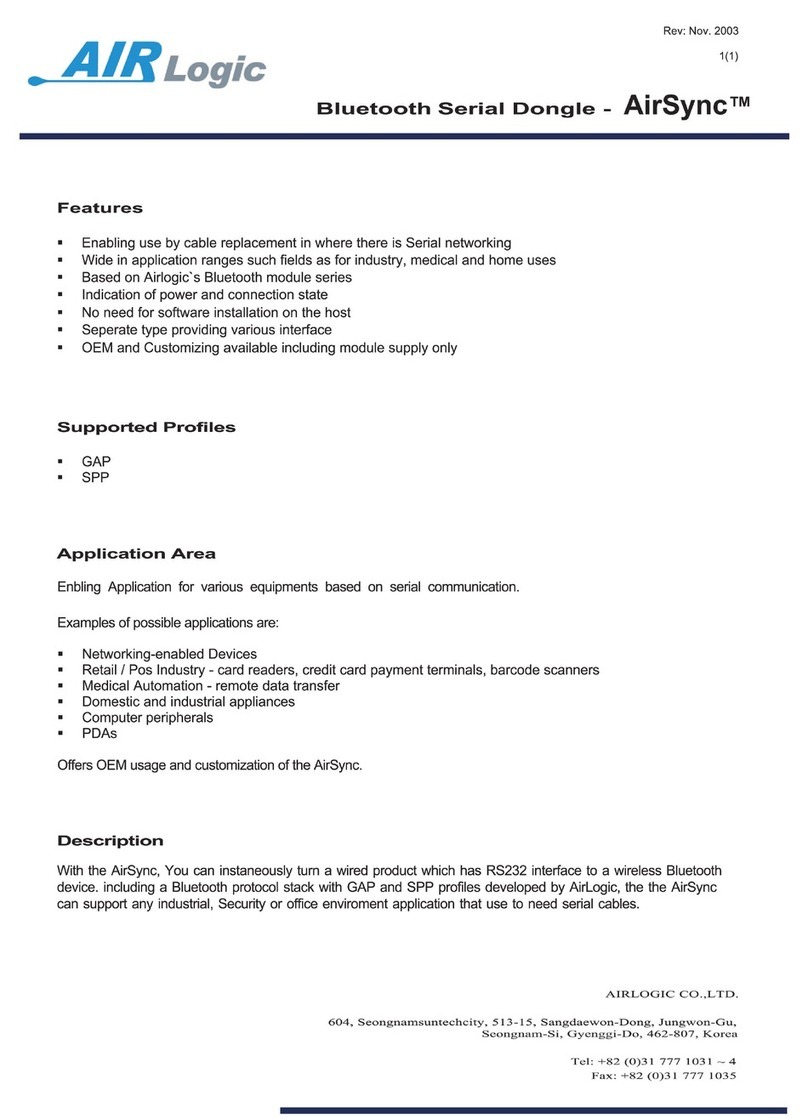
Airlogic AirSync Class 1 Features

Airlogic

Airlogic AirSync Class 1 Features

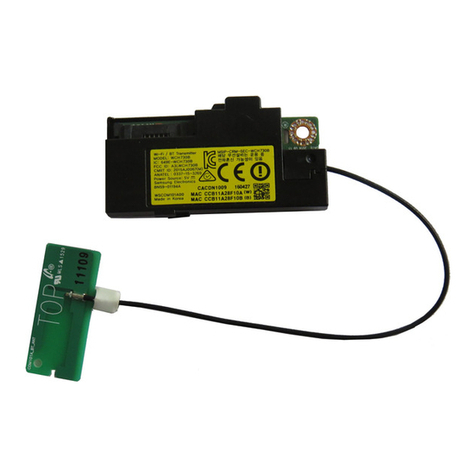
Samsung WCH730B user manual

Samsung

Samsung WCH730B user manual

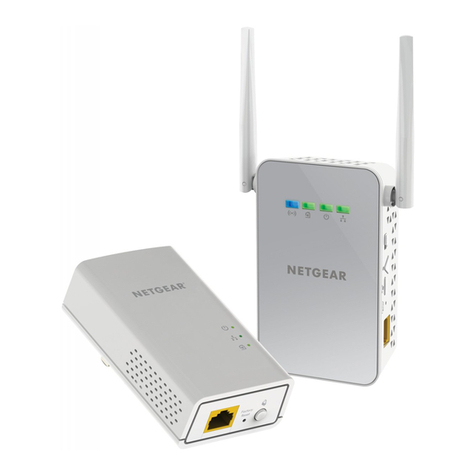
NETGEAR PowerLINE WiFi 1000 Series quick start

NETGEAR

NETGEAR PowerLINE WiFi 1000 Series quick start

TRENDnet TEW-211BRP user manual

TRENDnet

TRENDnet TEW-211BRP user manual

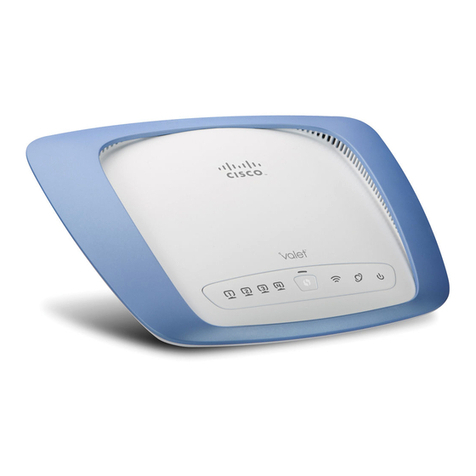
Cisco Valet M10 user guide

Cisco

Cisco Valet M10 user guide

Alloy WLF2454AP-S user guide

Alloy

Alloy WLF2454AP-S user guide

TELEFONICA USB Adapter quick start guide

TELEFONICA

TELEFONICA USB Adapter quick start guide

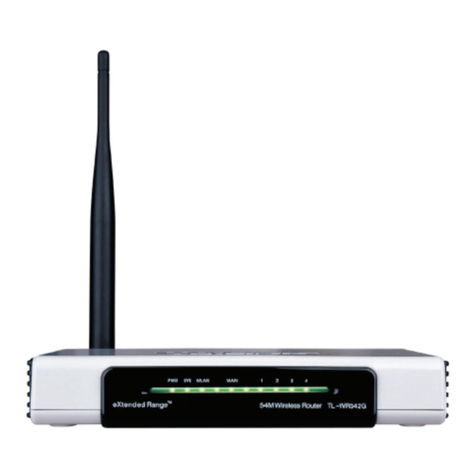
TP-Link TL-WR542G user guide

TP-Link

TP-Link TL-WR542G user guide

Hama 53120 Operating	 instruction

Hama

Hama 53120 Operating instruction

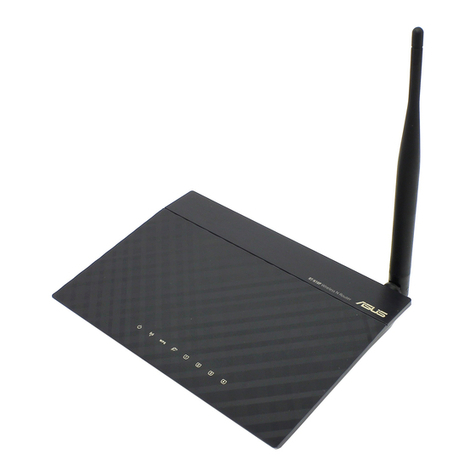
Asus RT-N10P user guide

Asus

Asus RT-N10P user guide

D-Link DIR-506L Quick installation guide

D-Link

D-Link DIR-506L Quick installation guide

manuals.online logo
manuals.online logoBrands
  • About & Mission
  • Contact us
  • Privacy Policy
  • Terms and Conditions

Copyright 2025 Manuals.Online. All Rights Reserved.

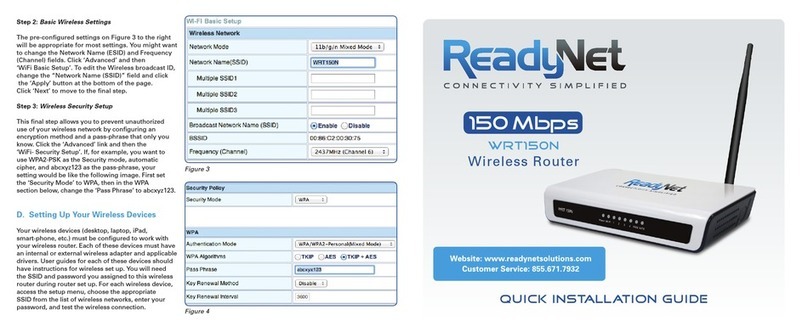
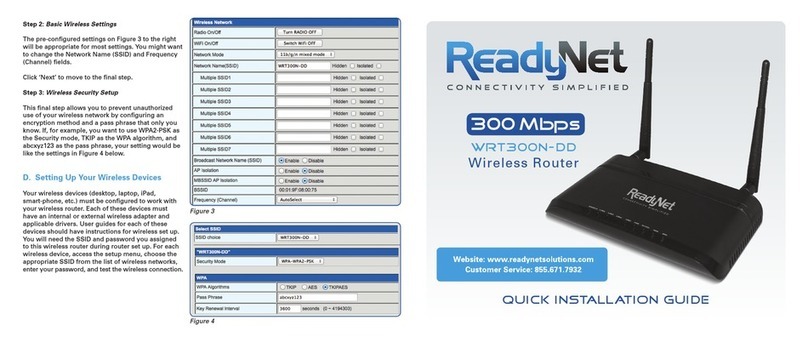
D. Setting Up Your Wireless Devices
Your wireless devices (desktop, laptop, iPad, smart-phone,
etc.) must be configured to work with your wireless router.
Each of these devices must have an internal or external
wireless adapter and applicable drivers. User guides for
each of these devices should have instructions for wireless
set up. You will need the SSID and password you assigned
to this wireless router during router setup. For each wireless
device, access the setup menu, choose the appropriate
SSID from the list of wireless networks, enter your
password, and test the wireless connection.
Quick Inst
allation Guide
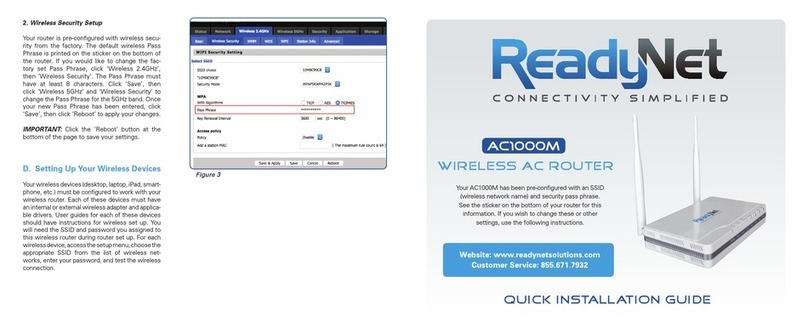
Your LTE500 has been pre-configured with an SSID
(wireless network name) and security pass phrase.
See the sticker on the bottom of your router for this
information. If you wish to change these or other
settings, use the following instructions.
Figure 4
300Mbps
Wireless Router
www.readynetsolutions.com
FCC Statement
This equipment has been tested and found to comply with the limits
for a Class B digital device, pursuant to part 15 of the FCC Rules.
These limits are designed to provide reasonable protection against
harmful interference in a residential installation. This equipment
generates, uses and can radiate radio frequency energy and, if not
installed and used in accordance with the instructions, may cause
harmful interference to radio communications. However, there is no
guarantee that interference will not occur in a particular installation.
If this equipment does cause harmful interference to radio or television
reception, which can be determined by turning the equipment off and
on, the user is encouraged to try to correct the interference by one
or more of the following measures:
—Reorient or relocate the receiving antenna.
—Increase the separation between the equipment and receiver.
—Connect the equipment into an outlet on a circuit different from
that to which the receiver is connected.
—Consult the dealer or an experienced radio/TV technician for help.
This device complies with part 15 of the FCC Rules. Operation is subject
to the following two conditions: (1) This device may not cause harmful
interference, and (2) this device must accept any interference received,
including interference that may cause undesired operation.
Radiation Exposure Statement
This equipment complies with FCC radiation exposure limits set forth
for an uncontrolled environment.
This transmitter must not be coÿlocated or operating in conjunction
with any other antenna or transmitter.
This equipment should be installed and operated with minimum distance
20cm between the radiator& your body.
Caution
Any changes or modifications not expressly approved by the party
responsible for compliance could void the user's authority to operate
the equipment.
B. Log In to User Interface
1. Type “http://192.168.12.1” in the Address field of your web browser
and press the “Enter” key. A User Name and Password dialog box
will appear. The default User Name is “root” and the default
password is “pz938qL500”. Enter the user name and password then
click the “Login”button.
Note: The default wireless IP address for the wireless router is 192.168.11.1
and the default Subnet Mask is 255.255.255.0
C. Configure Your Wireless SSID and Pass Phrase
1. Change SSID
To access the Wireless settings, click
‘Network’ and then ‘Wireless’. To change the
2.4GHz band SSID, click ‘EDIT’ under ‘radio0’.
Change the ESSID in the ‘Interface
Configuration’ section and click ‘SAVE’.
We recommend you change security passwords as
indicated in Step 2. If you are finished making
changes, click ‘APPLY CHANGES’ to apply your
changes.
2. Wireless Security Setup
Your router is pre-configured with wireless
security from the factory. The default wireless
Pass Phrase is printed on the sticker on the
bottom of the router. If you would like to
change the factory-set Pass Phrase, click
‘Wireless Security’ In the ‘Interface
Configuration’ section of the ‘Wireless’ tab
under ‘Network’ and enter the new Pass
Phrase in the ‘Key’ field. The Pass Phrase must
have at least 8 characters. Click ‘Save’. Once a
new Phase Phrase has been entered, click
‘Save’ before going to the next step.
IMPORTANT: Click the ‘APPLY CHANGES’ button at the bottom of the page to apply your changes.
LED Indicator Status Description
POWER On (Red) The router is powered on and running normally
Off The router is powered off
Mode or USB
Flashing (Blue) System is operating or USB device is connected
Off System not operating or USB device is connected
2.4G Wi-Fi
On (Blue) Wireless access point is ready
Flashing (Blue) Wireless traffic active
WAN
On (Blue) Port is connected
Off Port is disconnected
Flashing (Blue) Data is transmitting
LAN 1-4
On (Blue) Port is connected
Off Port is disconnected
Flashing (Blue) Data is transmitting
A. Connect the LTE500 Router to Your Computer
1. To set up your router for the first time, please connect the
router to your desktop or laptop computer as shown in the
following diagram. Your broadband Internet access will
generally be from a service provider modem such as a
cablemodem, ADSL modem, or similar device.
2. After the hardware connections have beencompleted,
check the status of the LED Indicators using the
following table:
LTE500
Power
Outlet
Broadband
Internet PC/LAN
RST
WANLANLANLANLAN
DC 12V
Figure 1
Figure 2
Figure 3
The WAN and LAN
Ethernet ports on the
router also indicate
communication status.
Blinking blue indicates the
port is connected and data
is transmitting.
Note: If the LED indicator
is not displaying a “Normal
Status” as described in the
table at left, please check
the associated hardware
and connections.
Safety Notice
•The device should be placed on a flat horizontal surface, or secured safely to a wall.
•Operate equipment away from heat sources.
•Provide good air ventilation.
•Keep away from water and damp areas.
•Disconnect power from the device during severe thunderstorms.
•Use only the included AC power adapter.
•Keep router at least 2 feet away from people to reduce exposure to radio frequency emissions.
Please install the wireless antenna on the SMA connector
which remark WIFI characters