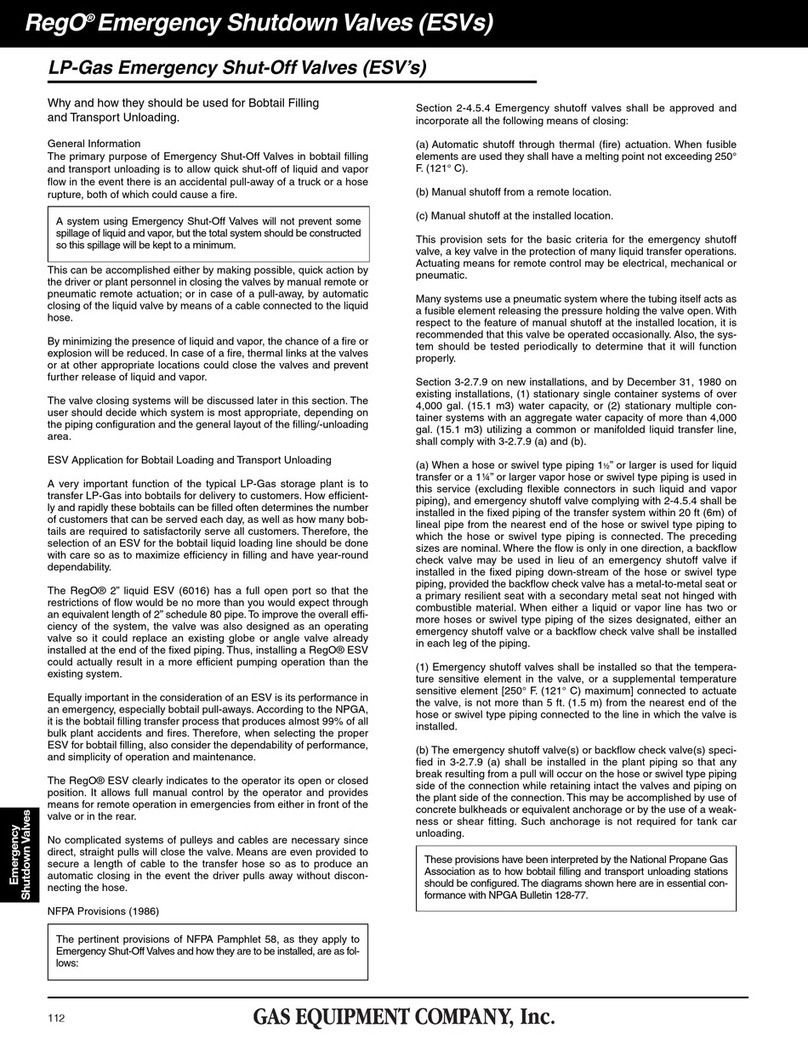
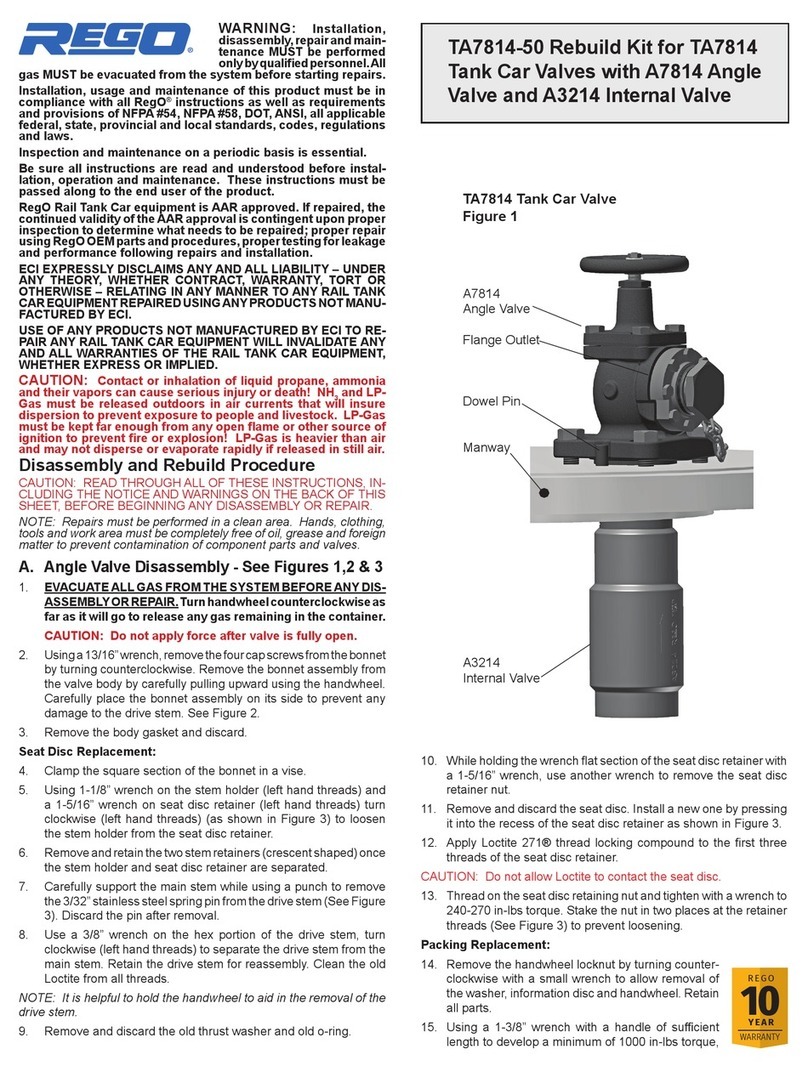
of the 5/16” cap screws. Install seat clamp and secure with the
5/16” cap screws, turning clockwise, torque 150-160 in-lbs.
2. Coat the o-ring seat area on stem with lubricant (do not get
on threads) and install stem o-ring onto stem.
3. Apply lubricant to outside of stem o-ring.
4. Stretch poppet o-ring to ensure snug t inside upper poppet.
5. Apply a liberal amount of lubricant to the poppet o-ring and
install in the upper poppet.
6. Install upper poppet with o-ring onto stem assembly. Apply
Loctite 242®thread locking compound to stem threads and
secure upper poppet to lower poppet with 3/4” hex nut and
washer. Torque to 50-60 ft-lbs.
7. Paying special attention not to contact the seat, slowly reinstall
the stem assembly through the bushing until the poppet o-ring
contacts the seat.
8. Apply non-detergent grease to stem threads.
9. Reinstall the springs and spring retainer. Align spring ends
so they start 180° apart.
10. Install the valve in a press (recommended), compress spring
retainer to compress the springs to a height of 9.63”. See
gure 1.
11. Using ONLY the 1” adjusting nut, engage until nut contacts
spring retainer.
DO NOT INSTALL 1” HEX JAM NUT UNTIL AFTER TESTING
IS COMPLETE.
12. Reinstall spring guide using two 5/16” hex head cap screws.
Torque to 150-160 in-lbs.
13. Tighten the bolt studs & nuts gradually in an alternate and
opposite sequence around the ange. Follow the sequence
shown in Figure 1 Tightening Sequence.
Testing
NOTE: Valve should be tested no sooner than 24 hours after as-
sembly to allow for proper seat compression.
1. Attach valve to test xture.
Figure 2 - Poppet & Stem Assembly
2. Fill spring guide with water and observe pressure gauge as
pressure is raised. After pressure is raised to within 25 psi
of the set pressure marked on the valve, begin to increase
pressure at a rate no greater than 2 psi per second, until the
rst bubbles through the water seal are observed. If bubbles
do not appear at proper start-to-discharge pressure, tighten or
loosen the adjusting nut until bubbles indicate proper setting.
3. After correct start-to-discharge pressure is reached, shut o
inlet pressure, observe and note at what pressure valve seals
o. Valve must reseal by 80% of start-to-discharge setting.
4. Exhaust air pressure and remove valve from xture.
5. Now that the valve is set, measure the spring height.
• For valves with set pressures of 225, 247.5 & 280.5 psi:
the spring height must not be less than 7 3/8”.
• For valves with a set pressure of 300 psi:
the spring height must not be less than 8 3/4”.
NOTE: If the spring height is less than these, the valve must be
disassembled and both springs must be replaced.
6. Install and tighten 1” hex jam nut, being careful not to turn the
adjusting nut.
7. Install a new cable and tie assembly onto one of the 5/16” hex
head cap screw and around the adjacent arm on the stem
guide. Install new cable and tie assembly onto the 1” adjust-
ing nut, looping the free end of cable through the hole in the
spring retainer, around coil of inner spring, back through hole
in spring retainer, and then back through the tie. Proper cable
and ties assembly installation is shown in gure 1.
Emergency Field Repair
NOTE: “Emergency Field Repair” is considered repair and/or re-
placement of any resilient components while the valve is installed
on a pressurized tank car. This procedure should be performed
only when ABSOLUTELY NECESSARY and when evacuating
the tank car is impractical. Take caution during this repair and
avoid open ames, as it is possible that some product vapor will
escape. The venting of SOME product during the repair procedure
is normal.
Seat Clamp Ring
Lower
Poppet
Upper Poppet
Poppet O-Ring*
Stem O-Ring*
Stem
Body
3/4” Hex Nut
Washer
5/16” Button Head
Cap Screw (2)
Upper Poppet
Poppet O-Ring*
Stem O-Ring*
Stem
Body
3/4” Hex Nut
Washer
A8890W Series A8890S Series
Seat
Seat Weld
Lower
Poppet