2 www.restek.com
3. Setting the Extraction Depth using the Extraction Guide
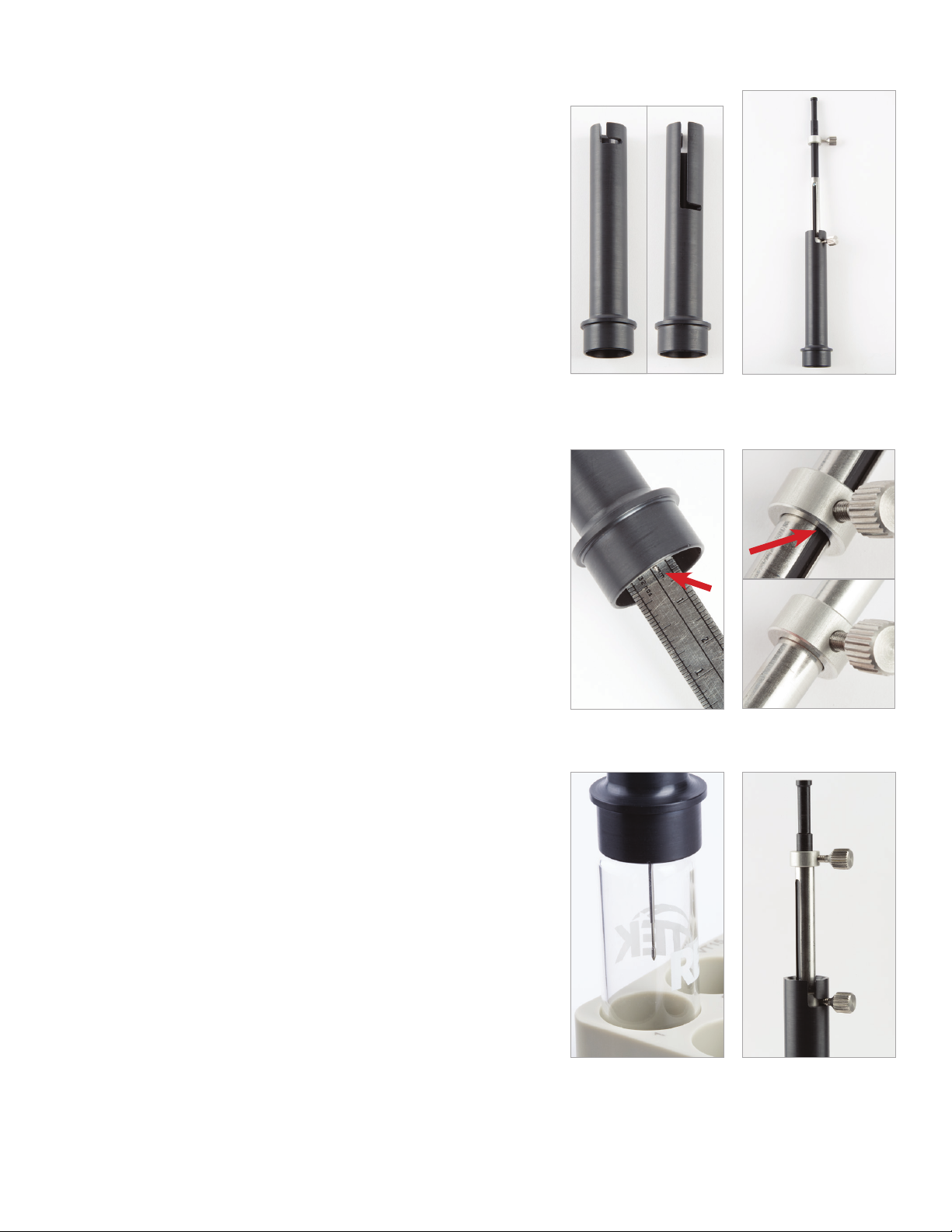
As shown in Figure 5, the extraction guide has two positions in which the syringe can be
installed. Use the upper position (9) for headspace extraction and the lower position (10) for
immersion extraction. For fine adjustment of the extraction depth, please refer to section 3.1
for headspace extraction and section 3.2 for immersion extraction. The extraction guide is de-
signed for use with 18 mm and 20 mm headspace vials.
3.1 Fine Depth Adjustment for Headspace Extraction
3.1.1 Raise the syringe plunger to the fully extended position and insert the syringe and
lower locking screw (4) into the upper position of the extraction guide. Lock the syringe
into place by rotating it until the locking screw is positioned in the notch (Figure 6).
3.1.2 Loosen the lower locking screw (4).
3.1.3 Adjust the syringe so that the SPME Arrow or SPME fiber is protruding ~1 cm beyond
the inner base of the extraction guide. When in proper position, the tip of the SPME Arrow or
SPME fiber will be recessed at least 1 mm in from the end of the extraction guide (Figure 7).
3.1.4 Tighten the lower locking screw (4) securely onto the silver body of the syringe. Do
not tighten the screw against the black plunger or you will not be able to move the SPME
Arrow or SPME fiber into position for sampling (Figure 8).
The septum penetration depth is now set. Proceed with steps 3.1.5 and 3.1.6 to the set the proper
exposure depth for headspace extraction.
3.1.5 Place the extraction guide (with the syringe in place) on an empty headspace
sampling vial and loosen the upper locking screw (5).
3.1.6 Adjust the SPME Arrow or SPME fiber to the desired exposure depth by moving the
black plunger up and down (Figure 9). Choose a depth that ensures the SPME Arrow or
SPME fiber will be in the gas phase and not submerged in the liquid phase of the sample.
3.1.7 Once the SPME Arrow or SPME fiber is at the proper depth, hold the plunger in place
and slide the upper locking screw (5) until it is flush against the top of the silver syringe
body. Then tighten the upper locking screw (5) securely as shown in Figure 10.
3.2 Fine Depth Adjustment for Immersion Extraction
3.2.1 Insert the syringe into the lower position (10) of the extraction guide (Figure 5).
3.2.2 Penetrate a vial and fully expose the SPME Arrow or SPME fiber within the vial
(Figure 11).
3.2.3 Adjust the lower locking screw (4) and upper locking screw (5) in order to obtain the
desired exposure depth (one that ensures immersion in the sample liquid). Note: If using
a SPME fiber, set a depth that prevents the tip of the fiber from hitting the bottom of the
vial as this can damage the fiber. If using a SPME Arrow, this is not a concern due to the
Arrow’s protective tip.
4. Adjusting the Injection Guide
Note: The positions of the upper (4) and lower (5) locking screws are set based on the extraction
technique and the depths used in either section 3.1 or 3.2. Do not change the position of the
locking screws during the following steps.
4.1 Carefully insert the syringe (3) into the injection guide (2). Use caution and avoid damaging
the SPME Arrow or SPME fiber when threading it through the hole in the base of the injection
guide.
4.2 Lock the syringe into place by rotating it until the locking screw is positioned in the notch
(Figure 12).
4.3 With the appropriate GC-specific adaptor cup on the end of the injection guide, measure
the distance from the tip of the SPME Arrow or SPME fiber to the groove inside the adaptor cup
(Figure 13).
4.4 Adjust the desorption depth by screwing the body of the injection guide up or down.
4.5 Set the depth to a maximum of 67 mm.
4.6 Twist the locking ring down until it locks on the body of the injection guide (Figure 14).
Figure 7: Proper Positioning
of a SPME Arrow in the
Extraction Guide
Figure 9: Exposure Depth for
Headspace Extraction
Figure 10: Upper Locking
Screw (5)
5
Figure 5: The extraction
guide has two extraction
positions (notches).
Figure 6: Syringe Installed in
the Extraction Guide
9 5
4
10
Figure 8: Incorrect and
Correction Position of the
Lower Locking Screw
3
7