EN-7
2016 02/2016
USING THE JUICER
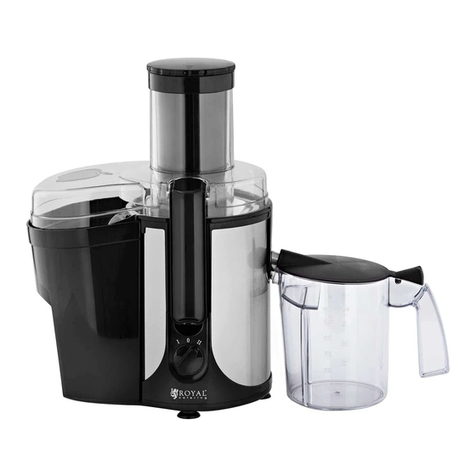
1. Make sure that the juicer is correctly assembled and then connect it to the el. power socket. The juicer
is equipped with a safety mechanism that prevents it from being started unless it is correctly assembled.
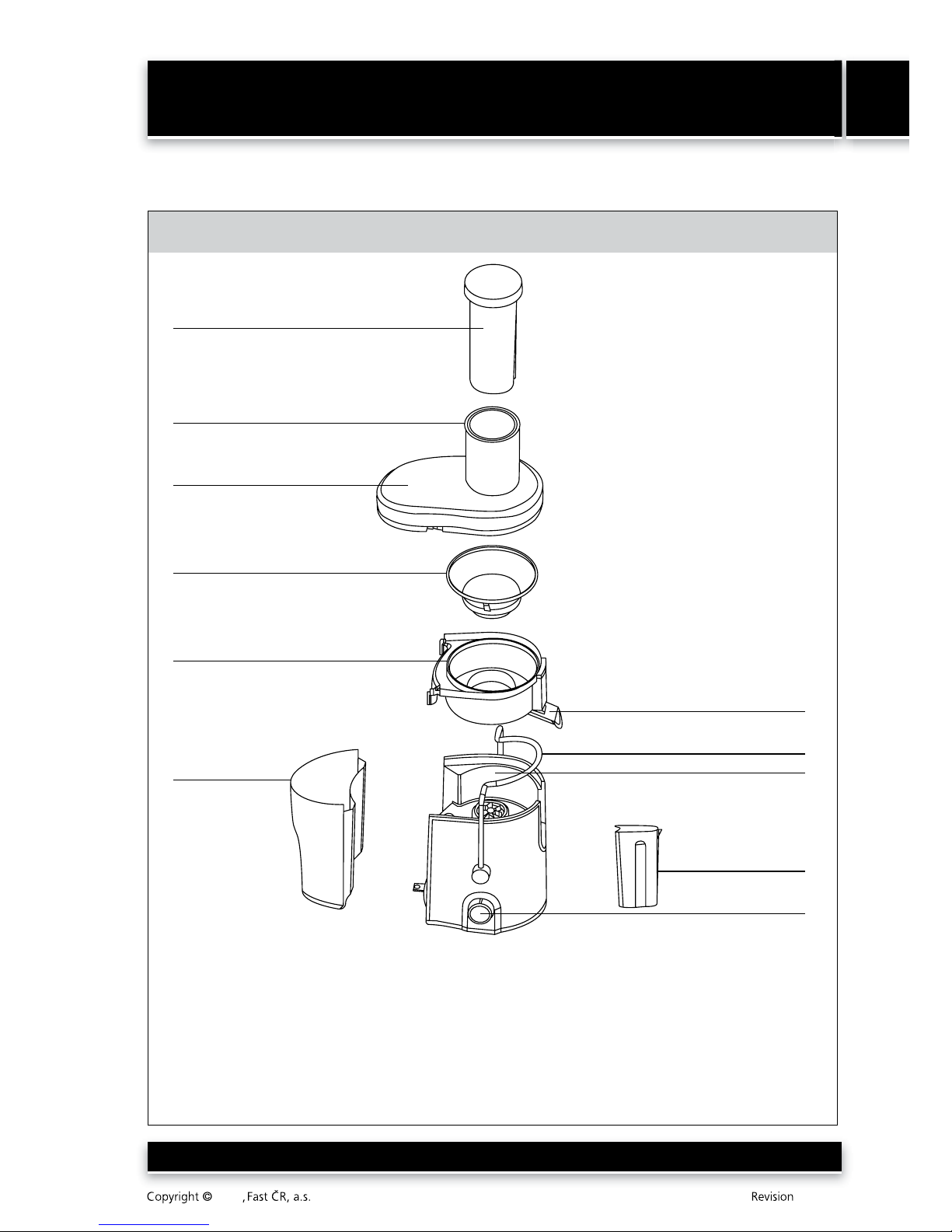
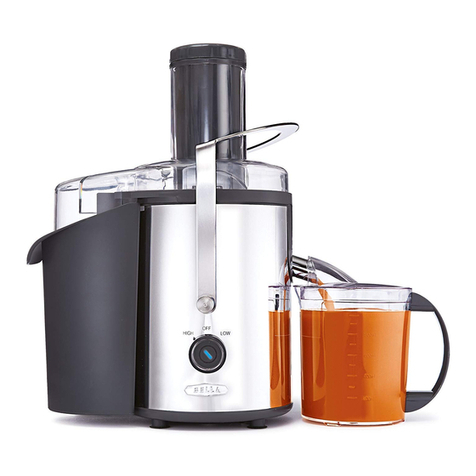
2. Place the juice jug A0, a glass or another suitable container below the juice spout A7. Open the
juice spout A7 by tilting it downwards so that juice can flow freely out of the juice collector during
juicing. Check that the pulp container A6 is installed in its place.
3. Prepare ingredients suitable for juicing (fruit and vegetables). Thoroughly wash them and cut them
up into pieces that will pass through the feed tube A2. Remove hard stones that are contained
in, for example, apricots, peaches, mangoes, etc. and inedible peels, e.g. from oranges, pineapples,
melons, mandarins, etc.
4. Prior to starting the juicer, make sure that the lid A3 is properly secured in the correct position.
Set the control dial Aqa to position I (low speed) or II (high speed) depending on the type of fruit
or vegetables that are being juiced. Use speed I for softer ingredients such as grapes, bilberries,
melons, raspberries, tomatoes, etc. Use speed II for harder ingredients such as bananas, celery,
carrots, beet, apples, etc. Take the pusher A1 out of the feed tube A2. Gradually add the prepared
ingredients into the feed tube A2 and push them down using the pusher. You will achieve optimal
results if you fill the feed tube A2 gradually and push the ingredients down gently.
Attention:
Do not use fingers or other utensils to push ingredients through the feed tube A2. Always use
the pusher A1 designed for this purpose.
The maximum time of non-stop operation of this appliance is 15 minutes. Then allow it to cool
down for 10 minutes.
When juicing larger batches of ingredients, do not run the appliance non-stop for longer than
10 seconds.
1. If the juice jug A5 or pulp container A6 fill up during the juicing process, turn the juicer off by
turning the control dial Aqa to position 0 (off), empty out the respective container and then put it
back in its place. Then you can put the juicer back into operation and continue juicing.
2. To turn off the juicer, set the control dial Aqa to position 0 (off). Then disconnect the juicer from
the power socket. Prior to removing the juice jug A5, we recommended closing the spout A7 by
tilting it upwards so that juice does not drip out of it.
3. When you have finished using the juicer, disassemble it according to the instructions contained in
chapter Disassembling the juicer on pg. 8 and clean it out according to the instructions contained
in chapter Cleaning and maintenance on pg. 8. Before disassembling the juicer, make sure that the
juicer is turned off, disconnected from the power socket and that the rotating parts have stopped.
USEFUL ADVICE AND TIPS
• Before you start juicing, thoroughly wash all the ingredients and cut them up into smaller pieces
that will pass through the feed tube A2. Remove hard stones that are contained in, for example,
apricots, peaches, mangoes, etc. and inedible peels, e.g. from oranges, pineapples, melons,
mandarins, etc.
• To achieve optimal results, always process only fresh ripened fruits and vegetables. Overripe or
unripe fruits and vegetables will negatively affect the resulting taste of the juice.
• If you juice fruits and vegetables of varying consistency, we recommend that you start with the
softer fruits and vegetables, e.g. citruses, berries, etc. and then proceed on with harder fruits, e.g.
apples. Always select a speed appropriate for the type of ingredients that are being juiced.
• Do not use the juicer for processing frozen or excessively hard ingredients, e.g. sugar cane.
• Place the ingredients into the feed tube A2 gradually and push through gently with mild pressure.
Do not overfill the feed tube A2 and do not push the ingredients in too quickly and with excessive
pressure. The process of separating the juice from the pulp occurs gradually and will not be sped
up by pushing ingredients in quickly.