manuals.online logo
Brands
  1. Home
  2. •
  3. Brands
  4. •
  5. Sharp
  6. •
  7. Refrigerator
  8. •
  9. Sharp SJ-D320V User manual

Sharp SJ-D320V User manual

Other Sharp Refrigerator manuals

Sharp SJ-F85VM-SS User manual

Sharp

Sharp SJ-F85VM-SS User manual

Sharp SJ-BA20DHXIC-EU User manual

Sharp

Sharp SJ-BA20DHXIC-EU User manual

Sharp SJ-XP570PG User manual

Sharp

Sharp SJ-XP570PG User manual

Sharp SJ-300V User manual

Sharp

Sharp SJ-300V User manual

Sharp SJ-PK70M User manual

Sharp

Sharp SJ-PK70M User manual

Sharp SJ-BB10IMXI2-EU User manual

Sharp

Sharp SJ-BB10IMXI2-EU User manual

Sharp SJ-EX770F2 User manual

Sharp

Sharp SJ-EX770F2 User manual

Sharp SJ-F70RV User manual

Sharp

Sharp SJ-F70RV User manual

Sharp SJ-BB10IMXW2-EU User manual

Sharp

Sharp SJ-BB10IMXW2-EU User manual

Sharp SJ-XP470HB User manual

Sharp

Sharp SJ-XP470HB User manual

Sharp SJ-LF204M1X-EU User manual

Sharp

Sharp SJ-LF204M1X-EU User manual

Sharp SJ-P482N User manual

Sharp

Sharp SJ-P482N User manual

Sharp SJ-LC41CHDAE-EU User manual

Sharp

Sharp SJ-LC41CHDAE-EU User manual

Sharp SJ-BA20IHXA3-EU User manual

Sharp

Sharp SJ-BA20IHXA3-EU User manual

Sharp SJ-C20X User manual

Sharp

Sharp SJ-C20X User manual

Sharp SJ-380V User manual

Sharp

Sharp SJ-380V User manual

Sharp SJ-58L-A2W User manual

Sharp

Sharp SJ-58L-A2W User manual

Sharp SJ-HD491P-S User manual

Sharp

Sharp SJ-HD491P-S User manual

Sharp SJ-F1529E0I-EU User manual

Sharp

Sharp SJ-F1529E0I-EU User manual

Sharp SJ-PT56R-HS User manual

Sharp

Sharp SJ-PT56R-HS User manual

Sharp SJ-GJ584V User manual

Sharp

Sharp SJ-GJ584V User manual

Sharp SJ-P68M User manual

Sharp

Sharp SJ-P68M User manual

Sharp SJ-BB02DTXLF-EU User manual

Sharp

Sharp SJ-BB02DTXLF-EU User manual

Sharp SJ-D340V User manual

Sharp

Sharp SJ-D340V User manual

Popular Refrigerator manuals by other brands

Haier HRF-369NAA null

Haier

Haier HRF-369NAA null

Haier HRF-688FR null

Haier

Haier HRF-688FR null

Haier HRF-416KAASS null

Haier

Haier HRF-416KAASS null

Haier HRF-348E null

Haier

Haier HRF-348E null

Bonnet Neve SKYVIEW PLUS User instructions

Bonnet Neve

Bonnet Neve SKYVIEW PLUS User instructions

Zanussi Electrolux ZERB 8441 Instruction book

Zanussi Electrolux

Zanussi Electrolux ZERB 8441 Instruction book

CORBERO CC2300MCW Instruction booklet

CORBERO

CORBERO CC2300MCW Instruction booklet

KitchenAid 2205264 Use and care guide

KitchenAid

KitchenAid 2205264 Use and care guide

NEFF KI181 Series user manual

NEFF

NEFF KI181 Series user manual

Hoshizaki Reach-In instruction manual

Hoshizaki

Hoshizaki Reach-In instruction manual

Amana ASD2524VES00 User instructions

Amana

Amana ASD2524VES00 User instructions

BOMANN KGC 213 instruction manual

BOMANN

BOMANN KGC 213 instruction manual

Danby DAR044A1SLDD Owner's use and care guide

Danby

Danby DAR044A1SLDD Owner's use and care guide

Beko CSA31022 Instructions for use

Beko

Beko CSA31022 Instructions for use

IKEA FROSTIG C 185 E manual

IKEA

IKEA FROSTIG C 185 E manual

Electrolux ER 6821 D Instruction book

Electrolux

Electrolux ER 6821 D Instruction book

True TS-28 Specifications

True

True TS-28 Specifications

Frigidaire FSC23R5DW9 installation guide

Frigidaire

Frigidaire FSC23R5DW9 installation guide

manuals.online logo
manuals.online logoBrands
  • About & Mission
  • Contact us
  • Privacy Policy
  • Terms and Conditions

Copyright 2025 Manuals.Online. All Rights Reserved.

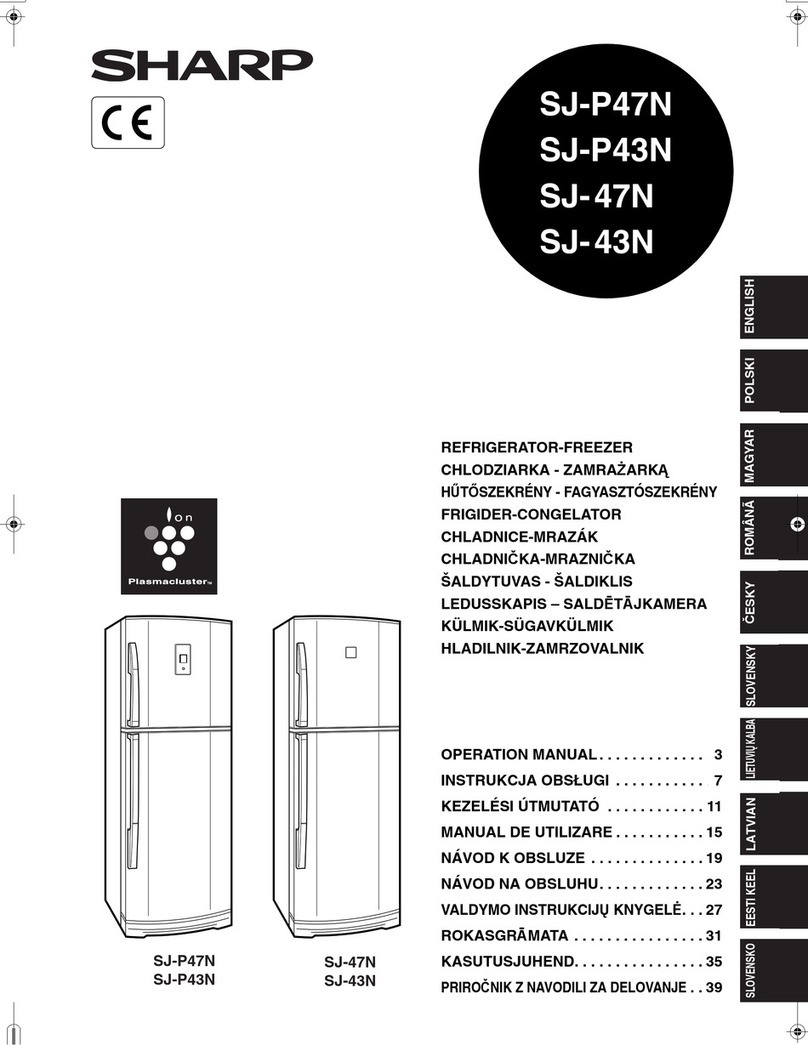
SJ-GC440V SJ-SC440V
SJ-GC480V SJ-SC480V
SJ-D320V
REFRIGERATOR - FREEZER
OPERATION MANUAL....................................... 1-15

NÁVOD K OBSLUZE......................................... 16-29

NÁVOD NA OBSLUHU...................................... 30-44

HASZNÁLATI UTASÍTÁS .................................. 45-59

............................... 60-74

EKSPLOATAVIMO INSTRUKCIJA .................... 75-89

............................................ 90-103

KASUTUSJUHEND......................................... 104-118
FRIGIDER-CONGELATOR
MANUAL DE UTILIZARE ................................ 119-133

......................... 134-148

 .... 149-163

UPUTE ZA UPORABU .................................... 164-177

UPUTSTVO ZA RUKOVANJE......................... 178-192

 ......................... 193-208
EST
GB
CZ
SK
H
GR
RO
LT
LV
BG
SLO
SB
RU
CRO
EN - 1 -
Contents
BEFORE USING THE APPLIANCE ........................................................................ 2
Safety Instructions ........................................................................................................ 2
Information on Disposal for Users (private households) ........................................... 3
Recommendations....................................................................................................... 3
Installation and Switching On The Appliance .............................................................. 4
Before Switching On ..................................................................................................... 5
THE VARIOUS FUNCTION AND POSSIBILITIES..................................................6
Thermostat Setting ....................................................................................................... 6
Super freeze and low ambient switch .......................................................................... 7
Display panel ................................................................................................................ 8
Turning On The Appliance ............................................................................................ 8
Accessories .................................................................................................................. 9
Ice tray .................................................................................................................................. 9
ARRANGING FOOD IN THE APPLIANCE.............................................................. 9
Refrigerator Compartment ........................................................................................... 9
Freezer Compartment .................................................................................................. 9
CLEANING AND MAINTENANCE ......................................................................... 10
Defrosting refrigerator compartment ........................................................................ 11
Defrosting Freezer compartment .............................................................................. 11
Replacing the Refrigerator Light Bulb ....................................................................... 12
Changing of Door Opening Direction ........................................................................ 12
TRANSPORTATION AND CHANGING OF INSTALLATION POSITION .............. 12
BEFORE CALLING YOUR AFTER SALES SERVICE .......................................... 13
Tips For Saving Energy .............................................................................................. 14
THE PARTS OF THE APPLIANCE AND THE COMPARTMENTS ........................ 15
EN - 2 -
PART 1. BEFORE USING THE APPLIANCE
Safety Instructions
• If the model contains R600a-see name plate under refrigerant (the coolant
isobutane), naturals gas that, is very environmentally friendly but also com-
bustible. When transporting and installing the unit care must be taken to en-
sure that none of the refrigeration circuit components become damaged. In
the event of damage avoid naked flames or ignition sources and ventilate the
room in which the unit is placed for a few minutes.
Warning: Keep ventilation openings in appliance enclosure or in structure for building
in, clear of obstruction.
• Do not use mechanical devices or other artificial means to accelerate the defrosting
process.
• Do not use electrical appliances in the refrigerator or freezer compartment of the
appliance.
• If this appliance is to replace an old refrigerator with a lock; break or remove the lock
as a safety measure before storing it, to protect children while playing might lock
themselves inside.
• Old refrigerators and freezers contain insulation gases and refrigerant, which must
be disposed of properly. Entrust the disposal of a scrap unit categorically to
competence of your local waste disposal service and contact your local authority or
your dealer if you have any questions. Please ensure that the pipe of work of your
refrigerating unit does not get damaged prior to being picked-up by the relevant waste
disposal service.
Important note:
Please read this booklet before installing and switching on this appliance. The
manufacturer assumes no responsibility for incorrect installation and usage as described
in this booklet.
Conformity Information
• Tropical Class is defined for the environment temperatures between 16°C and 43°C
in accordance with the TS EN ISO 15502 Standards.
• The appliance is designed in compliance with the EN15502, IEC60335-1 /
IEC60335-2-24, 2004/108/EC standards.
EN - 3 -
Information on Disposal for Users (private households)
1. In the European Union
Attention: If you want to dispose of this equipment, please do not use
the ordinary dust bin! Used electrical and electronic equipment must be
treated separately and in accordance with legislation that requires
proper treatment, recovery and recycling of used electrical and
electronic equipment.
Following the implementation by member states private households
within the EU states may return their used electrical and electronic
equipment to designated collection facilities free of charge*, in some
countries* your local retailer may also take back your old product free
of charge if you purchase a similar new one.
*) Please contact your local authority for further details.
If your used electrical or electronic equipment has batteries or
accumulators, please dispose of these separately beforehand
according to local requirements.
By disposing of this product correctly you will help ensure that the
waste undergoes the necessary treatment, recovery and recycling
and thus prevent potential negative effects on the environment and
human health which could otherwise anse due to inappropriate waste
handling.
2. In other Countries outside the EU
if you wish to discard this product, please contact your local
authorities and ask for the correct method of disposal.
For Switzerland: used electrical or electronic equipment can be
returned free of charge to the dealer, even if you don’t purchase a
new product. Further collection facilities are listed on the homepage of
www.swico.ch or www.sens.ch.
Attention;
Your product is marked
with this symbol. It
means that used
electrical and electronic
products should not to
mixed with general
household waste.
There is a separate
collection system for
these products.
Recommendations
Warning: Do not use mechanical devices or other means to accelerate the
defrosting process, other than those recommended by the manufacturer. Do
not use electrical appliances inside the food storage compartments of the
appliance, unless they are of the type recommended by the manufacturer.
Keep ventilation openings, in the appliance enclosure or in the built-in structure,
clear of obstruction. Do not damage the refrigerant circuit.
• Do not use adapters or shunts which could cause overheating
or burning.
• Do not plug old, warped power supply cables.
• Do not twist and bend the cables.
EN - 4 -
Installation and Switching On The Appliance
• This appliance is connecting to 220-240V or 200-230V and 50 Hz. Please check
nameneplate of appliance and be sure voltage range suitable to your mains voltage.
• You can offer help from the service to install and switching on the appliance.
• Before making the connection to the power supply,ensure that the voltage on the
name plate corresponds to the voltage of electrical system in your home.
• If the socket does not match the refrigerator plug, replace the plug with a suitable
one (at least 16 A)
• Insert the plug into a socket with an efficient ground connection.
If the socket has no ground contact or the plug does not match,
we suggest you to call an authorised electrician for assistance.
• The plug should be accessible after the appliance is positioned.
• Manufacturer is not responsible for failure to complete the
ground connection as described in this booklet.
• Do not place the appliance in direct sunlight.
• Do not use in open air and shall not be exposed to the rain.
• Place the refrigerator far from heat sources and in a
well-ventilated position. The refrigerator should be at least 50
cm from radiators, gas or coal stoves and 5 cm far from electrical
stoves.
• Do not allow children to play with the appliance. Children must
NEVER sit on drawers/shelves or hang from the door.
• Do not use sharp metal objects for removing ice on the freezer
compartment; they could puncture the refrigerator circuit and cause
unrepairable damage to the unit. Use the plastic scraper provided.
• Do not plug the power supply with wet hands.
• Do not place containers (glass bottles or tin containers) of liquids
into the freezer especially gassy liquids as they could cause the
container to burst during freezing.
• Bottles that contain a high percentage of alcohol must be sealed
well and placed vertically in the refrigerator.
• Do not touch the cooling surfaces, especially with wet hands as
you could be burnt or hurt.
• Do not eat ice, which have just been removed from the freezer.
• If the supply cord is damaged it must be replaced by the manufacturer or service
agent or appointed qualified person.
• The appliance is not intended for use by people (including children) with reduced
physical, sensory or mental capabilities, or lack of experience and knowledge, un-
less they have been given supervision or instruction concerning use of the appli-
ance by a person responsible for their safety. Children should be supervised to en-
sure that they don’t play with the appliance.
• If the supply cord is damaged it must be replaced by the manufacturer or service
agent or similary qualified people in order to avoid a hazard.

EN - 5 -
Before Switching On
• Wait after 3 hours before plugging the appliance in to the main
power to ensure proper performance.
• There can be an odour when you first switch on the appliance. It will disappear after
the appliance starts to cool.
• Keep the top free for at least 15 cm.
• Fit the plastic wall spacers to the condenser at the back of the
refrigerator in order to prevent leaning to the wall for good
performance.
• Do not place heavy and lots of things on the appliance.
• If the appliance is installed next to another refrigerator or freezer,
observe a minimum distance of 2 cm to prevent condensation.
• The appliance must be stand firmly and level on the floor Use
the two front levelling-feet to compensate for an even floor.
• The outside of the appliance and the accessories inside should be cleaned with a
solution of water and liquid soap; the inside of the appliance with sodium bicarbonate
dissolved in lukewarm water. After drying replace all the accessories.
EN - 6 -
PART 2. THE VARIOUS FUNCTION AND POSSIBILITIES
Thermostat Setting
Freezer thermostat automatically regulates the inside temperature of the compartments.
By rotating the knob from position 1 to 5, colder temperatures can be obtained.
Freezer & Refrigerator Thermostat Setting;
1 – 2 : For short-term storage of food in the freezer compartment, you can set the
knob between minimum and medium position.
3–4:For long-term storage of food in the freezer compartment, you can set knob
medium position.
5 :For freezing the fresh food. The appliance will work longer. So after you get
the cold condition you must position to previous position.
FREEZER & REFRIGERATOR THERMOSTAT
Your fridge is designed to operate in the ambient temperature intervals stated in the
standards, according to the climate class stated in the information label. We do not
recommend operating your fridge out of stated temperatures value limits in terms of cooling
effectiveness.
Climate Class Ambient Temperature (°C)
TBetween 16 and 43 (°C)
ST Between 16 and 38 (°C)
NBetween 16 and 32 (°C)
SN Between 10 and 32 (°C)
THERMOSTAT CONTROL
EN - 7 -
a) Super freezing: If ambient temparature is more than 18°C, This switch can be
used as superfreeze switch.
Super freeze switch should be used for freezing the fresh food or when the RED
lamp on the head panel is ON. (RED lamp on the head panel becomes ON
when there is insufficient cooling).
The appliance will work longer when you activate this switch. So after you get
the cold condition (or the Red lamp on the head panel is off) you must return to
previous position.
At the ambient temperature more than 18°C, if superfreezing function doesn’t
want to be used, it must always be set to OFF position.
b) Low ambient performance: If ambient temparature is less than 18°C, this switch
can also be used as a low ambient switch for good low ambient performence.
In low ambient temperatures, this switch heats the fridge part to prevent extra
cooling / freezing.
0 : OFF Position.
I: ON Position.
Super freeze and low ambient switch
low ambient switch
EN - 8 -
Display panel
ORANGE LAMP:
GREEN LAMP:
RED LAMP:
When the “Super Switch” operation is on (Super Switch is on-1
position), the orange lamp will turn on.
When the appliance is connected to the power supply, the green lamp
on the display panel will turn on automatically.
When the freezer compartment is not cold enough, the red lamp will
turn on. Set the super switch “1” position until the red lamp is off. After you get
the cold condition you must position to “0” position.
Turning On The Appliance
Once the appliance has been connected to the power supply make sure that the GREEN
lamp is on. Then turn the thermostat dial to position “5” (max position) and switch the
super switch ON until the RED lamp is off (Note that; for best internal temperature the
indicator in the thermostat should be positioned between 2 and 4.)
• When you first switch on the appliance, for starting a suitable cooling, the appliance
should work with in 24 hours continuously until it cools down to sufficient
temperature.
• In this time do not open the door so often and place a lot of food inside the appliance.
• If the unit is switched off or unplugged, you must allow at least 5 minutes before
restarting or re-plugged the unit in order not to damage the compressor.
ORANGE LAMP
GREEN LAMP
RED LAMP
EN - 9 -
Accessories
Ice tray
• Fill the ice tray with water and place in freezer compartment.
• After the water completely turned into ice, you can twist the tray as shown below to
get the ice cube.
ARRANGING FOOD IN THE APPLIANCE
Refrigerator Compartment
• To reduce humidity and consequent increase of frost never place liquids in unsealed
containers in the refrigerator. Frost tends to concentrate in the coldest parts of the
evaporator and in time will require more frequent defrosting.
• Never place warm food in the refrigerator. Warm food should be allowed to cool at
room temperature and should be arranged to ensure adequate air circulation in the
refrigerator compartment.
• Nothing should touch to refrigerator back wall as it will cause frost and the packages
can stick here. Do not open the refrigerator door too frequently.
• Arrange the meat and cleaned fish (wrapped in packages or sheets of plastic) which
you will use in 1-2 days.
• You can put the fruits and vegetables into crisper without packing.
Freezer Compartment
• The use of freezer is, storing of deep-frozen or frozen food for long periods of time
and making ice cubes.
• Do not put fresh and warm food to the freezer door shelves to be frozen. Only use for
storage of frozen food.
• Do not put fresh and warm food with frozen food side by side as it can thaw the frozen
food.
• While freezing fresh food (i.e. meat, fish and mincemeat) divide them in parts you
will use in one time.
• For storing the frozen food; the instructions shown on frozen food packages should
always be followed carefully and if no information is provided food should not be
stored for more than 3 months from the purchased date.
• When buying frozen food ensure that these have been frozen at suitable temperatures
and that the packing is intact.
PART 3.