PSE530-TF2Z041EN
Page 1 of 2
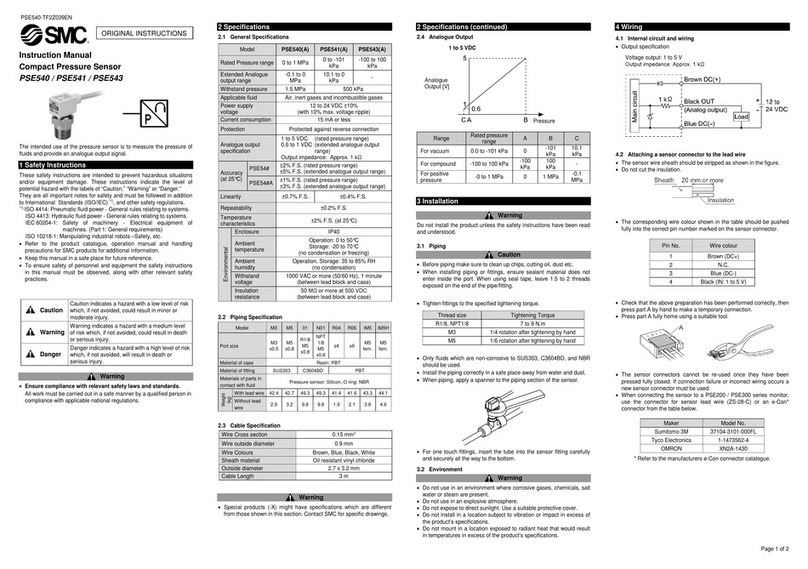
Instruction Manual
Compact Pressure Sensor
PSE530 / PSE531 / PSE532 / PSE533
The intended use of the pressure sensor is to measure the pressure of
fluids and provide an analogue output signal.
1 Safety Instructions
These safety instructions are intended to prevent hazardous situations
and/or equipment damage. These instructions indicate the level of
potential hazard with the labels of “Caution,” “Warning” or “Danger.”
They are all important notes for safety and must be followed in addition
to International Standards (ISO/IEC)*1), and other safety regulations.
*1) ISO 4414: Pneumatic fluid power - General rules relating to systems.
ISO 4413: Hydraulic fluid power - General rules relating to systems.
IEC 60204-1: Safety of machinery - Electrical equipment of
machines. (Part 1: General requirements)
ISO 10218-1: Manipulating industrial robots –Safety, etc.
•Refer to the product catalogue, operation manual and handling
precautions for SMC products for additional information.
•Keep this manual in a safe place for future reference.
•To ensure safety of personnel and equipment the safety instructions
in this manual must be observed, along with other relevant safety
practices.
Caution indicates a hazard with a low level of risk
which, if not avoided, could result in minor or
Warning indicates a hazard with a medium level
of risk which, if not avoided, could result in death
Danger indicates a hazard with a high level of risk
which, if not avoided, will result in death or
Warning
•Ensure compliance with relevant safety laws and standards.
All work must be carried out in a safe manner by a qualified person in
compliance with applicable national regulations.
2 Specifications
2.1 General Specifications
2.2 Piping Specification
Port size M5 x 0.8 male
ø6 reducer 1/4 inch
Material of parts in
contact with fluid Pressure sensor: Silicon, O-ring: NBR
Body: SUS304 Body: PBT
(3 m) 41 g 38 g
Without cable 7 g 3.8 g
2.3 Cable Specification
Wire outside diameter 0.8 mm
Halogen free heavy duty cable
Warning
•Special products (-X) might have specifications which are different
from those shown in this section. Contact SMC for specific drawings.
2 Specifications (continued)
2.4 Analogue Output
Range
A B C
For vacuum 0 to -101 kPa 0 -101 kPa 10.1 kPa
For compound -101 to 101 kPa
-101 kPa 101 kPa -
For low pressure 0 to 101 kPa 0 101 kPa -10.1 kPa
-0 to 1 MPa 0 1 MPa -0.1 MPa
3 Installation
Warning
Do not install the product unless the safety instructions have been read
and understood.
3.1 Piping Caution
•Before piping make sure to clean up chips, cutting oil, dust etc.
•When installing piping or fittings, ensure sealant material does not
enter inside the port. When using seal tape, leave 1.5 to 2 threads
exposed on the end of the pipe/fitting.
•Tighten fittings to the specified tightening torque.
1/6 rotation after tightening by hand
•Install the piping correctly in a safe place away from water and dust.
•When piping, apply a spanner to the piping section of the sensor.
•For one touch fittings, insert the tube into the sensor fitting carefully
and securely all the way to the bottom.
3.2 Environment Warning
•Do not use in an environment where corrosive gases, chemicals, salt
water or steam are present.
•Do not use in an explosive atmosphere.
•Do not expose to direct sunlight. Use a suitable protective cover.
•Do not install in a location subject to vibration or impact in excess of
the product’s specifications.
•Do not mount in a location exposed to radiant heat that would result
in temperatures in excess of the product’s specifications.
4 Wiring
4.1 Internal circuit and wiring
•Output specification
Voltage output: 1 to 5 V
Output impedance: Approx. 1 kΩ
4.2 Connecting the sensor cable (option)
•Hold the connector on the sensor cable. Insert it into the sensor
paying attention to connector orientation.
•The sensor cable connector has a locking cover in order to prevent
removal of the connector.
•Paying attention to the connector cover direction, install in the sensor,
rotate clockwise, and lock it.
•To remove the sensor cable, rotate the connector cover anti-
clockwise, release the lock, and remove the connector cover.
•After removing the connector cover, hold the connector and pull out.
4.3 Attaching a sensor connector to the lead wire
•The sensor wire sheath should be stripped as shown in the figure.
•Do not cut the insulation.
•The corresponding wire colour shown in the table should be pushed
fully into the correct pin number marked on the sensor connector.
Pin No. Wire colour
•Check that the above preparation has been performed correctly, then
press part A by hand to make a temporary connection.
•Press part A fully home using a suitable tool.
Model PSE530 PSE531 PSE532 PSE533
Rated Pressure range
Extended Analogue
output range
-
Air, inert gases and incombustible gases
12 to 24 VDC ±10%
(with 10% max. voltage ripple)
Analogue output
specification
1 to 5 VDC (rated pressure range)
0.6 to 1 VDC (extended analogue output
range)
Output impedance: Approx. 1 kΩ
Accuracy (at 25°C)
±2% F.S. (rated pressure range)
±5% F.S. (extended analogue output range)
Linearity ±1% F.S.
Repeatability ±1% F.S.
Power supply voltage
effect
±1% F.S. or less (based on the analogue
output at 18 V ranging from 12 to 24 VDC)
Temperature
characteristics
±2% F.S. (at 25°C)
Environmental
Ambient
temperature
Storage: -10 to 70°C
(no condensation or freezing)
Operation, Storage: 35 to 85% RH
(no condensation)
1000 VAC or more (50/60 Hz), 1 minute
(between lead block and case)
50 MΩ or more at 500 VDC
(between lead block and case)