Rev 2.0, 8/1/94 3
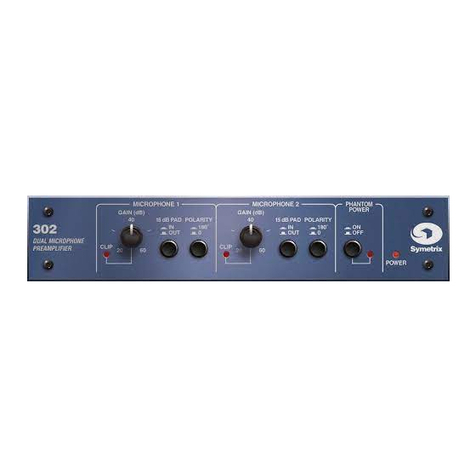
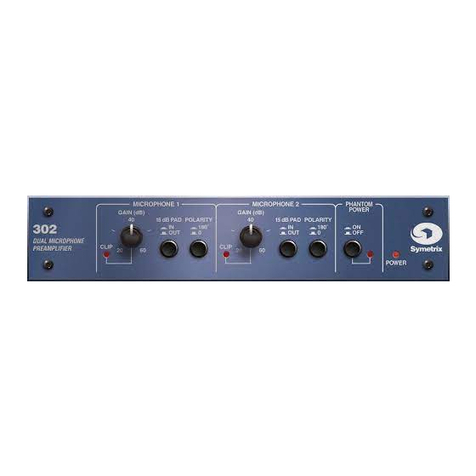
The pad switch on the SX202 reduces the input level by 15dB.
When a very high output mic is used, or for any reason the
incoming signal is so hot that the clip indicator is lighted with
the gain control at minimum, use the pad. As previously
mentioned, the SX202 uses gain controls, not volume controls or
faders. It is not necessary to use the pads to reduce input levels
to get the gain controls to operate in some theoretical "best"
position. The only "best" operating position for a gain control is
the minimum gain that delivers the required output level.
In addition to its more common use in reducing input signal
strength, the pads can also give the user a wider gain control
adjustment range, for a more accurate channel-to-channel level
matching. For very close level matching, the resolution of the
gain controls at the very lowest end of their range may be too
coarse. There is a trade-off here, however - when using pads the
apparent noise floor is higher.
2.3 Polarity Switch
Channel 1 includes a polarity switch. In the normal "out"
position, signal source polarity is maintained to the output(s). In
the 180o("in") position, the wiring from the Channel 1 XLR
connector Pins 2 and 3 is reversed. This allows for correction of
mis-wired cables, and for polarity matching of various
manufacturers' mics.
2.4 Powering for Condenser Microphones
All condenser microphones require some kind of electrical power.
This power may be supplied by internal batteries, an external
power supply that's connected to the microphone by a special
multi-wire cable, or through a standard microphone cable by
phantom or "T" System powering. Phantom powering and T
system powering are incompatible systems.
The front panel phantom power switch applies +48V phantom
power via pins 2 and 3 of the mic input XLR connectors.
Phantom power is so named because it is "invisible" to audio
signals, even though the microphone cable carries both phantom
power (as direct current), and audio signals (as alternating
current). Specifically, the term phantom power means a positive
DC voltage sent to the microphone on both audio leads, through
current limiting resistors which also serve to isolate the audio
leads from one another.
The phantom power technique uses the two signal conductors in
a standard mic cable to deliver the power required by the