4
GB
5
GB
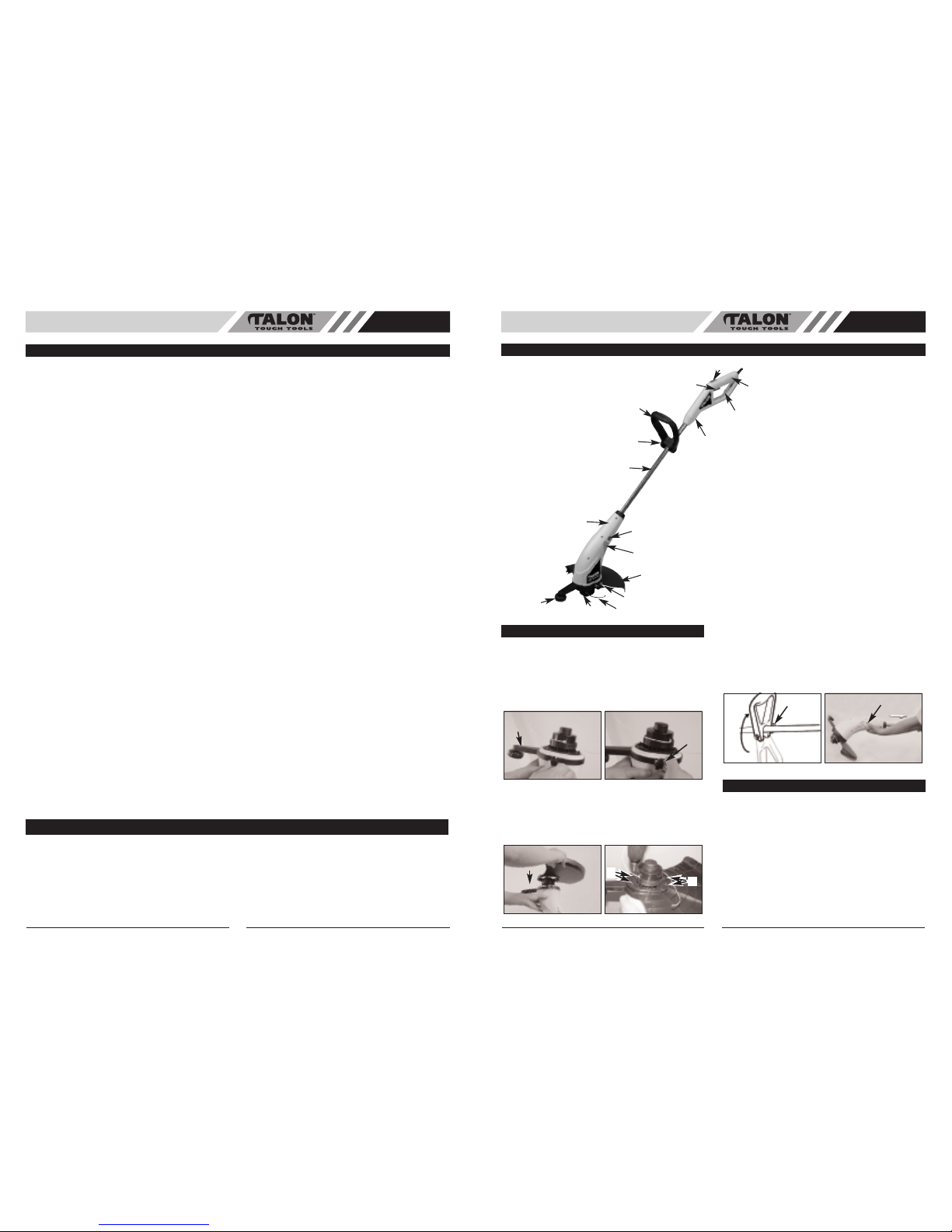
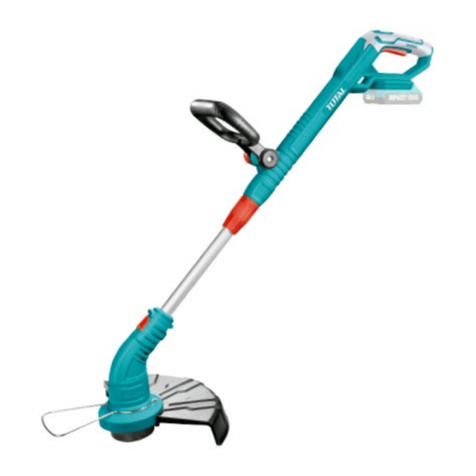
1. When starting the string-trimmer for the first time,
check that the nylon lines touch or pass over the wire-
cutting blade. If they are not long enough, press the
bump knob and, at the same time, pull the nylon lines
(Fig. 4A).
2. Adjust the height and cutting position as detailed in
adjustment instructions.
3. Take a secure hold of the grass trimmer and, without
letting it touch the grass to be cut push safety switch
then press the trigger. Let the string trimmer run for a
few seconds to trim the length of the nylon line.
4. To switch off the string trimmer let go of the switches.
5. To automatically lengthen or advance the nylon cut-
ting line, tap the spool bump knob (A) lightly on
ground (while the unit is running). (Fig. 4B)
These operations should be repeated a few times before
starting work to make sure that everything is functioning
properly and to familiarize yourself with the string trimmer.
Start off slowly, when you have gained experience, you
will be able to use the grass trimmer to its full potential.
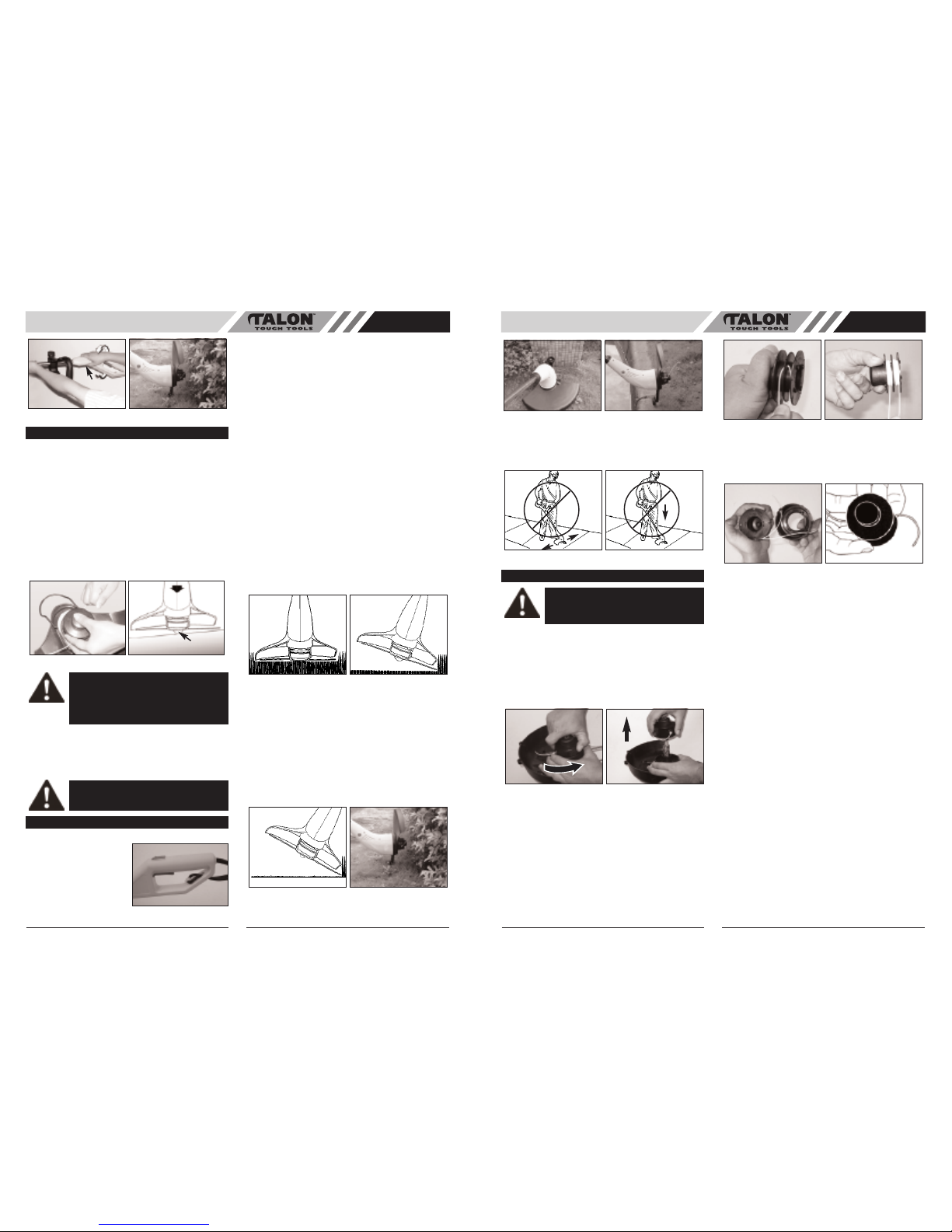
• CONNECT THE
CORD
1. Ensure the cord is NOT
plugged into a recepta-
cle before this proce-
dure.
2. Make a loop with 8” - 10”
(20 - 25cm) of the end of
the extension cord.
3. Place the loop into the groove at the end of the rear
handle and lock into place as shown in Fig. 5.
4. Connect the extension cord to the power cord on the
trimmer.
5. Plug the extension cord into a receptacle ONLY when
you are ready to operate the trimmer.
• TRIMMER OPERATION
1. TRIMMING / MOWING (Fig. 6A). Swing trimmer with
a sickle-like motion from side to side. Do not tilt the
stringhead during the procedure. Test area to be
trimmed for proper cutting height. Keep stringhead at
same level for even depth of cut.
2. CLOSER TRIMMING (Fig. 6B). Position trimmer
straight ahead with a slight tilt so bottom of string-
head is above ground level and string contact occurs
at proper cutting point. Always cut away from opera-
tor. Do not pull trimmer in toward operator.
3. FENCE/FOUNDATION TRIMMING. Approach trim-
ming around chain link fences, picket fences, rock
walls and foundations slowly to cut close without
whipping string against the barrier. If the string comes
in contact with rock, brick walls, or foundations, it will
break or fray. If string snags fencing, it will snap off.
4. TRIMMING AROUND TREES. Trim around tree
trunks with a slow approach so string does not con-
tact bark. Walk around the tree trimming from left to
right. Approach grass or weeds with the tip of the
string and tilt stringhead slightly
5. SCALPING (Fig. 6C). Scalping refers to removal of
all vegetation down to the ground. To do this, tilt the
stringhead to about a 30 degree angle to the left. By
adjusting the handle you will have better control dur-
ing this operation. Always keep a distance of 100 feet
(30 meters) from other people and animals when
scalping. Do not attempt this procedure if there is any
chance flying debris could injure operator, other peo-
ple or cause damage to property.
6. OPERATING AS AN EDGER (Fig. 6D, 6E, 6F). With
the unit configured as an edger, hold it so that the
motor is to your left side and debris is thrown to the
rear. Always use eye protection.
Fig. 3C Fig. 3D
STARTING
CAUTION: A short or worn nylon line cuts
less efficiently so, to improve its operation on
subsequent occasions, tap the spool button
(A) lightly on the ground while the trimmer is
running. This will bring about the self- adjust-
ment of the nylon line. (Fig. 4B)
Fig. 4A Fig. 4B
A
CAUTION: After switching off, the nylon line
will continue to rotate for a few more sec-
onds.
B
OPERATION
Fig. 5
Fig. 6A Fig. 6B
Fig. 6C Fig. 6D
7. SWEEPING - DO NOT SWEEP WITH TRIMMER
(Fig. 6G)
8. DO NOT BUMP TRIMMER (Fig. 6H). A “bump” will
not advance line.
•REPLACE THE SPOOL OF NYLON LINE
1. Remove the spool assembly from the trimmer. To do
so, hold the outer ribbed part of the assembly with
one hand, while pushing down and turning the spool
head with the other to unlock it. (Fig. 7A & 7B) The
spool carrier and spool will now disassemble easily.
NOTE: There is a spring inside the head that could
easily be lost. Ensure that it is put in a safe place.
2. Remove any existing line from the spool.
3. Using 0.065" replacement line measure off approxi-
mately 14' (4.3m) of line (Fig. 7C). Loop the line into
2 equal lengths. Insert looped center into slot of spool
divider. (Fig. 7C)
4. Wind the line tightly and neatly around the spool. The
line is wound counterclockwise with each half sepa-
rated by the divider. Tightly wind it until there is about
6" (154mm) of bare line left (Fig. 7D).
5. Lock each end of line into opposite holding slots.
Ensure you use the slots located on the bump knob
side of the spool.
6. Insert the line through each eyelet in the spool carri-
er and slide the spool into it. (Fig. 7E & 7F)
NOTE: Ensure that the line is within the divider. If it's
out of the divider, it won't be fed out.
7. Making sure to insert the spring, assemble the spool
and spool carrier back onto the trimmer. To do so,
push the head on and turn it clockwise until it locks.
8. To test if the line is advancing properly, push the
bump knob with your thumbs while pulling the line
with your fingers. The line should advance freely.
9. In the event of the line breaking inside the spool,
repeat the replacement operation.
10. Start the grass trimmer following the instructions in
“STARTING”.
•CLEANING
1. Regular cleaning and maintenance of your string
trimmer will ensure efficiency and prolong the life of
your machine.
2. After each cutting operation, take apart and clean out
the grass and soil from: the spool and its slot, the
whole trimmer and in particular the guard.
3. During operation, keep the air slots clean and free of
grass.
4. Only use a cloth soaked with hot water and a soft
brush to clean the string trimmer.
5. Do not spray or wet the appliance with water.
6. Do not use detergents or solvents as these could ruin
the trimmer. The parts in plastic can easily be dam-
aged by chemical agents.
Fig. 6E Fig. 6F
Fig. 6G Fig. 6H
MAINTENANCE
CAUTION: Before carrying out any mainte-
nance operations, cut off the electric power
supply by switching off power and discon-
necting extension cord.
Fig. 7A Fig. 7B
Fig. 7C Fig. 7D
Fig. 7E Fig. 7F