manuals.online logo
Brands
  1. Home
  2. •
  3. Brands
  4. •
  5. Technics
  6. •
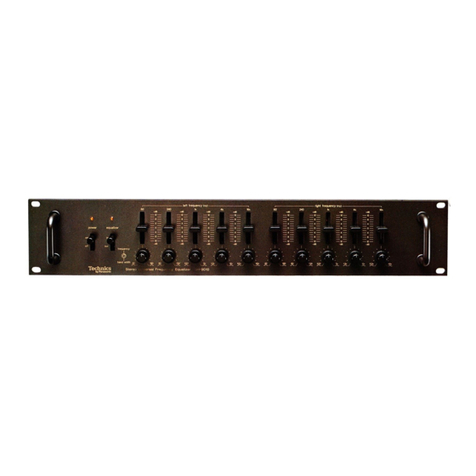
  7. Stereo Equalizer
  8. •
  9. Technics SH-8075 User manual

Technics SH-8075 User manual

This manual suits for next models

5

Other Technics Stereo Equalizer manuals
Technics SH-9010 User manual

Technics

Technics SH-9010 User manual

Technics SH-9010 User manual

Technics

Technics SH-9010 User manual

Technics SH-GE70 User manual

Technics

Technics SH-GE70 User manual

Technics SH-GE50 User manual

Technics

Technics SH-GE50 User manual

Technics SH-8016 User manual

Technics

Technics SH-8016 User manual

Technics SH-8066 User manual

Technics

Technics SH-8066 User manual
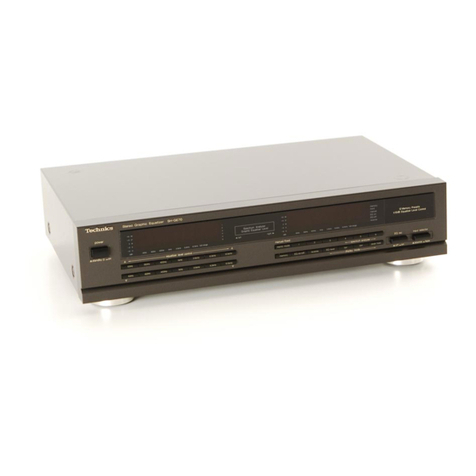
Technics SH-8058 User manual

Technics

Technics SH-8058 User manual

Technics SH-8066 User manual

Technics

Technics SH-8066 User manual
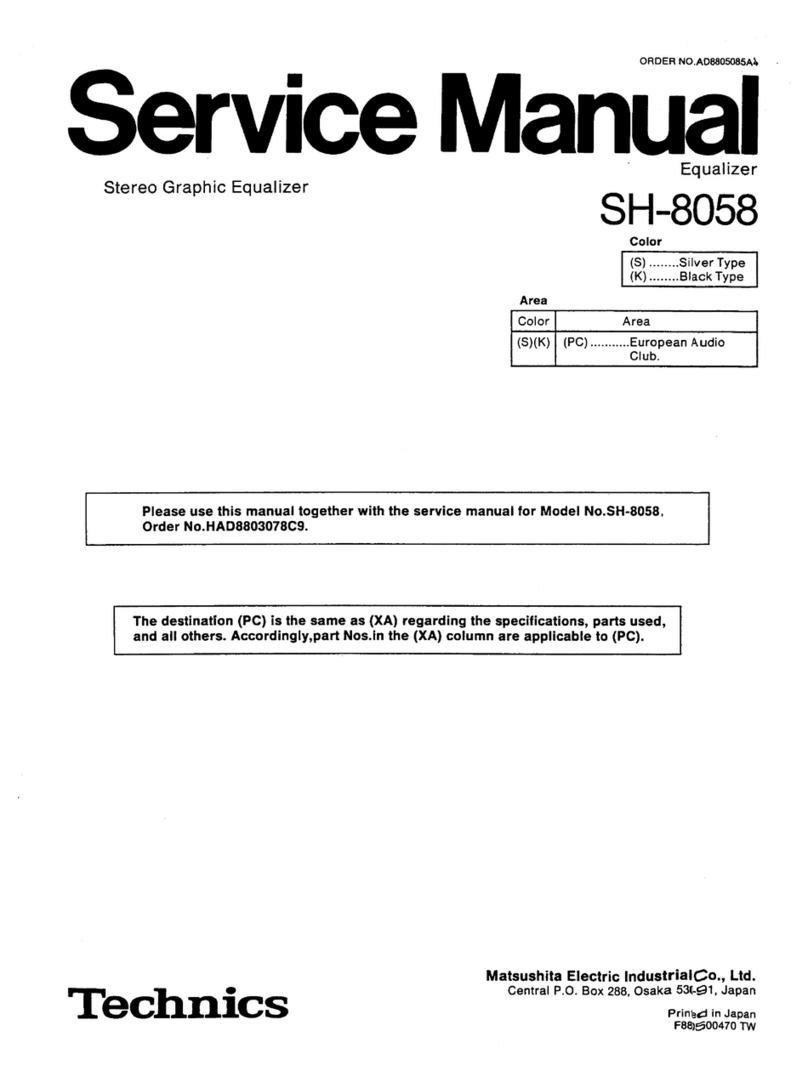
Technics SH-Z200 User manual

Technics

Technics SH-Z200 User manual
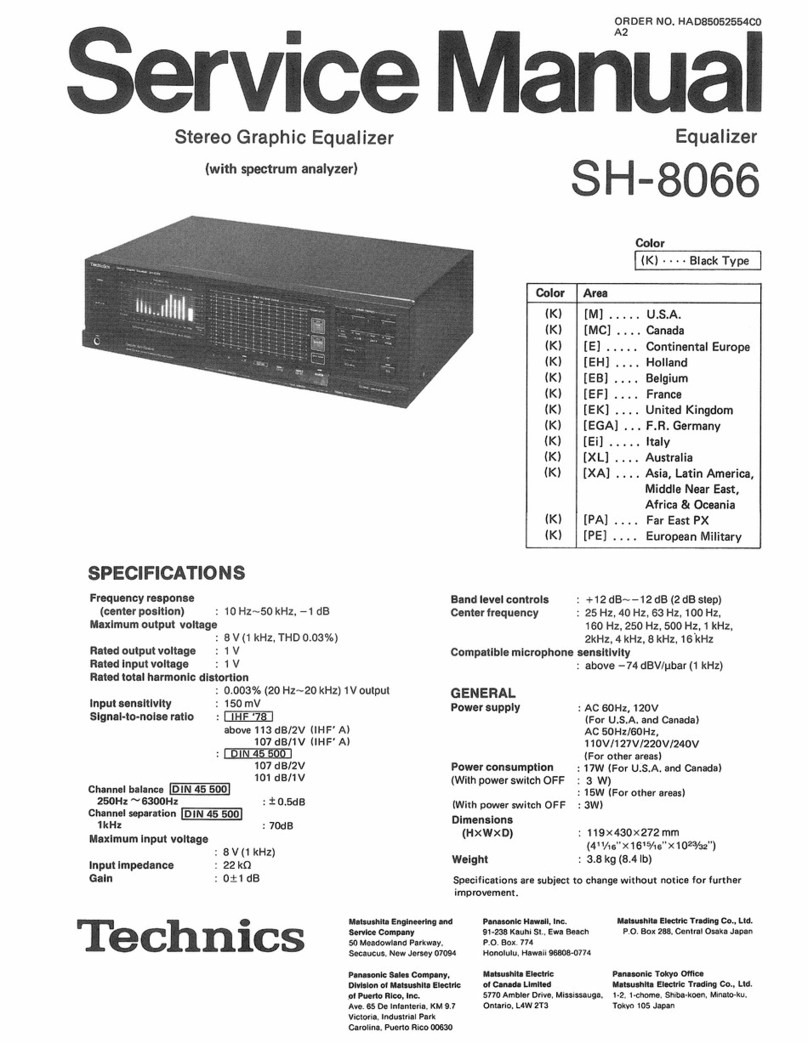
Technics SH-8038 User manual

Technics

Technics SH-8038 User manual

Technics SH-8020 - SERVICE User manual

Technics

Technics SH-8020 - SERVICE User manual

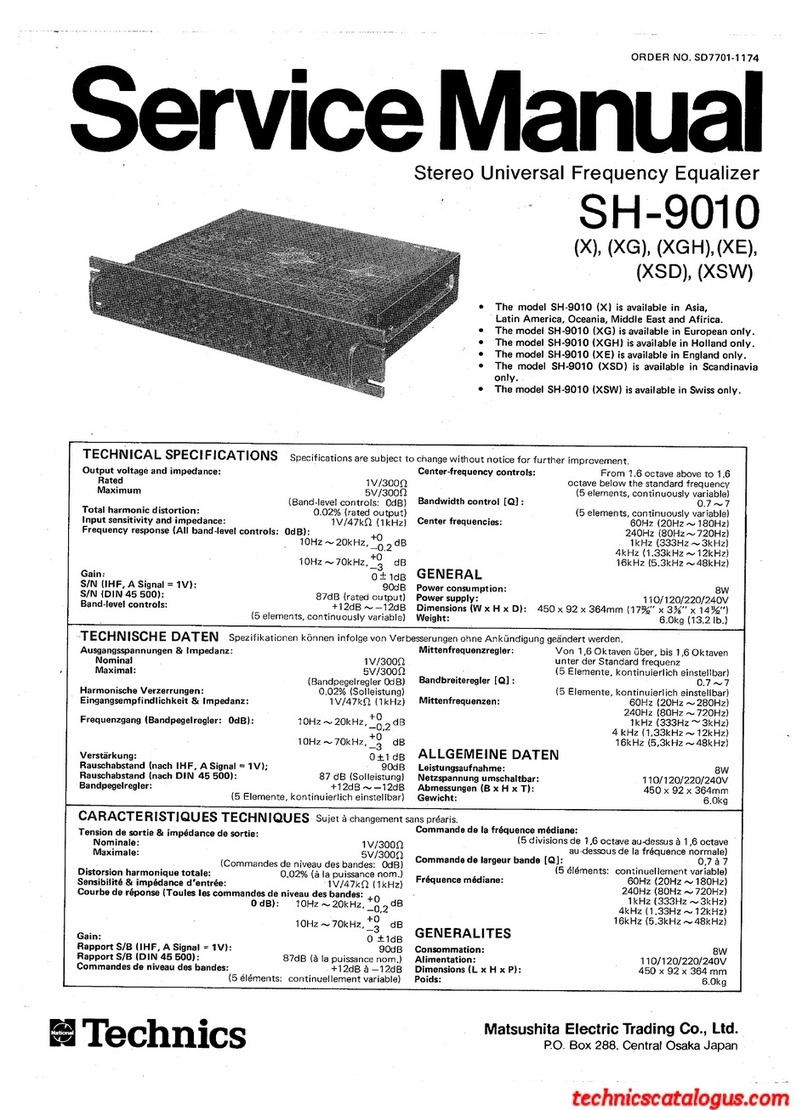
Technics SH-8066 User manual

Technics

Technics SH-8066 User manual
Popular Stereo Equalizer manuals by other brands

Pyramid PM8600 owner's manual

Pyramid

Pyramid PM8600 owner's manual

Pioneer DEQ-P90 owner's manual

Pioneer

Pioneer DEQ-P90 owner's manual

Roland E-660 owner's manual

Roland

Roland E-660 owner's manual

elysia mpressor manual

elysia

elysia mpressor manual

Free The Tone PA-1QG quick start guide

Free The Tone

Free The Tone PA-1QG quick start guide

Kenwood KRC-999II instruction manual

Kenwood

Kenwood KRC-999II instruction manual

AudioBahn AEX250X operating instructions

AudioBahn

AudioBahn AEX250X operating instructions

Onkyo EQ-08 Service manual

Onkyo

Onkyo EQ-08 Service manual

Samson D3500 owner's manual

Samson

Samson D3500 owner's manual

Me WM8 installation instructions

Me

Me WM8 installation instructions

Rob Papen RP-EQ user guide

Rob Papen

Rob Papen RP-EQ user guide

Kenwood GE-4030 instruction manual

Kenwood

Kenwood GE-4030 instruction manual

Rane RE 27 Operating and service manual

Rane

Rane RE 27 Operating and service manual

SPL SX2 owner's manual

SPL

SPL SX2 owner's manual

Rane MQ 302S Operator's manual

Rane

Rane MQ 302S Operator's manual

Aphex 9901 operating guide

Aphex

Aphex 9901 operating guide

Behringer Ultragraph Pro FBQ6200 Technical specifications

Behringer

Behringer Ultragraph Pro FBQ6200 Technical specifications

Black Rooster Audio VEQ-5 OVERVIEW & INSTRUCTIONS

Black Rooster Audio

Black Rooster Audio VEQ-5 OVERVIEW & INSTRUCTIONS

manuals.online logo
manuals.online logoBrands
  • About & Mission
  • Contact us
  • Privacy Policy
  • Terms and Conditions

Copyright 2025 Manuals.Online. All Rights Reserved.

|
\*
i
The
Bleek.
type
model
is
‘indicated
by
(K)
in
the
Service
Manual.
The
colors
of
this
model
|
1S
black
type
only.
"Naseperoctumsateleotinmnctoaity
cman
a
peta
in
ss
He
aces
Specifications
(DIN
45
500)
Frequency
response
(center
position)
Maximum
output
voltage
Rated
output
voltage
Rated
total
harmonic
distortion
Input
sensitivity
Signal-to-noise
ratio
Maximum
input
voltage
input
impedance
Output
impedance
Gain
Channel
balance
250
Hz~6300
Hz
Channel
separation
1
kHz
Band
level
controis
>5
HZ~100
kHz,
—1
dB
>8V
(1
kHz,
THD
0.01%)
(LOW
LEVEL
150
mV)
ames
>
0.001%
(20
Hz~20
kHz)
a
110
dB
(120
dB,
IHF
‘A)/2
V
104
dB
(114
dB,
IHF
’A)/1
V
8
V
(1
kHz)
(LOW
LEVEL
150
mv)
>
47
kQ
>
600Q
>O0+1dB
=+0:506
:70dB
+12dB~-12dB
Stereo
Graphic
Equalizer
Specifications
are
subject
to
change
without
notice
for
further
improvement.
Weights
and
dimensions
shown
are
approximate.
Center
frequency
ORDER
NO.
SD83072619C2
Areas
|,
[EH],
[EB],
*
EK]
is
cAvailieal
in
United
Kingdo
*
[EF]
is
available
in
France.
*{EH]
is
available
in
Holland.
*
(EB)
is
available
in
Belgium.
x
[EGA]
iS
available
in
F,
R.
Germ
an
a
TOA
202.
25
AZ
OV
oases
40
Hz,
50
Hz,
63-H2,:80:
Hz,
100:HZ,.125
Hz,
160
Hz,
200
Hz,
250
Hz.375-Hz,
400
Hz,.500
Hz,
630
Hz,
800
Hz,
1
KHz,
1.25
kHz,
16
KHz,
2
kHz;
2.5
KHZ,
3.15
kHz,
4
kHz,
5
KHz,
6.3
KHz,
8
KHz,
10
kHz,
12.5
KHz,
16
KHz,
20
kHz,
25
KHz
Variable
equalizer
Center-frequency
controls
(variable)
>
20
Hz~
400
Hz
Bandwidth
controls(Q)
:0.7~7
Band
level
controls
hie
dB]
1208
GENERAL
Power
supply
>
AC
110
V/120
V/220
V/240
V,
50
Hz/60
Hz
Power
consumption
>
34
W
Dimensions
(33
elements
continuously
variable
per
channel)
Signal
level
selector
7150
mV/1
V
&
CONTENTS
Page
SAFETY:PRECAUTION
2p
pei
ee
ERE
Baws
Seem
2
TOTAL
FREQUENCY
RESPONSE
ii
Bi
ity
Seah
Gas
Hes
hae
Cie
SO
aera
ean
LOCATION
OF
CONTROLS
.
Sk
WR
ote
lelctan
Woe
a
Ae
Ge
DISASSEMBLY
INSTRUCTIONS
.
;
fay
8k
ena
a
Oe
MODEL
NO.
SH-8065
BE
DIFFERENT
MODEL
NO.
SH-8075
:
:
ews:
&.
pay
“6
PRINTED
CIRCUIT
BOARDS
WIRING.
CONNECTION
DIAGRAM
i
a
iat
Bye
‘Technics
(HxWxD)
>
153x430
x
330
mm
(6-1/32"
«
16-15/16"
x
13")
Weight
:
6.6
kg
(14.5
Ib)
Page
PRINTED
CIRCUIT
BOARDS
..................
9°16
TECHNICAL
INFORMATION
.
ee
ee
ee
eee
|
EXPLODED
VIEW.......
le
18,19
REPLACEMENT
PARTS
LIST
.
Bi
eae
ole
ee
ea
ee
SCHEMATIC
DIAGRAM
..............
000-5.
21~30
BLOCK
DIAGRAM
.....
Say
&
bre
&
i
oe
SG
eee
RESISTORS
AND
CAPACTIORS
Pg
yk
he
BB
eA
Hata
ie,
Op
OA
Matsushita
Electric
Trading
Co.,
Ltd.
P.O.
Box
288,
Central
Osaka
Japan
B
SAFETY
PRECAUTION
mf
WN
-
Wh
-
©
_
Before
servicing,
unplug
the
power
cord
to
prevent
an
electric
shock.
.
When
replacing
parts,
use
only
manufacturer's
recommended
components
for
safety.
_
Check
the
condition
of
the
power
cord.
Replace
if
wear
or
damage
is
evident.
.
After
servicing,
be
sure
to
restore
the
lead
dress,
insulation
barriers,
insulation
papers,
shields,
etc.
.
Before
returning
the
serviced
equipment
to
the
customer,
be
sure
to
make
the
following
insulation
resistance
test
to
prevent
the
customer
from
being
exposed
to
a
shock
hazard.
INSULATION
RESISTANCE
TEST
.
Unptug
the
power
cord
and
short
the
two
prongs
of
the
plug
with
a
jumper
wire.
|
.
Turn
on
the
power
switch.
.
Measure
the
resistance
value
with
ohmmeter
between
the
jumpered
AC
plug
and
each
exposed
metal
cabinet
part,
such
as
screwheads
antenna,
control
shafts,
handle
brackets,
etc.
Equipment
with
antenna
terminals
should
read
between
3M22
and
5.2MQ
to
all
exposed
parts.
(Fig.
A)
Equipment
without
antenna
terminals
meule
read
approximately
infinity
to
all
exposed
parts.
(Fig.
B}.
Note:
Some
exposed
parts
may
be
isolated
from
the
chassis
by
design.
These
will
read
infinity:
Antenna
terminal
Exposed
metal
part
Ohmmeter
Ohmmeter’
(Fig.
A)
(Fig.
B)
Resistance
=
3M2
~
5.2M@Q
Resistance
=
Approx
OO
.
1f
the
measurement
is
outside
“he
specified
‘limits:
there
is
a
possibility
of
a
shock
hazard
The
equipment
should
be
saps
and
rechecked
before
it
is
returned
to
the
customer.
heed
@
TOTAL
FREQUENCY
RESPONSE
Frequency
response
(+12dB
position}
+12
poeta
ee
ee
ee
alee
die
2th
+10
PAAR
RAO
TAA
UTA
AA
wa
<p
PANINI
LIE
tee
oe
CONES
An
44
Ht
AAR
A
AAU
A
A
“4215
LL
A
AX
MARA
SAX
ee
Nrenuniel
0
ee
SSS
2
RAAT
OP
I
I
IO
ODI
AY
ALLA
—
4
DANO
MAK
KY
MY
TY
IXY
YI
TY
XIX
KAY
XX
AL
VARY
YY
yYVV
VV
YY
Vi
3
vuUW
Uh
ed
ori
a
SOFA
TA
A
TA
WUT
LT
A
“10
23.
§
7100
2.3
§
71%
23
5710k
23
§
Frequency
(H2)
Level
a
SH-8075
@
LOCATION
OF
CONTROLS
Power
switch
©
Band
ievel
control
Equalizer
on/of*
switch
|
B
oft,
=
on}
Recording
mode
switch
{
Mf
straight,
=
EQ)
tape
7
tase
2
@
Sand
level
contro!
@
Bandwidth
{Q)
control
©
Variable
equalizer
switch:
Lch.
{
EE
off,
=
on)
@
Bandwidth
(Q)
contral
Band
jevel
controls
:
L
ch,
+12d8
@
Frequency
control
{Hz)
Band
level
controls
:
R
ch.
+12dB
@
Frequency
control
(Hz)
@
Variable
equalizer
switch
:
Rich.
(
M
off,
=
on)
input
selector
input
signal
level
saleetec
@
VARIABLE
EQUALIZER
os
“Technica:
Information”
on
page
17
also
describes
me)
variable
equalizer.
The
variable
2qualizer
can
be
used
for
corrections
of
low-frequenc.
characteristics.
The
functions
in
this
unit
are
as
follows:
@
Center
frequency
contro!
knob
(frequency,
Hz)
is
able
to
cantinuously
vary
the
frequency
in
a
range
Of
20Hz
~
400Hz
to
set
it
to
the
desired
point.
@
Band
width
knob
fhandwidth.
O)
ie
able
to
conti-
hudusly
.aty
the
resonance
peak
{Q)
of
frequency
set
by
knob
6
@_
in
a
range
of
0.7~7.
Turning
it
counters
7ckwise
decreases
the
value
of
Q,
making
H
9a
te
ri
a
a
an
an
Ahn
Sie
ma
To
©
iets
A
hab
fs
dee
rh
MN
wate
on
LINE
IN
!
——PLAYBACK
=
:
ae
Dba
eh
I
To
Tape
deck
2
Pa
REC
OUT
el
cae
sn
4
PLAYBACK—————y
=
-
Low
level
~
150m
V
side
{Input
from
“REC
OUT"
of
amplifier:
Output
to
“"PLAYBACK"’)
High
level
>
1V
side
(Input
from
“PRE
OUT"
of
amplifier
:
Output
to“MAIN
IN’)
Voltage
setector
(110V/120V/220V/240V)
=
To
Tape
deck
1
the
peak
and
dip
gentle,
while
turning
it
clockwise
increases
the
value
of
Q,
making
the
peak
and
dip
sharp,
resulting
in
less
interference
given
by
or
to
adjacent
channels.
©)
Variable
equatizer
band
level
control
is
able
to
vary
the
frequency
set
by
knob
@
by
+12
dB.
If
the
frequency
set
by
knob
@
is
63
Hz,
then
it
can
be
varied
+24
dB
by
using
the
knob
@
and
the
22-division
GB
Hz
band
terel
conirel
Kage.
4)
Variable
equalizer
switch
(variable
£Q)
is
a
switch
to
turn
on/off
the
control
knobs
@
~
@.
(16H2~25kHz,
divided
into
33
band
in
1/3
octave.)
(16Hz~25kHz,
divided
into
33
band
in
1/3
octave.)
ook
Sa
S29
@®
OTHER
SWITCHES
*
Equalizer
on/off
switch
(EQ)
This
switch
is
used
to
turn
on/off
the
equalizer
circuit.
With
it
set
to
“on”,
the
frequency
characteristic
can
be
varied
by
the
upper
and
lower
band
level
controls
(33
sets
each)
and
the
variable
equalizer
band
level
controls
(1
set
gach)...
hy
Bas
*
With
Jit:
‘set,
to,
"off
“a
signal
is.
‘obtained
not
to
make
%
“off,
the
signal
comes
out
through
the
unit.
*
Record
mode
switch
(rec
mode)
When
recording
on
a
tape
deck,
correction
mode
is
selected
by
this
switch.
“EQ”
is
the
position
for
recording
with
correction
given,
@
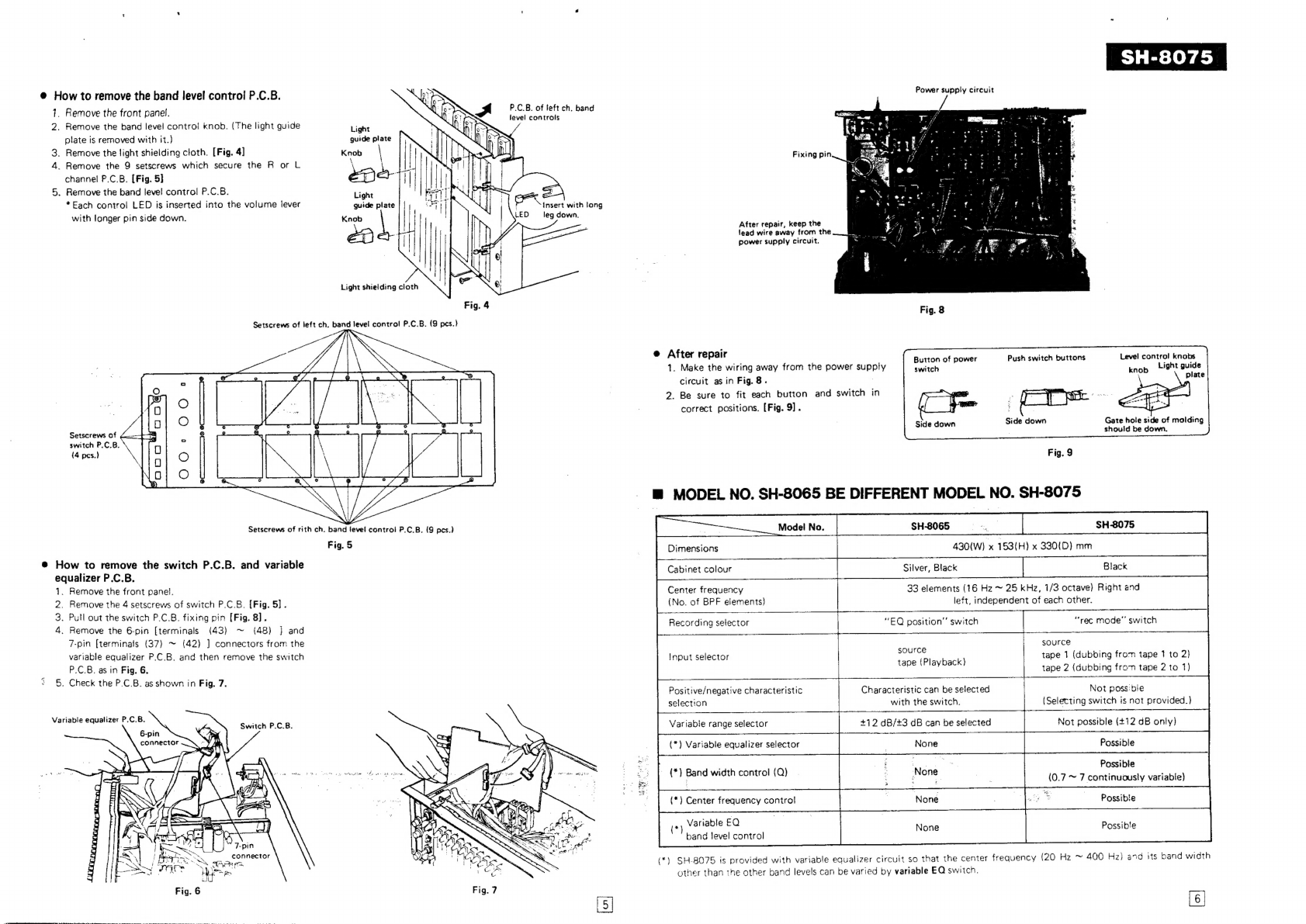
DISASSEMBLY
INSTRUCTIONS
@
How
to
remove
the
bottom
board
.
Remove
the
8
setscrews
{red)
as
in
[Fig.
1]
to
reomve
the
bottom
board.
*Remove
the
bottom
board
from
andenesih
the
front
pane!
as
shown
by
the
arrows.
a
Red
‘<
(8
pes)
pte
oi
Input
selectar
switch
:
1
ie,
“Source”
is
the
position
“for
record
say:
and
radio
‘broadcast.
%
2
>
#
,
“equalizer
cotrection.4
flan
a7
*
Even
when
power
switch
is
off
with
this
switch
turned
yee
lf
the
equalizer
on/off
switch
is
set
to
“off’’,
the
“straight”
indicator
lights
up
and
signal
without
correc-
tion
will
be
recorded.
“Straight”
is
the
position
for
recording
without
correc-
tion
sae
“tape
1”
is
the
position
for
playback
on
a
tape
deck
connected
to
“TAPE
1°
terminal
on
the
rear
chassis
or
for
dubbing
from
tape
deck
1
to
2.
“tape
2”
is
the
position
for
playback
on
tape
deck
2
or
for
dubbing
from
tape
deck
2
to
1.
How
to
remove
the
front
panel
1.
Remove
the
setscrews
@
~
@
[Fig.
2]
to
remove
the
cabinet.
2.
Remove
the
5
setscrews
[Fig.
2]
of
the
front
panel.
3.
Pull
out
the
6-pin
connector
{terminals
@
~
@]
from
the
switch
P.C.B.
on
the
left
side.
[Fig.
3]
4.
Remove
the
front
panel
with
care
not
to
scratch
the
knobs.
Power
switch
and
bottom
connecting
rod
Pull
out
the
connector
before
removing
the
front
panel.
Front
panet
~—
Panel
setscrews
(5
pes)
Fig.
2
®
How
to
remove
the
band
level
controj
P.C.B.
if
2:
3;
Remove
the
front
panel.
Remove
the
band
level
contro!
knob.
(The
light
guide
plate
is
removed
with
it.)
Remove
the
light
shielding
cloth.
[Fig.
4]
_
Remove
the
9
setscrews
which
secure
the
R
or
L
channel
P.C.B.
[Fig.
5}
.
Remove
the
band
level
control
P.C.B.
*Each
control
LED
is
inserted
into
the
volume
lever
with
longer
pin
side
down.
Setscrews
af
switch
P.C.B.
(4
pes.)
P.C.B.
of
teft
ch.
band
level
contro!s
Light
guide
plate
Knob
\
epe
Light
guide
plate
Knob
2
insert
with
long
leg
down,
Ss
Setscrews
of
rith
ch.
band
fevei
control
P.C.B.
{9
pes.)
Fig.
5
@
How
to
remove
the
switch
P.C.B.
and
variable
equalizer
P.C.B.
1.
Remove
the
front
panel.
2.
Remove
the
4
setscrews
of
switch
P.C.B.
[Fig.
5].
3.
Pull
out
the
switch
P.C.B.
fixing
pin
[Fig.
8].
4.
Remove
the
6-pin
[terminals
(43)
~
(48)
]
and
7-pin
[terminals
(37)
~
(42)
]
connectors
from
the
variable
equalizer
P.C.B.
and
then
remove
the
switch
P.C.B.
as
in
Fig.
6.
5.
Check
the
P.C.B.
as
shown
in
Fig.
7.
Variable
equalizer
P.C.B.
Switch
P.C.B.
connector
6-pin
;
~
as
jy
7-pin
connector
SS
ACH
L
ua
TRRD
Woy
ass
ay
Power
supply
circuit
After
repair,
keep
the
lead
wire
away
from
the
power
supply
circuit.
Fig.
8
s
F
After
repair
a
Button
of
power
Push
switch
buttons
Level
control
knobs
1.
Make
the
wiring
away
from
the
power
supply
switch
knob
bight
guide
circuit
as
in
Fig.
8.
plat
2.
Be
sure
to
fit
each
button
and
switch
in
correct
positions.
[Fig.
9]
.
3
.
Side
down
Side
down
Gate
hole
side
of
malding
;
should
be
down.
Fig.
9
m@
MODEL
NO.
SH-8065
BE
DIFFERENT
MODEL
NO.
SH-8075
Center
frequency
33
elements
(16
Hz
~
25
kHz,
1/3
octave}
Right
and
(No,
of
BPF
elements}
left,
independent
of
each
other.
Recording
selector
|
“EQ
position’
switch
“rec
mode”
switch
source
tape
1
(dubbing
from
tape
1
to
2}
tape
2
(dubbing
fron
tape
2
to
1)
source
tape
{Playback}
Input
selector
ot
Positive/negative
characteristic
Characteristic
can
be
selected
Not
poss:
bie
selection
with
the
switch.
(Selecting
switch
is
not
provided.}
Variable
range
selector
+12
dB/+3
dB
can
be
selected
Not
possible
(+12
dB
only)
(*)
Variable
equalizer
selector
Possible
{*}
Band
width
control
(Q)
Possible
:
(0.7
~
7
continuously
variable)
(*)
Center
frequency
control
of.
©
Possible
“]
band
level
control
(*)
SH-8075
is
provided
with
variable
equalizer
circuit
so
that
the
center
frequency
(20
Hz
~
400
Hz)
end
its
band
width
other
than
the
other
band
levels
can
be
varied
by
variable
EQ
switch.
‘None
(6)
SH-8075
SH-8075
™@
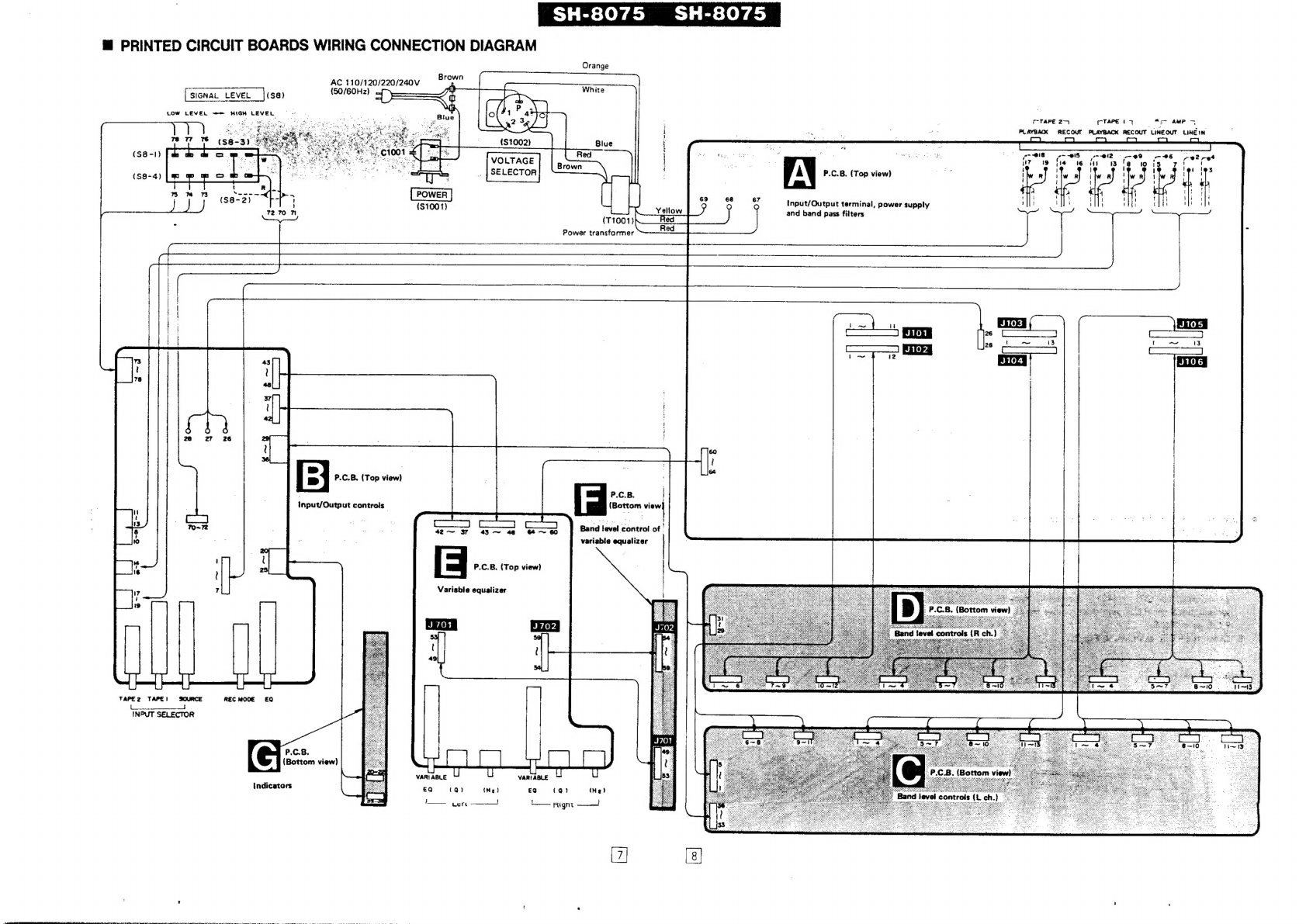
PRINTED
CIRCUIT
BOARDS
WIRING
CONNECTION
DIAGRAM
Orange
AC
110/420/220/240V
[sigwat
Lever
_](se)
a
>
LOW
LEVEL
==
HIGH
LEVEL
~~
-
:
=
TAPE
2-7
p
TAPE
i
4
“~
AMP
i
ue
os
PLAYBACK
=
RECOUT
PLAYBACK
RECOUT
LINEOUT
LINEIN,
:
oe
+s
f
(58-1)
{
aan
ee
’
a
eee
A
08
018
~-IS
aes
=
.
VOLTAGE
749
ta
ia
i
eto
fe
.
i
.
J
of
J
($8+4)
SELECTOR
P.C.B.
(Top
view)
R
wR}
ifw
al
iiwr”
1
lw
i
'
P
p
2
a
69
—s«g
8
67
.
ale
ons
ak
itty
;
($1001)
0)
Input/Output
terminal,
power
supply
lt
ra
thy
aa
ane
Yellow
and
band
pass
filters
ao
(T1001)
Red]
Power
transformer
(Bottom
view
Se
ae
|
|
|
Band
level
control
of
variable
equalizer
S~o
o~%
|
P.C.B.
(Top
view)
.
Input/Output
controls
t
—
:
’
25
P.C.B.
(Top
view)
zs
7
7
Variable
equalizer
é
level
controls
(R
ch.)
che
P.C.8.
{Bottom
view)
VARIABLE
Indicators
EQ
(Q)
(Me)
EQ
«1
@)
(He)
I
Lery
——!
—
Rignt
——
SH-8075
H
PRINTED
CIRCUIT
BOARDS
[ej
P.C.B.
(INDICATORS)
To
fe
PCB.
ToB}PC.B.
|
(-
B)
ae
To
‘(LINE
OUT)
termina
eiay
Fro
From
Pj
PC.B.
Muting
sw
a
a
B
From
(LINE
IN)
terminal
—(‘uobing
1»
S
|
ae
¥
dubbing
2>
—
2
PLAYBACK)
(CUMIN
Bo
SN
es
;
=
To
(tane?
RFC
un)
terminal
-
me"
:
Font
—
PLAYBACK)
Tp
(tepef
REC
OUT)
A
To
inverter
of
BPF.
|
SiG
NAL
LEVEL
|
SH-8075
SH-8075
P.C.B.
(BAND
LEVEL
CONTROLS,
LEFT
CH.)
J102
I
{
ake
‘
J
Or!
gel.
a
-
.
J104
f
x
~~
at.
oh:
“yeh
AL
O°
3106
oj
Dp
BOB.
(BAND
LEVEL
CONTROLS.
RIGHT
cH,)
Fil
.c.8.
(POWER
SUPPLY
AND
BAND
PASS
FILTERS)
TAPE
2
AMP—~
TAPE
j
,
[LINE
IN
|[LINE
OUT
|[REC
OUT}[PLAYBACK]
[REC
OUT][PLAYBACK]
From
EY
PCB,
ACK
eo
SH-8075
SH-8075
[a
Pcs.
(
BAND
LEVEL
CONTROL
\.
OF
VARIABLE
EQUALIZER
Ee!
P.C.B.
(VARIABLE
EQUALIZER)
“
S
:
LEFT
bes
Leon]
|
[VARIABLE
Ea
i
S&
5n
——~
Off
Gutput
circuit
\7p-
0
E
Fe
CG,
aa
ges
aA
ae
er?
7
eel
egite®
~
ts
4
oe
ure
2
res
.
#
-
“a
bch
BL
fain
ae
Preah
F
-
LS
aes
eRe
SE
lag
"AR
ee
ee
een
¥
sine,
3
ecu!
a
age
:
“ae
%
=
“a.
a
f
aS
er
ae
5
2
os
f
%
aoe
%
:
sa
Se
eT
oe
‘
ee:
’
é
A
:
%
.
;
¢
se
opted
*,
ere
,
,
F,
A,
:
y
2.
:
:
SD
ito
Sake
q
R
:
ps
P
#
£
i
coe
:
:
*
cy
3
AEG
ROB
BB
ey
.
ros,
a
$
%
F
i
°
.
:
f
-
“he
:
i.
2
Bg
;
:
%
‘
4g.
*$
3
gh
;
cea
elas
5
5
¥
:
eo
ber
Be,
7
;
r,
”~
F
mee
F
‘
%
‘
wat
x,
je
>
aed
a
Ss
3%
,
=
ais
.
P
we
J
3
«
3
||
[BAND
siDTH(@)
+8
-B
To
EY
2C.8
Muting
|
|
[FREQUENCY
(Hz)
eae
Relay
Power
supply
circuit
|
Muting
From
EY
PCB.
+B-
RIGHT
}j
action]
]
[vaRiaBce
Ea
S7
on
——~
Off
|]
[Bano
widTH
(a)
|
|
TEREQUENCY
(H
Me
ile
vee
ae
ee
me
*
Pe
ie
20~400HzZ
BAND
LEVEL
SH-8075
@
TECHNICAL
INFORMATION
@
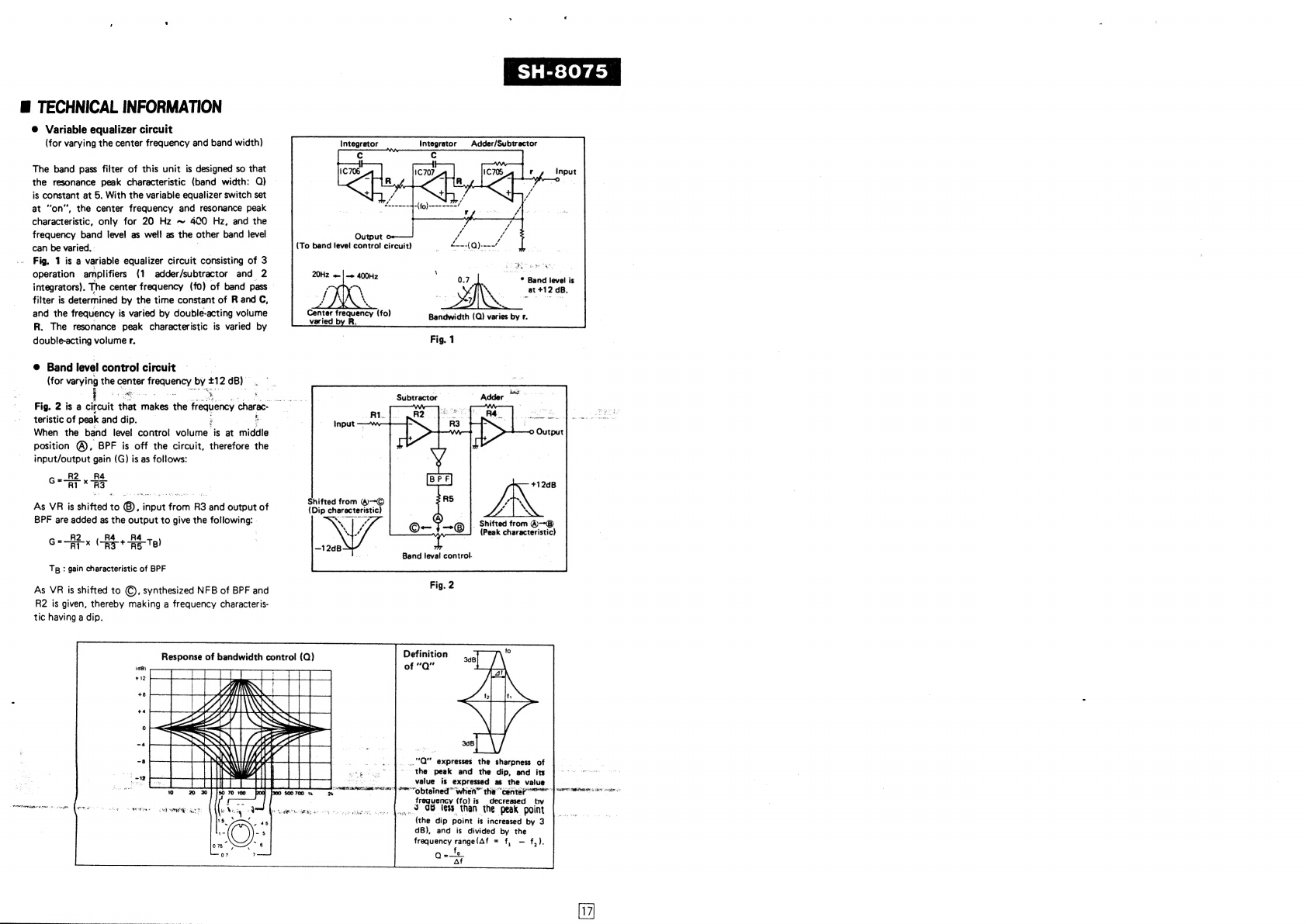
Variable
equalizer
circuit
(for
varying
the
center
frequency
and
band
width)
Integrator
Integrator
|
Adder/Subtractor
The
band
pass
filter
of
this
unit
is
designed
so
that
the
resonance
peak
characteristic
(band
width:
Q)
is
constant
at
5.
With
the
variable
equalizer
switch
set
at
“on”,
the
center
frequency
and
resonance
peak
characteristic,
only
for
20
Hz
~
400
Hz,
and
the
frequency
band
level
as
well
as
the
other
band
level
can
be
varied.
-
Fig.
1
is
a
variable
equalizer
circuit
consisting
of
3
operation
amplifiers
(1
adder/subtractor
and
2
integrators).
The
center
frequency
(fo)
of
band
pass
*
Band
ievel
is
at
+12
dB.
filter
is
determined
by
the
time
constant
of
R
and
C,
:
e
pay
ee
A
and
the
frequency
is
varied
by
double-acting
volume
poodle!
preauency
(fo)
Bandwidth
(Q)
varies
by
r.
R.
The
resonance
peak
characteristic
is
varied
by
:
double-acting
volume
r.
.
Fig.
1
©
Band
level
control
circuit
|
(for
varying
the
center
frequen):
by
#12
dB)
abe
Loe
eae
ss
*
¥
Fig.
2
is
a
circuit
that
‘ibs
the
frequency
charac:
eee
teristic
of
peak
anddip.
a
When
the
band
level
control
volume.
is
at
middle
position
@,
BPF
is
off
the
circuit,
therefore
the
input/output
gain
(G)
is
as
follows:
As
VR
is
shifted
t
to
0
®.
i
input
Gon
R3
and
output
of
(ore
cer
BPF
are
added
as
the
output
to
give
the
following:
.
or
a
Shifted
from
@—-@
R.,
_
(Peak
characteristic)
(=7+4
aT)
G=
Band
leval
control.
Tg
:
gain
characteristic
of
BPF
As
VR
is
shifted
to
©,
synthesized
NFB
of
BPF
and
Fig.
2
R2
is
given,
thereby
making
a
frequency
characteris-
tic
having
a
dip.
Response
of
bandwidth
contro!
(Q)
Definition
ne
|
|
|
INN
|
oN
ZING
“NA
.
“nq
expresses
the
sharpness
of
~
the
peak
and
the
dip,
and
its
value
is
expressed
as
the
value
Steere!
a
ary
obtained”
“when”
the’
“center
9
aOR
Se
sete:
frequency
(fo)
is
decreased
by
3
06
less
than
the
peak
point
(the
dip
point
is
increased
by
3
dB),
and
is
divided
by
the
frequency
range(Af
=
f,
—
f,).
fo
:
Af