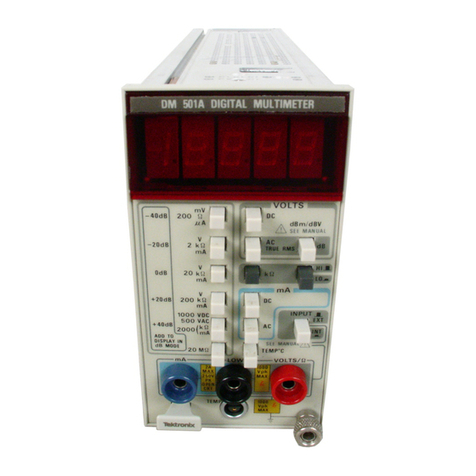
Operating Instructions—DM 502
AC Voltage, Current and Resistance Measurements
Select an appropriate full scale AC VOLTS, AC mA or
OHMS position on the range-function switch. Connect the
unknown voltage, current or resistance to the INPUT
binding posts.
Decibel Measurements
To use this feature, switch to an ac voltage or current
range and push the button marked dB on the front panel.
Connect the voltage or current source to the DM 502. To
arrive at the correct dB reading, algebraically add the
number on the outside scale to the display reading. When
the dB switch is depressed, the decimal point is fixed and
the maximum display reading is 19.99 on all scales.
For example, if the range-function switch is on the 2AC
VOLTS position and the display reading is +13.98, then
the correct dB reading is:
+13.98
-20 00
-602 dB
If the range-function switch is on the 200 AC mA
position and the display reads -4.04, then:
-4.04
120.00
-15.96 dB
Selection of dB readout in dBV or dBm is accomplished
by ajumper shown in Fig. 1-2. The reference for dBV when
measuring ac voltage is one volt and when measuring
current one milliampere The reference for dBm in the
voltage range is one milliwatt dissipated in 6000 or 0.7746
volts: in the current measuring range the reference is
0.7746 milliamperes. When dBm or dBV is applied to
current measurements, they have no significance other
than to the reference current as stated above.
Useful dB formulas are:
E' I' p,
dB =20logio-ri,20 logio -r- and 10 log t0 -=p
ti ii ri
For calculations substitute the reference voltage or
current listed as the denominator.
Temperature Measurements
With the P6430 probe connected to the front panel
connector labeled TEMP PROBE, set the range-function
switch to the °F or °C in the TEMP position. Apply the
probe sensor tip to the device being measured. For
optimum temperature transfer, coat the surface of the
device being measured with silicone grease and apply the
probe tip squarely to the surface. Allow sufficient time for
the probe tip to stabilize before taking areading. The time
required depends upon several factors. Generally, when
the tip is first applied to the device under test, the readings
change rapidly. As the probe tip temperature approaches
the temperature of the device under test, the readings
change less rapidly, and finally stabilize. The readings are
in °C or °F, depending on the position of the range-
function switch. See the P6430 manual for more informa-
tion on temperature measurements and probe use.
Using aTransistor as aTemperature-Sensing
Device
Certain npn transistors such as a2N2484 can be used
as separate sensors in place of the P6430 probe with little
or no selection of the transistor. Connect the temperature-
sensing transistor to the DM 502 through the TEMP
PROBE connector as shown in Fig. 1-4. Accuracy without
recalibration of the DM 502 is within ±8°C to 150°C. If the
Connector shell
Connector
TEKTRONIX Pari Number
131-1653-00
Fig. 1-4. Schematic diagram of temperature-sensing transistor
connected to probe connector.
REV. A, OCT. 1974 1-5