8
OPERAT NG NSTRUCT ONS continued
Pre-Use Inspection
WARNING: Before using the instrument be sure to test and inspect the equipment
to ensure that it is functioning properly and is in safe, working condition. Failure to do
so may cause serious injury or death and may result in erroneous test measurements.
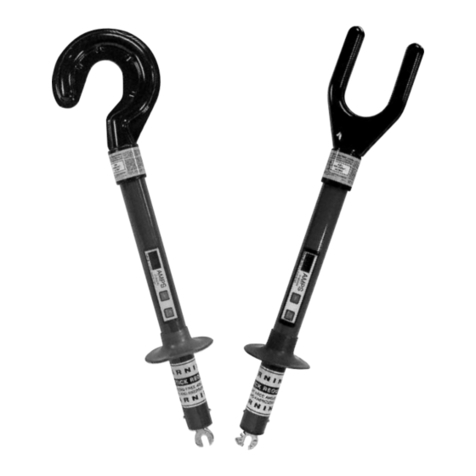
Before making any high voltage measurements, test and inspect the voltmeter/phaser as follows:
1) Make certain the instrument is clean and dry.
2) nspect the cord for cracked insulation.
3) Be sure that you are using hotsticks of the appropriate length, and examine each
hotstick to ensure that it is clean, dry and waxed to a clear shiny surface.
4) Attach the appropriate probes for overhead or underground applications
(see page 11) and ensure that the probes are properly installed and tightened
(do not overtighten).
5) Confirm that the meter is configured for the correct application (normal reading,
Peak Hold, Test Point).
6) Test each voltmeter with a voltmeter tester such as the HD Electric PT-5000B Proof
Tester® Voltmeter Tester (see page 11).
Volta e and Phasin Measurements – Line-to-Ground
First connect the ground cord to either a ground or system neutral. Maintain contact with
the meter probe tip only long enough to read the meter. Always remove the probe from
the energized source first before removing the ground connection.
Volta e and Phasin Measurements – Line-to-Line
We recommend that two person crews perform all line-to-line voltage measurements
and phasing operations. Since the operation is occurring near two energized conductors,
the use of two person crews allows each person to operate one meter stick and maintain
high safety standards.
n order to make line-to-line measurements, each meter must contact an energized
line. Be sure that only those probes intended for the particular application are used
(see page 11). Always keep the ground cord free and clear of energized phases
and conductors. For phasing applications, the meters will be placed on opposite sides
of an open point, typically a switch. The phasing operation will indicate if two sides
of a line are in-phase before closing a switch. f the two phases are out of phase, the meter
will indicate which is leading and which is lagging.
To check all phases proceed as follows:
1) Measure voltage on each phase from line-to-ground to verify all phases
are live and at the same voltage.
2) Place one of the probes on a conductor on one side of the switch.
3) Place the other probe on one of the three phases on the other side of the switch.
4) f the conductors are out-of-phase, the meter will read line-to-line voltage.
f they are in-phase, the meter will read near zero but may read up to 15%
of the line-to-line voltage.
5) Continue this procedure with all three phases on both sides of the switch.
f an intermediate reading is found, the phasing cannot be determined by this method
and the switch should not be closed until other means are used for phasing.