manuals.online logo
Brands
  1. Home
  2. •
  3. Brands
  4. •
  5. TP-Link
  6. •
  7. Network Router
  8. •
  9. TP-Link ER8411 User manual

TP-Link ER8411 User manual

Other TP-Link Network Router manuals

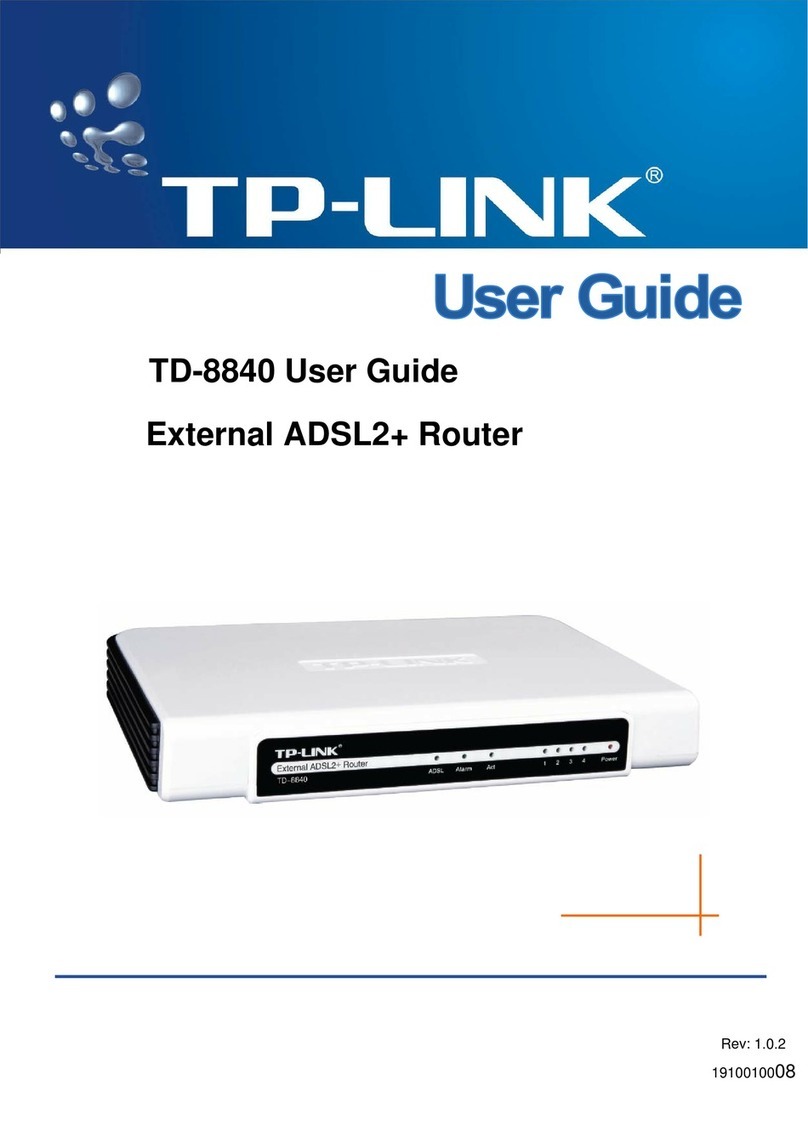
TP-Link TL-WR810N User manual

TP-Link

TP-Link TL-WR810N User manual

TP-Link Archer VR600 User manual

TP-Link

TP-Link Archer VR600 User manual

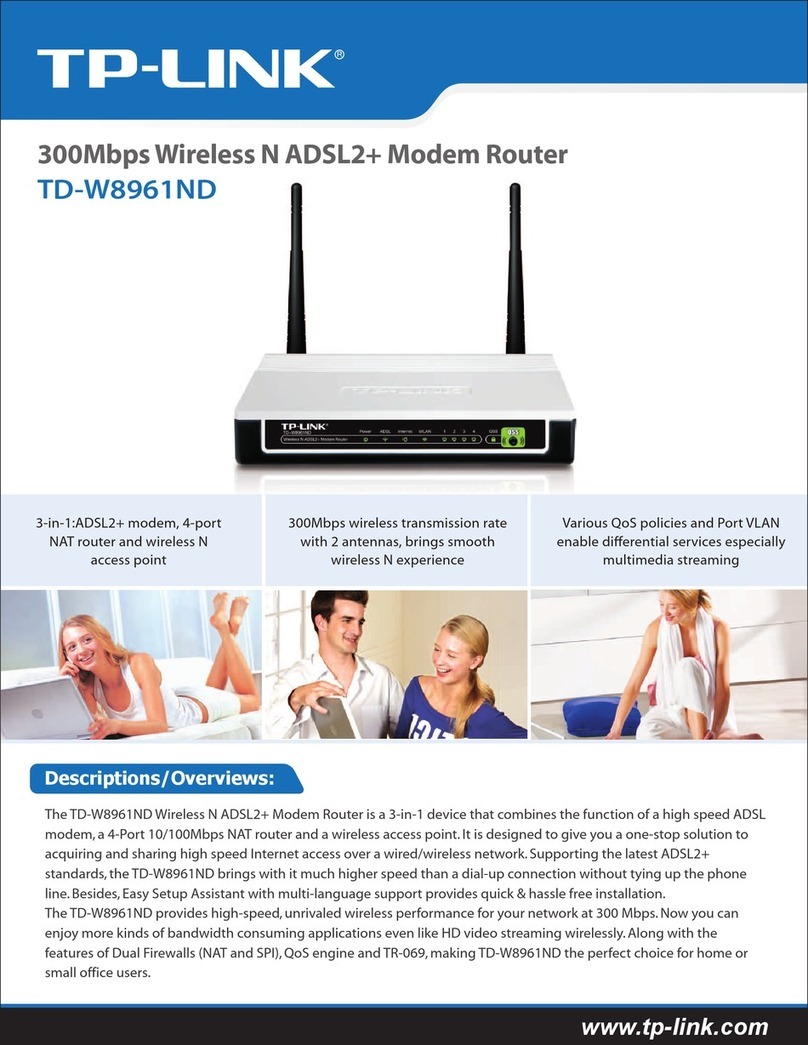
TP-Link TD-W8961ND User manual

TP-Link

TP-Link TD-W8961ND User manual

TP-Link SafeStream TL-R600VPN User manual

TP-Link

TP-Link SafeStream TL-R600VPN User manual

TP-Link TL-R470T+ User manual

TP-Link

TP-Link TL-R470T+ User manual

TP-Link TD-W8961ND User manual

TP-Link

TP-Link TD-W8961ND User manual

TP-Link PSM150-DC User manual

TP-Link

TP-Link PSM150-DC User manual

TP-Link TL-WR1043ND - Ultimate Wireless N Gigabit... User manual

TP-Link

TP-Link TL-WR1043ND - Ultimate Wireless N Gigabit... User manual

TP-Link VX230v User manual

TP-Link

TP-Link VX230v User manual

TP-Link TL-WR841N User manual

TP-Link

TP-Link TL-WR841N User manual

TP-Link TL-R460 User manual

TP-Link

TP-Link TL-R460 User manual

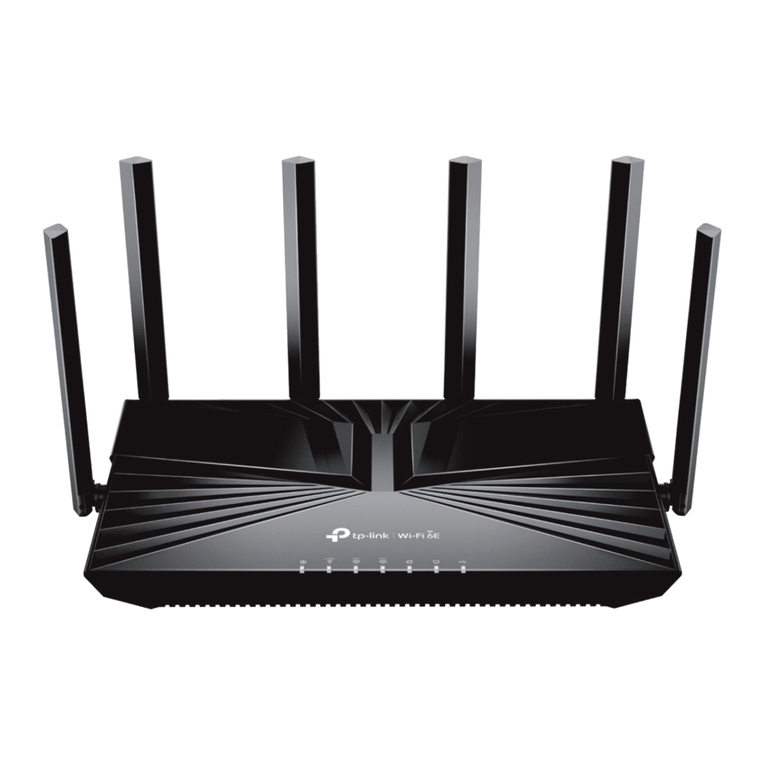
TP-Link AXE5400 User manual

TP-Link

TP-Link AXE5400 User manual

TP-Link RE705X User manual

TP-Link

TP-Link RE705X User manual

TP-Link Archer D9 User manual

TP-Link

TP-Link Archer D9 User manual

TP-Link TL-WR802N User manual

TP-Link

TP-Link TL-WR802N User manual

TP-Link archer VR900V User manual

TP-Link

TP-Link archer VR900V User manual

TP-Link TD-W9970B User manual

TP-Link

TP-Link TD-W9970B User manual

TP-Link Archer C5400 User manual

TP-Link

TP-Link Archer C5400 User manual

TP-Link TD-W9960v User manual

TP-Link

TP-Link TD-W9960v User manual

TP-Link TL- WR740N User manual

TP-Link

TP-Link TL- WR740N User manual

TP-Link Archer C7 AC1750 User manual

TP-Link

TP-Link Archer C7 AC1750 User manual

TP-Link TDW8968V3 User manual

TP-Link

TP-Link TDW8968V3 User manual

TP-Link TD-8817 User manual

TP-Link

TP-Link TD-8817 User manual

TP-Link Archer VR900 User manual

TP-Link

TP-Link Archer VR900 User manual

Popular Network Router manuals by other brands

TRENDnet TEW-435BRM - 54MBPS 802.11G Adsl Firewall M Quick installation guide

TRENDnet

TRENDnet TEW-435BRM - 54MBPS 802.11G Adsl Firewall M Quick installation guide

Siemens SIMOTICS CONNECT 400 manual

Siemens

Siemens SIMOTICS CONNECT 400 manual

Alfa Network ADS-R02 Specifications

Alfa Network

Alfa Network ADS-R02 Specifications

Barracuda Networks Link Balancer quick start guide

Barracuda Networks

Barracuda Networks Link Balancer quick start guide

ZyXEL Communications ES-2024PWR Support notes

ZyXEL Communications

ZyXEL Communications ES-2024PWR Support notes

HPE FlexNetwork 5510 HI Series Openflow configuration guide

HPE

HPE FlexNetwork 5510 HI Series Openflow configuration guide

Allied Telesis AT-AR236E quick start guide

Allied Telesis

Allied Telesis AT-AR236E quick start guide

ADTRAN NetVanta 3458-PoE quick start

ADTRAN

ADTRAN NetVanta 3458-PoE quick start

C&H Technologies EM405-8 manual

C&H Technologies

C&H Technologies EM405-8 manual

Huawei WiFi Mesh 3 Product description

Huawei

Huawei WiFi Mesh 3 Product description

Addonics Technologies ISC8P2G-S Quick install guide

Addonics Technologies

Addonics Technologies ISC8P2G-S Quick install guide

Atel W02 Arch+ Faqs

Atel

Atel W02 Arch+ Faqs

Allnet ALL0333AU user guide

Allnet

Allnet ALL0333AU user guide

Sercomm Genesis OC3505D Quick installation guide

Sercomm

Sercomm Genesis OC3505D Quick installation guide

Billion BIPAC 5102 Series user manual

Billion

Billion BIPAC 5102 Series user manual

Motorola MR1900 user guide

Motorola

Motorola MR1900 user guide

Cisco SOHO Series Regulatory compliance and safety information

Cisco

Cisco SOHO Series Regulatory compliance and safety information

NETGEAR WGE101 Reference manual

NETGEAR

NETGEAR WGE101 Reference manual

manuals.online logo
manuals.online logoBrands
  • About & Mission
  • Contact us
  • Privacy Policy
  • Terms and Conditions

Copyright 2025 Manuals.Online. All Rights Reserved.

Installation Guide
Connection
Conguration
Modem
Internet
© 2022 TP-Link 7106509681 REV1.0.0
Omada VPN Router with 10G Ports
Option 1: Standalone Mode
Open a web browser and type the default management address
192.168.0.1 in the address eld of the browser, then press the Enter key.
2.
Connect a computer to a LAN port of the router with an RJ45 cable
properly. If your computer is congured with a xed IP, change it to Obtain
an IP address automatically.
1. For detailed congurations, refer to the User Guide of the router. The guide
can be found on the download center of our ocial website:
https://www.tp-link.com/support/download/.
Create a username and a password for subsequent login attempts and
for security.
3.
Use the username and password set above to log in to the webpage.4.
After a successful login, you can congure the function by clicking the
setup menu on the left side of the screen.
5.
The router supports two conguration options:
Standalone Mode: Congure and manage the router singly.
Controller Mode: Congure and manage the network devices centrally. It is recommended in the large-scale network, which consists of mass devices such as
access points, switches, and gateways.
Router PC
In Standalone Mode, use a computer to congure and manage the router.
Note: When the router is managed by a controller, congurations of the router will be overridden by the controller.
ER8411
AC Power Cord
LED Indication
PWR1*
On:The router is powered by PWR1.
O:PWR1 is disconnected or it works improperly,or the router is powered o.
PWR2
Green On:The router is powered by PWR2.
YellowOn** :PWR2 are connected,but the router is powered by PWR1.*
O:PWR2 is disconnected or it works improperly,or the router is powered o.
SYS
Flashing:The router works properly.
On orO:The router works improperly.
Quick Flashing:The router is being reset.
FAN
Green On:The fan works properly.
YellowOn:The fan works improperly.
USB
For USB Modem:
Green Flashing:A modem is connected and it is initializing.
Green On:The modem is loaded.
O:No modem is inserted,or it is corrupted or incompatible.
For USB Storage:
Green On:A USB storage device is inserted and identied.
O:No USB storage device is inserted,or it is corrupted or incompatible.
SFP+ (Port 1-2)
Green On:Running at 10 Gbps,but no activity.
Green Flashing:Running at 10 Gbps and transmitting or receiving data.
YellowOn:Running at 1000 Mbps,but no activity.
YellowFlashing:Running at 1000 Mbps and transmitting or receiving data.
O:No device is linked to the corresponding port.
On:Running at 1000 Mbps,but no activity.
Flashing:Running at 1000 Mbps and transmitting or receiving data.
O:No device is linked to the corresponding port.
RJ45 (Port 4-11)
Green On:Running at 1000 Mbps,but no activity.
Green Flashing:Running at 1000 Mbps and transmitting or receiving data.
YellowOn:Running at 100/10 Mbps,but no activity.
YellowFlashing:Running at 100/10 Mbps and transmitting or receiving data.
O:No device is linked to the corresponding port.
*PWR1 is the primary power supply and it takes priority over PWR2.
**When both PWR1 and PWR2 work properly and the router is powered by PWR1,it takes 10-20
seconds for the LED PWR2 (yellow) to go out.
SFP (Port 3)
Safety Information
Keep the device away from water, re, humidity or hot environments.
Do not attempt to disassemble, repair, or modify the device. If you need service, please contact us.
Place the device with its bottom surface downward.
The plug on the power supply cord is used as the disconnect device, the socket-outlet shall be easily
accessible.
TP-Link hereby declares that the device is in compliance with the essential requirements
and other relevant provisions of the Electromagnetic Compatibility Regulations 2016 and
Electrical Equipment (Safety) Regulations 2016.
The original UK declaration of conformity may be found at
https://www.tp-link.com/support/ukca/
TP-Link hereby declares that the device is in compliance with the essential requirements
and other relevant provisions of directives 2014/30/EU, 2014/35/EU, 2009/125/EC,
2011/65/EU and (EU)2015/863.
The original EU declaration of conformity may be found at
https://www.tp-link.com/en/support/ce/.
EU Declaration of Conformity
For technical support and other information, please visit
https://www.tp-link.com/support, or simply scan the QR code.
If you have any suggestions or needs on the product guides, welcome
to email tech[email protected]om.cn.
To ask questions, find answers, and communicate with TP-Link users or
engineers, please visit https://community.tp-link.com to join TP-Link
Community.
Option 2: Controller Mode
Switch
Router
EAP
Clients
Omada Hardware Controller
(OC200/OC300)
EAP EAP
Type1: Via Omada Hardware Controller (OC200/OC300)
Switch
Router
EAP
Clients
Controller
Omada Software Controller
running on the Host PC
EAP EAP
Omada Cloud Portal
4. (For Remote Management) You can remotely access and manage your
controller via Omada Cloud Service.
3. After the quick setup, the login page appears. Enter the username and
password you have created and click Log in. Then you can further
configure the controller.
2. On the Omada Controller’s web page, follow the wizard to complete the
quick setup.
1. As Omada Hardware Controller gets its IP address from the DHCP server of
the router, we don’t know its IP address explicitly. However, we can nd it out
on the router’s DHCP client list.
a. Make sure that Cloud Access is enabled on your controller. By default, Cloud
Access is enabled. Make sure that the Cloud LED is flashing slowly.
b. Launch a web browser and enter https://omada.tplinkcloud.com in the address
bar. Enter your TP-Link ID and password to log in. Click + Add Controller and
choose Hardware Controller to add your controller. Then you can further
configure the controller.
a. You need rst nd the IP address of the router. Open the command line on your
PC and enter ipconfig. In the result list, find the Default Gateway, which is also the
IP address of the router.
b. Launch a web browser and enter the IP address of the router. Create a username
and password, and log into the router’s web page. Then go to Network > LAN >
DHCP Client List to find the IP address of your controller according to its MAC
address.
c. Enter the IP address of your controller in the address bar to open its web page.
1. On the PC with Windows OS or Linux OS, download the Omada Software
Controller installation file from
https://www.tp-link.com/support/download/omada-software-controller/.
2. Run the file and follow the wizard to install the Omada Software Controller.
3. Launch the Omada Software Controller and follow the step-by-step
instructions to complete the Quick Setup. After the wizard is finished, a
login screen will appear.
4. Enter the username and password you created and click Log in. Then you
can further configure the network.
a. Enable Cloud Access on the setting page on the controller and bind a TP-Link ID
to your controller. If you have configured this in the setup wizard, skip the step.
b. Launch a web browser and enter https://omada.tplinkcloud.com in the address
bar.
c. Enter your TP-Link ID and password to log in. A list of controllers that have been
bound with your TP-Link ID will appear. Then you can click Launch to further
configure the controller.
After installing Omada Software Controller, you can remotely access the
controller through Omada Cloud Portal. Follow the steps below.
For the detailed congurations, refer to the User Guide of the controller. The
guide can be found on the download center of our ocial website:
https://www.tp-link.com/support/download/.
Choose from the following two types of Omada Controller:
Type2: Via Omada Software Controller
With Omada App, you can also
manage your controller at a
local site or a remote site via
your mobile device. Scan for Omada App Omada App
or
Omada App
Note: To download Omada Software Controller successfully, it is recommended to
configure the router’s network to access the internet. Refer to Standalone Mode to
launch the management page and go to Network > WAN to complete the
configuration.
Omada Hardware Controller (OC200/OC300) is a good alternative if you have no spare PC to keep
running Omada Software Controller in the network. It needs to be purchased additionally.
For more details, refer to the Installation Guide of OC200/OC300.
Omada Software Controller is a free software for centralized management. To centrally manage
your devices, Omada Software Controller needs to keep running on your computer.
UK Declaration of Conformity