manuals.online logo
Brands
  1. Home
  2. •
  3. Brands
  4. •
  5. Trigon Elektronik
  6. •
  7. Amplifier
  8. •
  9. Trigon Elektronik Advance User manual

Trigon Elektronik Advance User manual

Other Trigon Elektronik Amplifier manuals

Trigon Elektronik Exxpert User manual

Trigon Elektronik

Trigon Elektronik Exxpert User manual

Trigon Elektronik Exxceed User manual

Trigon Elektronik

Trigon Elektronik Exxceed User manual

Trigon Elektronik EXXACT User manual

Trigon Elektronik

Trigon Elektronik EXXACT User manual

Trigon Elektronik TRV-100 User manual

Trigon Elektronik

Trigon Elektronik TRV-100 User manual

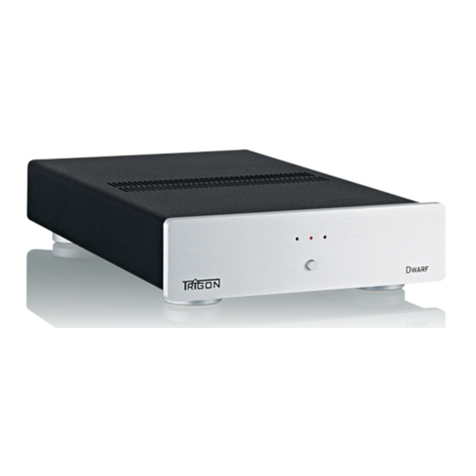
Trigon Elektronik Dwarf User manual

Trigon Elektronik

Trigon Elektronik Dwarf User manual

Popular Amplifier manuals by other brands

ASTRO HVO V40 P operating manual

ASTRO

ASTRO HVO V40 P operating manual

Marantz SUPERSCOPE BLA-545 Service data

Marantz

Marantz SUPERSCOPE BLA-545 Service data

NAD CI980 Quick setup guide

NAD

NAD CI980 Quick setup guide

Technics SE-CH770 Service manual

Technics

Technics SE-CH770 Service manual

Harman Kardon HK6300 instruction manual

Harman Kardon

Harman Kardon HK6300 instruction manual

NAD T975 owner's manual

NAD

NAD T975 owner's manual

McIntosh MA6850 Brochure & specs

McIntosh

McIntosh MA6850 Brochure & specs

Electro-Harmonix ENGLISH MUFF’N manual

Electro-Harmonix

Electro-Harmonix ENGLISH MUFF’N manual

Viatron Autrix Technical manual

Viatron

Viatron Autrix Technical manual

GME GA9800 instruction manual

GME

GME GA9800 instruction manual

Atlas CP700 Specification sheet

Atlas

Atlas CP700 Specification sheet

Roland KC-1000 owner's manual

Roland

Roland KC-1000 owner's manual

Pyle PFMRA350BW user manual

Pyle

Pyle PFMRA350BW user manual

Advantage S-250 manual

Advantage

Advantage S-250 manual

IRT Electronics DVA-3007 manual

IRT Electronics

IRT Electronics DVA-3007 manual

Dimavery BA-100 Series user manual

Dimavery

Dimavery BA-100 Series user manual

Sony XM-S400D operating instructions

Sony

Sony XM-S400D operating instructions

Schertler ROY X quick guide

Schertler

Schertler ROY X quick guide

manuals.online logo
manuals.online logoBrands
  • About & Mission
  • Contact us
  • Privacy Policy
  • Terms and Conditions

Copyright 2025 Manuals.Online. All Rights Reserved.

1
OPERATING INSTRUCTIONS
FOR PHONO AMPLIFIER
Advance
2
Analogic
Even more than two decades ago, so the propagandists of the new medium Compact Disc
wanted it, the record had retired. The number of sold records removed from year to year,
those of the CD’s increased, until apparently now eternally of yesterday ones and the
nostalgic people at unexplainable expenditure maintained and supplemented their record
collections and had still no CD player. Yes, in addition maintained they their record player
makes more music... and harvested a pitiful smile.
But parallel to this development remarkable happens - and the smiled at record lover and
convinced analogue fan formulated not without sneers:
“The claiming already in the year 1980 perfect CD player is constantly improved and to the
yardstick of this striving the music rendition becomes similar good analogue record player but
not only this. At public demonstrations once CDs were thrown in the surprised public for the
demonstration of the insensitivity by Compact Discs then today the realization made itself
broad that they want to be treated just as carefully as records, even more, demagnetised,
frozen, painted or ground and with coatings provides to sound only correct to be supposed. A
similarity or an agreement with living disk washing machines, pucks, disk platelayers and
needle cleaners is purely coincidental and not intended.
If the first CD Player made music apparently still in each situation in life and on each
underground perfectly, then its descendants received beside constantly improved
digital/analogue transducers always more complex housings, damping and, a beggar who
thinks bad thereby, sub chassis drives or belt drives.
Almost exorbitantly expensive CD drive assemblies with separate digital/analogue
transducers recruit for itself with the statement, now, finally, in such a way to sound like the
best record players. But the uneasiness, which in-crept in things CD in the course of the
years, seems remained. New digital formats, like SACD and DVD, urge on the market and
are to now reach, what was already promised twenty years ago: “SACD has a transmission
range as large up to 64 times as the CD. Thus results a refinement of the signal, which
corresponds to analogue technique. (dpa/dwe, 14.11.2001)
We consider the evaluation of memory procedures, which work with data reduction, before
this background simply renounce able. Rational at this newest stage of the development of
digital music storage media, which increases not the transmission range, but the scanning
rate, is the insight that people had underestimated substantially the quantity and quality of
musical information from the record groove, once again the new wasn’t even the. In the age
of the permanent announcement of technical sensations and revolutions we form an analogy:
High End Audio won’t invent each month again. Persistent, consistent advancement and
innovation in smaller and larger steps, which is relevant before the introduction on the
market, define High End for us at the last state of things.
What now? Sell all CDs as once unfortunately, the record collection? Perhaps the view
continues to help that tone carriers and their artful packing are more than only technical,
exchangeable canned goods. The speech is about cultural properties and time documents,
which are not to be excluded straight from the individual Biography. In this regard the record
already furnished the proof of their, also technical, longevity as canned goods, that of the CD
isn’t done yet. There it is nevertheless reassuring that in the year 2001 the number of the
sold records doubled itself to more than in relation to the previous year. (dpa/dwe,
14.11.2001).
The latter makes at the same time hope for a further creative next to each other, which we,
apart from the conservative aspect, agree with. Because like the attempt of the CD to be
finally records heir had lead to ever better CD-players, without which already in view of the
existing software only few can to do and want seriously, then the competition of the new
medium has the similar record rendering again accelerated and on, at the gloss times of the
old tone carrier,

3
a probably non-existing level elevated. Never before there were as good drive assemblies,
tone arms and pick-up systems as today. Oh, and phono amplifiers with which we would be
finite with the topic.
How little has to do the complex task of an equalizer pre amplifier with pure opinion, you’ll be
told in the next chapter. Who doesn’t want to know it so exactly first, may skip this chapter,
but only this, to find out, how the Advance wants to be up and adjusted, attached, served and
treated, thereby it can helps to transform the high-quality, but sensitive phono signals of your
records in the best possible way into music and to thank you itself in our name for your
investment.
Little phono technology and technical description of the Advance
With the Advance concerns it a phono pre amplifier for the equalization and reinforcement of
signal voltage coming from a record player.
Signal voltage coming from a pick-up system is unfortunately not as with CD-players or other
audio devices over the shown frequency range linear, but contained with 20 cycles per
second approx. 1000 time smaller signal than with 20 kHz. Without equalization the music
would therefore sound itself extremely full of high tones.
The task of the phono amplifier or better said the equalizer pre amplifier is it now to produce
a linear audio signal from this bent rendition characteristic, i.e. with all shown frequencies
equivalent loud.
Thus however not enough, the signals of the pick-up systems are also still very weak (or
quietly), so that a relatively high reinforcement is needed to raise the audio signal to the
level, which is usually available with all other audio sources (except microphones). With MC
pick-ups the task of the equalizer pre amplifier is more fastidious, because the output voltage
of these systems is usually lower even again around the factor 10 (i.e. 20dB) than with MM
pick-ups.
Furthermore the different pick-up systems need also another appropriate feed impedance,
which can be adapted individually for each pick-up, to be able to unfold their qualities
complete.
The demands, which are made against a phono amplifier, therefore are:
1. Exact equalization of the input signal
2. High, adjustable reinforcement
3. Individual adjustment of the feed impedance
The first task, exact equalization of the input signal, can be mastered only if you use
highly exact construction units in the equalizer part of the phono amplifier. Therefore we
measure each construction unit for this stage with highly precise measuring instruments. The
values of the assigned construction units are selected here on a deviation from less than 1%!
Identical pairs of construction units are always formed for the two stereo channels, to exclude
channel inequalities. In this way the Advance produces an almost perfectly linear output
voltage.
The second task, high, adjustable reinforcement, represents a problem of completely
different kind. High reinforcement of the information signal means at the same time also high
reinforcement of spurious signals. The main spurious signal is thereby the noise. This
problem can be solved only satisfyingly with very efficient and at the same time low-noise
amplifier stages. In the Advance we use highly exact operation amplifiers, which besides
exhibit extremely small distortion values.
The other spurious signal, which leads to problems in phono amplifiers again and again, is
the so-called humming. This humming has usually three causes: Stray effect through nearby
mains transformers, careless supply voltage and incorrect printed circuit board design.
4
Over to avoid the stray effects by the mains transformer the power pack of the Advance is
accommodated in a separate housing and so it can be set up in some distance to the set.
A special power pack circuit supplies the sensitive amplifier circuit with filtered direct current.
In order to however completely exclude net influences, is besides a lead gel accumulator
inserted, which (alternatively switch able) supplies the Advance also without power pack
support with (principle-caused) really clean direct current.
The printed circuit board design is characterised among other things by a special star shaped
arrangement of the pig pus courses, so that humming signals cannot disturb the sensitive
amplifier stages.
The reinforcement can be adjusted individually in 16 stages by small mini switches, which
are attached on the lower surface of the set. With the help of that table indicated far down
you could make the correct attitude for the respective pick-up system there.
The third task, individual adjustment of the feed impedance, can be settled with the
Advance by a mini switch on the lower surface of the set. Here are six different adjustment
resistances and this means 64 combinations are for the adjustment of one MC pick-up and 2
capacities, so there are four combinations for the adjustment of a MM pick-up at the disposal.
Information about all combinations gives a table indicated far down.
You recognize already by the larger number of possibilities of adaptation of a MC pick-up
that the Advance treats MC pick-ups preferentially. The reason lies in the fact that the
majority of the offered High-end pick-up systems are nowadays of the type MC.
If the case should arise that no suitable combination can be found, then in the inside of the
Advance is a plug-in socket for each channel, into which the suitable value can be put. There
could be put in a resistance (for MC) or a condenser (for MM) depending on whether type of
pick-up. In this way it’s ensured that every adjustment can be manufactured which is needed
in practice.
Because the Advance is a separate phono amplifier that is connected with the pre- rather full
amplifier via link cable, there are also placed high requirements to the output stages of the
amplifier. Here we have decided us for an output stage, which makes a sufficiently small
output resistance available, so that also cables of more than 2m lengths can be attached.
This makes it possible to set up the Advance in direct proximity of the record player and to
keep so the cable length between record players and Advance very small. This is of
importance, because short cables can to minimize transducer losses and offer at the same
time external influences less attack region, so that the anyway very susceptible, low signal of
the pick-up is impaired as little as possible.
5
The operation and wiring
The following picture shows front and back of the Advance.
1
2 3 4 5 6 7 8
58,5
200
1.Operating key and control lamps
With the tracer (1) the Advance can be switched on and off, but in addition it can be switched
between the two operating modes, pure accumulator mode or combined accumulator - line
operation.
A short depressing the key switches the Advance on. Each further short depressing the key
switches between the operating modes. To switch off the Advance, the key must to be kept
pressed approx. 2 seconds. The operating conditions are indicated in each case by the light
emitting diodes over the tracer.
The control lamps signal thereby the following conditions:
No LED shines for - The set is out. The power pack supplied however the charger
automatic controller for the accumulators and the accumulators are loaded.
The red LED shines for - The set is switched on and works in the combined accumulator -
line operation. If the Advance is switched on, flashes the red LED several times before it
constantly lights up and the signal at the exit is connected through. If no power pack is
attached, then the green LED flashes and the set starts in the pure accumulator mode.
The red and the yellow LED shine for - The set runs in the combined accumulator - line
operation and the yellow LED signalled additionally that the accumulator is fully loaded.
6
The green LED shines for - The set runs in pure accumulator mode. The power pack
supplies only control electronics and the announcement LED's. If the accumulator is fully
loaded, you can hear music in pure accumulator mode for approx. 6 hours.
If the power pack is separated from electricity mains in the pure accumulator mode, then the
accumulator must supply the control electronics and the announcement LED's, too, which
leads to a reduction of time of operation in this mode. Therefore leave the power pack always
at the net.
The green LED flashes - The accumulator is now so far unloaded that it should be loaded
now again. Please switch back again to the combined accumulator - line operation, by
pressing the key 1 once briefly.
The red and the green LED shine for –You switched from the pure accumulator mode to
the combined accumulator - line operation, but the separate power pack is not put in or
connected with the lighting system.
As soon as you connect the power pack again duly with the Advance rather insert the mains
plug into the wall socket, the green LED switches off and only the red LED shines alone, i.e.
it is restarted the combined enterprise.
2. Accumulator switch
With this key it is possible to separate the accumulator electrically from the set. This function
is important, if the Advance isn’t to be operated at electricity mains for longer time, e.g.
during transport or during the vacation period. Thus is avoiding an inadmissible over-
discharging of the accumulators.
Importantly!!! If the Advance were connected neither at the mains nor with the accumulator
(accumulator key was switched to OFF without attached power pack), then the separate
power pack must with renewed start-up at least for some seconds for river supply the
Advance, so that the set can be switched on. From this the accumulator key must be
switched naturally to ON. If the accumulator was fully loaded, there isn’t an obstacle for you
to enjoy now approx. 6 hours pure accumulator mode. Although we do not recommend it, it is
now again possible to separate the power pack from the mains. However, the run of the
accumulator shortens accordingly, because now the control electronics and the LED's are
supplied with river by the accumulator.
3. Line Out - right channel
The output signal of the right channel rests at this socket. Connect this exit with a high level
or a line entrance of your pre/full amplifier. Frequently such entrances are designated with
AUX. In addition, the CD- or TAPE- entrance of the pre/full amplifier can be used usually.
4. Line In - right channel
At this socket the right channel of the record player (pick-up) is attached. With the mini
switches at the ground the feed impedance can be indicated adjusted, like in the table 1.
5. Power pack entrance socket
To this socket the ground power pack belonging to the scope of supply is attached.
Therefore you use the likewise cable connection which is attached.
Make first the connection between power pack and Advance, before you connect the
power pack with the lighting system. Thus it is guaranteed that it comes to no inadvertent
short-circuits at the exit of the power pack. If the accumulator key (2) should stand still on
OFF, switch it now to ON please.
7
Consider please! - The mains cable has a 9-ending D-sub-plug on both sides like they are
to be found in the computer engineering frequently, too. Make sure however that you never
operate this cable with and at a computer. Never connect the power pack or the Advance
with the computer by this socket because then both sets will take damage.
6. Line In- left channel
It applies the same as described under 4, only to the left channel.
7. Line Out - left channel
It applies the same as described under 3, only to the left channel.
8. Ground (ground terminal)
At this clamp the grounding- rather earth-cable, which is usually led out separately at record
players, is attached. In most cases is at these grounding electrodes a fork-putting shoe. To
be able to attach this fork, you untwist the knurled thumbscrew of the ground terminal a little
and wedge then the fork through closing the knurled thumbscrew. Simple stripped cable
ends can be also attached by solving, after that they were put into the lateral drilling of the
knurled thumbscrew and then likewise again with the knurled thumbscrew clamped.
View of the ground with the mini switches for the reinforcement (9) and the feed impedance
adjustment (10)
R
L
910
8
9. Mini switch for the gain setting
With these switches for each channel the reinforcement is adjusted separately. For the
attitude you use the following table as guideline assistance.
Table of the switching positions for the gain setting
With the four-fold mini switch for each stereo channel on the lower surface of the Advance
the reinforcement can be adjusted separated.
As this table shows, the reinforcement between 35,7 dB and 60,2 dB can be adjusted in 16
stages.
S4
S3
S2
S1
Reinforcement
in dB
For systems
with
The following
Output voltages
0
0
0
0
35.7
8mV
0
0
0
1
41.5
4mV
0
0
1
0
45.3
2.7mV
0
0
1
1
47.6
2mV
0
1
0
0
48.8
1.8mV
0
1
0
1
50.4
1.5mV
0
1
1
0
51.9
1.2mV
0
1
1
1
53.2
1.1mV
1
0
0
0
56.0
0.8mV
1
0
0
1
56.8
0.7mV
1
0
1
0
57.6
0.64mV
1
0
1
1
58.2
0.59mV
1
1
0
0
58.6
0.58mV
1
1
0
1
59.1
0.54mV
1
1
1
0
59.8
0.51mV
1
1
1
1
60.2
0.5mV
If you do not find the exact value of the output voltage of your pick-up in this table, you could
select the value, which comes next to your pick-up.
You reach in each case with the in the preceding table given attitudes a DIN-Output voltage
of 500 mV. It’s depended from the entrance sensitivity and reinforcement of your pre or full
amplifier you need often only a clearly smaller output voltage to achieve the desired hearing
volume. You should experiment in this regard because a lower reinforcement can be tonal
more favourable.
Louder systems (output voltage more largely 8 mV) can be naturally also attached, however
thereby the over-regulation reserve is reduced, i.e. it can come to the over-regulation of the
amplifier, which expresses itself by higher distortions.
Quieter pick-ups (output voltage of small 0.5 mV) can be operated accordingly problem-free.
Frequently, pick-up manufacturer indicates the output voltage of their systems in the e.g.
following way.
9
Output voltage = 2.5 mV with 4.36 cm/s
The standardized output voltage refers usually however to a reference fast of 5.6 cm/s. In our case
therefore the output voltage results to:
Output voltage =
Thus results an output voltage of approx. 3.2 mV, i.e. you should set switch 1 with the mini
switches for the reinforcement to ON.
10. Mini switch for the feed impedance
These switches are adjusted separately for each channel the feed impedance. For the
attitude you use the following tables 1.1 and 1.2 as guideline assistance.
Table 1.1 of the switching positions for the entrance capacity
Adjustment capacities can be connected to magnetic systems by depressing the switches S1
and S2. S3 to S8 are switched off with MM systems, since MM systems are usually operated
at input impedance by 47KOhm.
S1
S2
S3
S4
S5
S6
S7
S8
Entrance capacity
Input impedance
in ohm
0
1
0
0
0
0
0
0
47pF
47000,0
1
0
0
0
0
0
0
0
100pF
47000,0
1
1
0
0
0
0
0
0
147pF
47000,0
The entrance capacity without connected capacity amounts to approx. 60 - 100pF with the
Advance.
Each capacity, which is connected, must be added to this entrance capacity. The cable
capacitance of the cable connections between record players and preamplifiers must be
added, too. Furthermore the cable capacitance of the cable in the tone arm pipe adds itself.
In this way do values of more than 200pF - 300pF often already come without auxiliary
capacities.
To be noted it should, however, that deviations by the pick-up manufacturer recommended of
the adjustment capacity, in the order of magnitude of 20 - 30 % are acceptable, since during
the production of pick-ups frequently similar tolerances develop.
10
Table 1.2 of the switching positions for the input impedances
100p 47p 1800 1000 470 220 100 47
S1 S2 S3 S4 S5 S6 S7 S8.. input impedance computes
A 1 means: Switch posed on position ON
A 0 means: Switch not switched.