1Before Installing - the basics
Hot air rises from stoves and radiators, forming a layer of
warm air close to the ceiling. This layer of warm air can
extend far away from the source of heat. Hot-Tubes
work by bringing that warmer air down to floor level.
Warm air distribution is improved, and less heat is lost
through your ceiling or roof.
2 Prepare your home
First, eliminate drafts from leaky windows and doors.
Even a good heating system is challenged by a drafty
house. With a few minutes and less than $10 you can
minimize cold drafts using window caulking cord and
door weather stripping from the hardware store. This
can be done even in the dead of winter, and can make a
big difference - improving comfort and significantly
lowering heating costs.
Second, install a digital thermostat with timer on your
gas heating stove and anywhere you have typical old
style mercury thermostats. Set them to a lower the temp
at night and to bring the heat back up before you wake.
3 Decide where to install
a) Central heat, with gas or wood stove. In up to a
moderately sized room with a stove, it’s probably best to
place the Hot-Tube by the wall furthest from the stove,
and direct the air deflector back towards the heat source.
Alternatively, direct the air deflector towards a well used
seating area.
b) Forced hot air / baseboard heating / radiators.
Same as above, but you may to experiment more to find
the best spot. A small thermometer held near the ceiling
can help make your decision.
c) Heating a nearby room. In the room where the heat
source is located, place the Hot-Tube near the doorwary
and direct the vent through the doorway and into the
adjacent room. Keep in mind Hot-Tubes don’t work
quickly. In the morning it might be necessary to rely on
central heat first, at least until the living space becomes
comfortable.
4 Installation and Operation
a) Select a safe, effective location within reach of an
outlet.If you are not sure the ceiling area is free from
pipes and electrical wiring, consult a professional
b) Work safely. Make sure area is clear and use a
stable chair or short ladder to safely reach the ceiling.
Always have an assistant support you and hand you
what you need while working on a ladder.
b) Insert included hook into the ceiling. Pre-drill a
hole in ceiling prior to installing the hook screw. For best
results, bottom of hook should be no more than 1 inch or
so from the ceiling.
c) Attach foam dust filter (if included) between the
lines at the top of the Hot-Tube.The filter must extend
beyond the rim of the inner core, and rest on top.
Inspect and replace filter as needed.
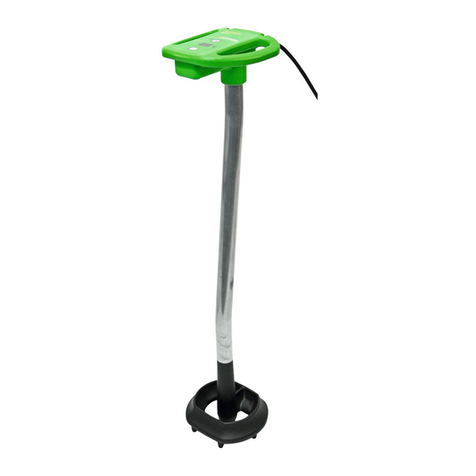
d) Make sure bottom deflector opening faces desired
direction. The power cord should be placed in one of
the notches found in the retaining rim of the deflector.
e) Turning on the Hot-Tube.
Plugging the power adapter into the wall and the barrel
plug of the cord into the socket at the bottom of the lower
disk starts the fan immediately. If your version has a
switch, press it once to speed up or slow down the fan.
On the inside of the air deflector a thermometer strip (if
included) shows the temperature. Many people will not
perceive vented air as warm if it’s less than 70 degrees.
f) Turning off the Hot-Tube.
To shut off the Hot-Tube unplug the DC connector from
the Hot-Tube or the DC power supply from the AC outlet.
Running a Hot-Tube 24/7 costs only pennies each
month, so leaving them running constantly during the
winter is recommended. For safety and efficiency,
unplug the Hot-Tube if the room will be unoccupied for
more than 24 hours.
5
Can I plug the Hot-Tube into a timer? Yes.
Can I connect a thermostat? Yes but it’s not
recommended. It would only work if you were to place
the sensor at the heat source or the ceiling close to the
heat source.
How efficient is a Hot-Tube? Very. Hot-Tubes are
double walled for insulation and move warm air quickly
from the ceiling to the floor. In testing, air temperature at
the vent is within a degree of the air at the top of the Hot-
Tube. Using the formula for Sensible Heat, if the air
temperature near the lower vent is 65 F and 75 F at the
ceiling, approximately 10,000 BTU’s per day can be
moved downward per tube. In addition, by breaking up
the stratification of stagnant warm air at the ceiling and
lowering the overall rate of heat loss, overall room
comfort increases. Hot-Tubes use very little electricty.
Depending on the model, Hot-Tubes cost less than a
quarter to perhaps 50 cents a month to run 24/7.
6 Warranty Information
Hot-Tubes have a 1 year limited warranty. Should this
product not function properly under normal use within 1
year of your purchase, contact Hot-Tubes for return
information. Hot-Tubes alone will determine if the
problem is due to a manufacturing defect. If so, Hot-
Tubes will repair or replace the unit at its discretion and
return it to you free of charge. This warranty does not
cover damage or failure caused by normal wear, misuse,
negligence, or accidents. This warranty applies only to
the original purchaser - proof of purchase is required.
All implied warranties required under law are limited to
one year. Hot-Tubes shall not be liable for any incidental
or consequential damages whatsoever. This warranty
gives you specific legal rights. You may also have other
rights that vary from state to state. Some states do not
allow the exclusion or limitation of incidental or
consequential damages, or limitation or exclusion of
implied warranties, so the above exclusions or
limitations may not apply to you.