9
OVERVIEW
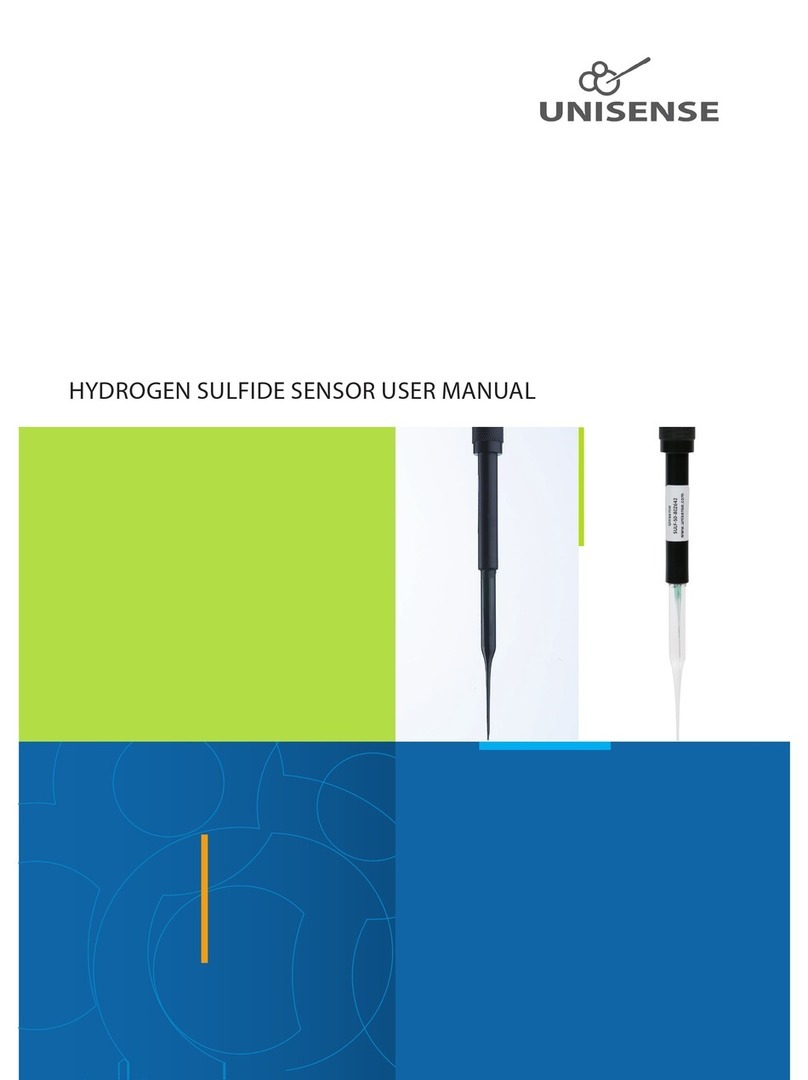
The Unisense hydrogen microsensor is designed for research
applications within physiology, biotechnology, environmental sci-
ences, and related areas.
With the minute tip size, excellent response time, and good sen-
sitivity the Unisense hydrogen sensor facilitates reliable and fast
measurements with a high spatial resolution.
The Unisense hydrogen microsensor is a miniaturized Clark-type
hydrogen sensor with an internal reference electrode and a
sensing anode. The sensor must be connected to a high-sensitivity
picoammeter where the anode is polarized against the internal
reference. Driven by the external partial pressure, hydrogen from
the environment will pass through the sensor tip membrane and
will be oxidized at the platinum anode surface. The picoammeter
converts the resulting oxidation current to a signal.
THIS MANUAL COVERS THE UNI-
SENSE HYDROGEN MICROSENSORS
H210 (tip diameter <20 µm)
H225 (tip diameter 20-30µm)
H250 (tip diameter 40-60µm)
H2100 (tip diameter 90-110µm)
H2500 (tip diameter ~500µm)
H2-MR (for use with microrespiration
chambers MR-Ch)
H2-N (Needle type sensor)
H2-spec - Customer specified.
Schematic view of a hydrogen sensor with a LEMO plug.
Sensor tip
LEMO plug
IMPORTANT
Unisense sensors
are neither
intended nor
approved for use in
humans