User Manual - English
V. Brøndum A/S RONDA®2800H Page 8
2.3 Safety Precautions / Disposal.
This appliance is not intended for use by persons (including children) with reduced physical, sensory or mental
capabilities, or lack of experience and knowledge, unless they have been given supervision or instruction
concerning use of the appliance by a person responsible for their safety.
Children should be supervised to ensure that they do not play with the appliance.
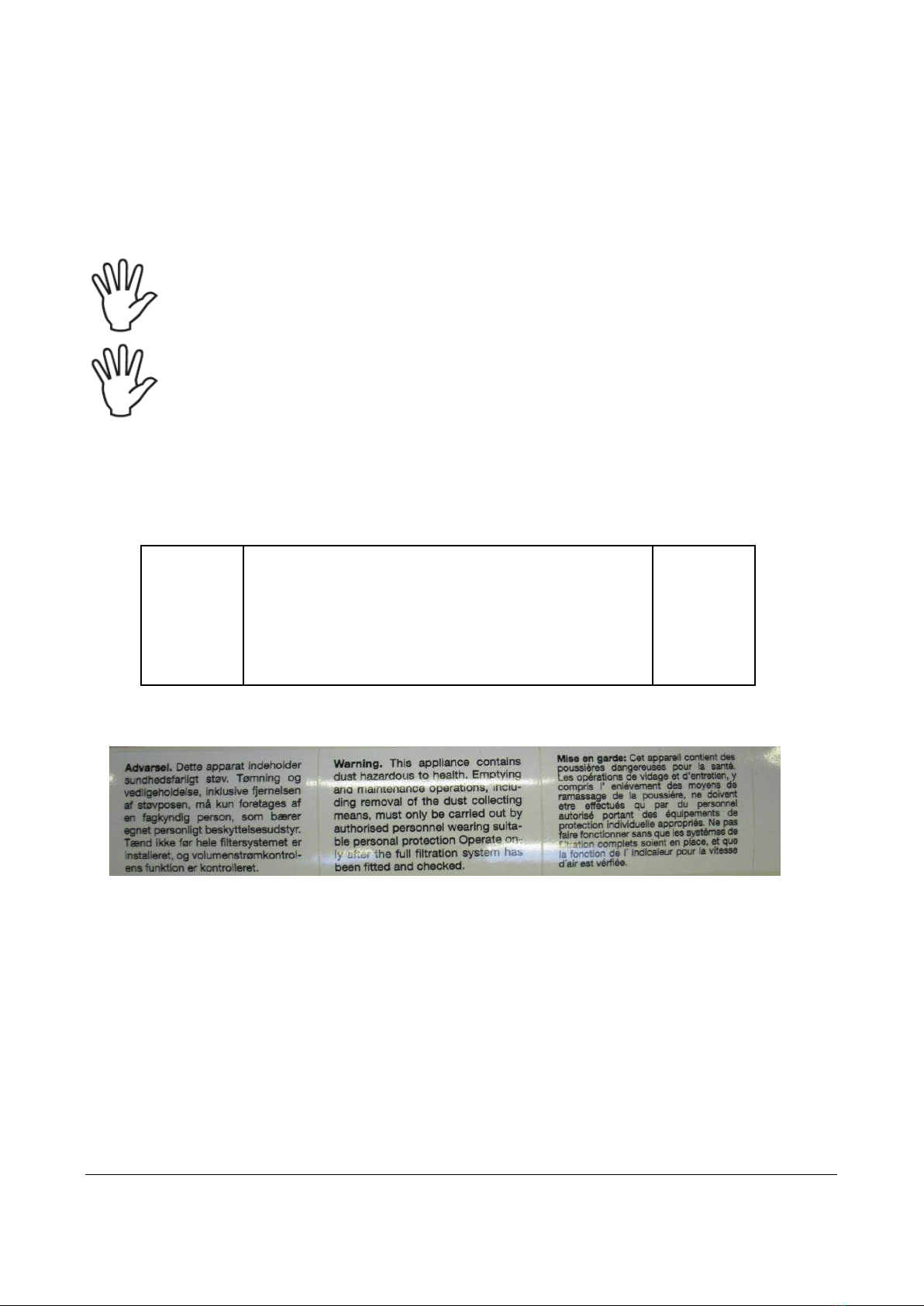
The vacuum cleaner is NOT approved for collection of flammable, explosive, poisonous or extremely
health hazardous dust, fluids or gasses.
RONDA2800H can be used for collection of dust hazardous to health according to CEI/IEC 60335-2-69
Annex AA, dust class H.
The user must ensure that the vacuum cleaner is adjusted to the task and that regulatory requirements
are met.
When collecting dust hazardous to health you must use a filter bag and a plastic sack for dust-free
emptying.
Avoid damaging the supply cord. When replacing the supply cord, only use an original supply cord (see
the spare parts list). V. BRØNDUM A/S, an authorized V. BRØNDUM A/S dealer or an equally qualified
person must carry out the replacement in order to avoid danger. Regularly check the mains connection for
damage, such as fissures or ageing. If damage is found, the supply cord must be replaced before further
use.
The vacuum cleaner must be connected to the mains voltage with a reliably operating grounding (HFI or
HPFI circuit breaker).
The plug must be removed from the power supply before any repair or maintenance operations –also
cleaning.
RONDA2800H must be connected to 230 V power supply. Make sure that the voltage and safety fuse of
the power supply correspond with the data of the data plate and the information given in this manual.
The mains socket of the vacuum cleaner is to be used only for the purposes specified in this user manual.
In addition to the use as an industrial vacuum cleaner, this machine is also suitable for commercial use,
e.g. in hotels, schools, hospitals, factories, shops, offices and rental businesses.
Before use the operators should be provided with information, instruction and training for the use of the
appliance and the substances for which it is to be used, including the safe method of removal and
disposal of the material collected.
For user servicing, the appliance must be dismantled, cleaned and serviced, as far as is reasonably
practicable, without causing risk to the maintenance staff and others. Suitable precautions include
decontamination before dismantling, provision for local filtered exhaust ventilation where the appliance is
dismantled, cleaning of the maintenance area and suitable personal protection.
In the case of class H appliances the outside of the appliance should be decontaminated by vacuum
cleaning methods and wiped clean or treated with sealant before being taken out of a hazardous area. All
the appliance parts shall be regarded as contaminated when removed from the hazardous area and
appropriate action taken to prevent dust dispersal.
The manufacturer, or an instructed person, shall perform a technical inspection at least annually,
consisting of, for example, inspection of filters for damage, air tightness of the appliance and proper
function of the control mechanism. On class H appliances the appliance filtration efficiency should be
tested at least annually, or more often, according to national requirements. The test method that may be
used for the verification of the appliance filtration efficiency is given in AA.22.201.2. If the test will not be
passed, it must be repeated with a new essential filter.