Caution and Usage Tips
ALWAYS use Tester with vehicle engine turned <OFF>.
Use this equipment in the manner specified by the manufacturer.
Follow common sense safety precautions.
Connect Tester’s black cable to chassis ground.
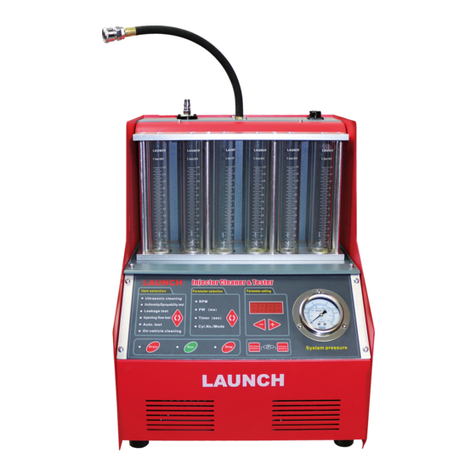
Use UltraTraceUV® Smoke Solution No. P0712UV in Tester. Using a non-approved
solution can cause damage to vehicles being tested and may cause personal injury.
Do not leave Tester’s hose or power cables connected to the vehicle if tests are not
being performed.
Do not perform test near source of spark or ignition.
Wear appropriate eye protection.
Wear yellow glasses supplied when using ultraviolet light.
Air or gas pressure supplied to Tester can be 50 to 150 PSI (3.4 to 10.3 bar).
Connect Tester to compressed air for general purpose leak detection applications.
Connect Tester to inert gas, such as nitrogen, when testing fuel vapor (EVAP) system.
Note: DO NOT use workshop air for EVAP testing. Adding oxygen to the fuel vapor
space can create a flammable mixture in the fuel tank.
When using alternate source of UV light, use light that includes 405 nanometer (nm)
UV light range.
The more time smoke is allowed to exit a leak, the more dye will be deposited at that
leak location.
When operating the Tester in near freezing temperatures, cycle the operation of the
Tester 15 seconds <ON> and 15 seconds <OFF> for approximately the first minute or
two of operation. This will allow the Tester to reach optimum operating
temperature.
When testing an engine's intake or exhaust system for leaks, it is best if the engine is
cold. Small leaks may be sealed due to thermal expansion.
When testing a closed system, such as the EVAP system, it is best to purge the ‘non-
smoke’ air out of the system by leaving an opening in the system being filled. Close
the system once smoke exits and continue to fill with smoke. This quickly fills the
system with smoke.