Vescent SLICE-QTC User manual

2022/04/17 01:59 1/10 SLICE-QTC Four-Channel Temperature Controller Quick Start Guide
Product Manuals - https://vescent.com/manuals/
SLICE-QT Four-Channel Temperature
Controller Quick Start Guide
Model No. SLICE-QT
Document Revision: 1
Document Last Updated on 2021/08/26 14:26
Please read Limited Warranty and General Warnings and Cautions prior to operating the SLICE-QT.
SLICE-QT web page.
Description
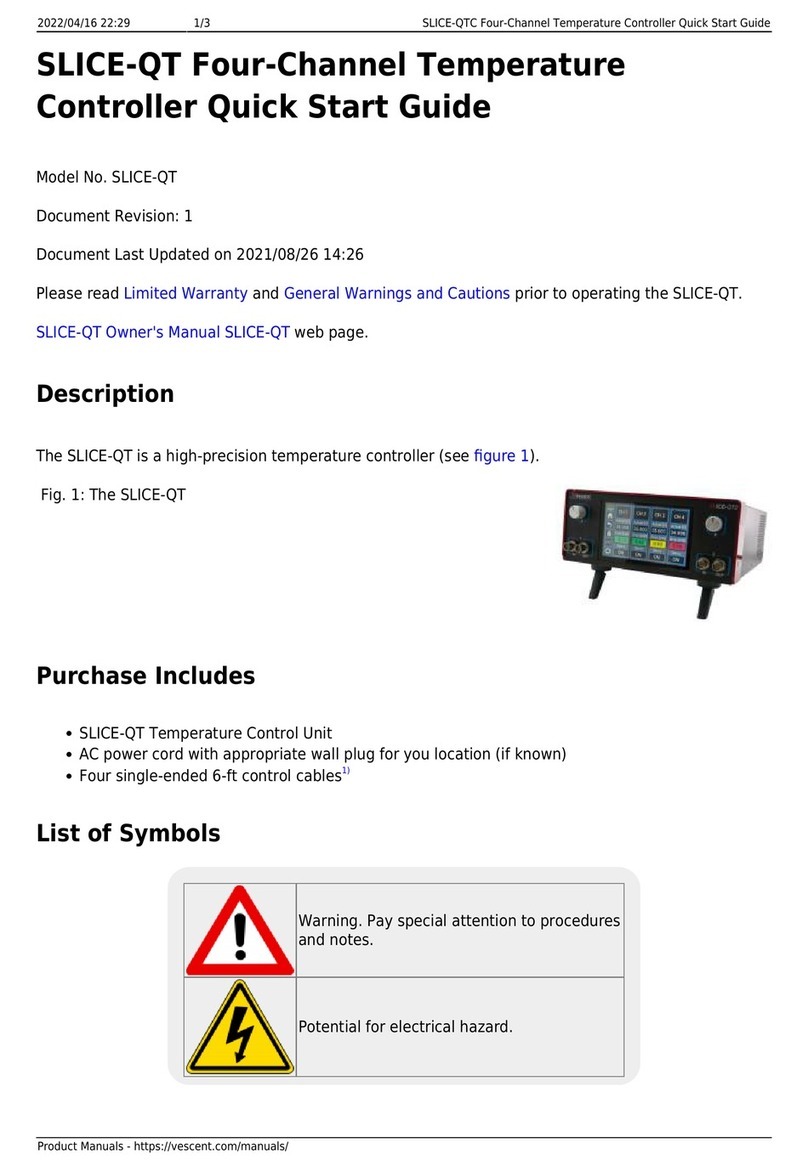
The SLICE-QT is a high-precision temperature controller (see figure 1).
Fig. 1: The SLICE-QT
Purchase Includes
SLICE-QT Temperature Control Unit
AC power cord with appropriate wall plug for you location (if known)
Four single-ended 6-ft control cables1)
List of Symbols
Do not have servo loop engaged when
connecting Servo Output to your plant.
Getting Started
Value Units

Last update: 2021/08/26 14:26 slice:quick_start_qt https://vescent.com/manuals/doku.php?id=slice:quick_start_qt&rev=1544480837
https://vescent.com/manuals/ Printed on 2022/04/17 01:59
90-250 VAC
50-60 Hz
Tab. 2: Input Voltage Range
Using table 1, make connections from the SLICE-QT and your thermal plant via the cables1.
supplied by Vescent. Ensure the shield of the cable is well grounded.
Use the supplied AC power cord to provide power to the SLICE-QT. The power converter inside2.
the unit will accept any line voltage within the range in table 2.
Turn on the SLICE-QT with the power switch on the back of the unit located near the power3.
entry module.
Touch the Channel Label Icon for the channel you intend to use to enter the Channel Details4.
screen.
Touch the Setpoint Temperature Icon to enter in the desired set point temperature.5.
Touch Settings > Limits6.
Set the absolute minimum and absolute maximum temperature allowed for your plant.1.
Touch Settings > PID7.
Set the PID parameters for your plant1.
Touch each window to set the given parameter1.
We recommend the Ziegler-Nichols method of setting your PID parameters2)
2.
Touch the OFF icon to engage the temperature servo8.
Monitor on the performance screen to ensure system settles9.
Front Panel
Rear Panel
Interface Connections
Connections to the thermal plants are made from the rear panel. Four cables are provided with the
SLICE-QT. Each has one end terminated with a CUI Inc. PDP-40 connector for connecting to the SLICE-
QT. The other end is unterminated and is for connecting to your specific plant. The pin out for
connecting the cable Beldon 1502R 010500 to your specific plant is given in table 1.
Connector
Pin Number Color Function AWG
1 Red TEC+ 18
2 Black TEC- 18
3 White RTH+ 22
4 Blue RTH- 22
Metal Sleeve Drain Wire 24
Tab. 1: Cable pinout
You may purchase more cables separately from Vescent Photonics. We do not recommend making
cables, but if you do so, make sure the metal sleeve is well grounded to provide proper shielding to
the signal cables.

2022/04/17 01:59 3/10 SLICE-QTC Four-Channel Temperature Controller Quick Start Guide
Product Manuals - https://vescent.com/manuals/
User Interface
General Concepts
The touch screen interface and the Host GUI operate in a substantially similar way, except touch is
substituted for a click in the touch screen interface.
Screen Navigation
When presented with a given view, it is possible to select the functionality or change the values in a
field bordered in blue. When a particular field is actively being edited, its border will be yellow. The
Home Screen of the SLICE-QT is shown in figure ##. Summary control over the four channels is
possible from the Home Screen, such as setting Tset, initiating lock, or entering an individual channel's
Detail Screen.
Fig. ##: Home screen of SLICE-QT
Home Button
Fig. ##: Home button Returns to Home Screen (figure ##).
Back Button
Fig. ##: Back button Returns to previous screen. Changes will be lost if not accepted
before going back.

Last update: 2021/08/26 14:26 slice:quick_start_qt https://vescent.com/manuals/doku.php?id=slice:quick_start_qt&rev=1544480837
https://vescent.com/manuals/ Printed on 2022/04/17 01:59
Lock Button
Fig. ##: Lock button (shown in unlocked mode) Locks out further modification of
parameters. Touch to unlock. It is still possible to engage the temperature control loops when system
is locked.
I/O Button
Fig. ##: I/O button Enters the screen for programming the front-panel I/O.
System Settings Button
Fig. ##: System settings button Enters screen for system control settings (brightness,
volume, etc.).
Entering Values
In most instances, there are two methods for entering parameter values.
Keypad
If you touch and hold an editable field such as the set point temperature, a numeric keypad will
appear. You can enter in the full value of the desired parameter with this keypad.
Rotary Knobs
If you touch for a brief moment an editable field, a cursor will appear under one of the digits of the
parameter value. Turning the right knob, it is possible to increase (cw) or decrease (ccw) the value of
the underlined digit. Turning the left knob will change which digit is editable (cw to move to the left
and ccw to move to the right).

2022/04/17 01:59 5/10 SLICE-QTC Four-Channel Temperature Controller Quick Start Guide
Product Manuals - https://vescent.com/manuals/
Home Screen
The Home screen gives a summary of the status of all four channels (figure ##). The data for each
channel is arranged vertically. At a glance, for each channel, Tset, Tact, and ∆T can be read, as well as
whether control is engaged. If the loop is engaged and ∆T is smaller than a user-defined range, the
Error value field will be green. If ∆T is outside this user-defined range, this field will turn yellow.
Setting the Temperature
To set the temperature set point from the home screen, touch the Setpoint window for the desired
channel (circled in red for CH 1 in figure ##). A long touch will cause a keypad will appear. Enter
desired value and touch the accept button.
A short touch will highlight the Setpoint window in yellow (figure ##). Use rotary knobs to select digit
to edit and value for digit.
Fig. ##: Select Temperature setpoint for CH 1
Fig. ##: Knob adjustment of Temperature setpoint for CH 1
Enabling Feedback

Last update: 2021/08/26 14:26 slice:quick_start_qt https://vescent.com/manuals/doku.php?id=slice:quick_start_qt&rev=1544480837
https://vescent.com/manuals/ Printed on 2022/04/17 01:59
Touch the OFF button at the bottom of the column for the desired channel. The button will turn white
and read ON to indicate the channel is actively controlling the temperature. In figure ## and
figure ## CH 1 is active and CHs 2-4 are inactive.
Channel Detail Screen
You can set how individual channels behave in the Channel Detail screen. To enter a Channel Detail
screen from the Home screen, touch the CH button for the appropriate channel (figure ##). figure ##
shows the CH 1 Detail screen. From this screen, you can change Tset, and initiate temperature control
as from the Home screen. You can also visually monitor the performance of the loop. The graph in the
lower right of the screen displays ∆T (Tact - Tset) on a rolling basis. The yellow dashed lines indicate the
user-defined “lock range.” In figure ##, the lock range is set to ±3 mK. If ∆T is outside of this range,
the Error field will change from green to yellow.
You can also set the various parameters for how the loop will behave.
Fig. ##: Initial view of CH 1 Detail screen
Setting Control Modes
Touch the Settings button in the top right of the window. The sub-menu shown in figure ## will
appear.

2022/04/17 01:59 7/10 SLICE-QTC Four-Channel Temperature Controller Quick Start Guide
Product Manuals - https://vescent.com/manuals/
Fig. ##: Menu of settable parameters
Adjusting the Graph
To adjust the vertical range (∆T) of the graph from the Details screen, touch Settings > Y Scale. Select
the appropriate setting (figure ##).
Fig. ##: Setting the y-scale on ∆T vs. t graph
To adjust the time base of the graph from the Details screen, touch Settings > X Scale. Select the
appropriate setting.
Configuring Channel Settings
Channel Settings
PID Filter and Slew Rate Adjustment
Fig. ##: Screen for adjusting PID parameters for individual channel
To set the PID loop filter parameters from the Details screen, select Settings > PID Params and the

Last update: 2021/08/26 14:26 slice:quick_start_qt https://vescent.com/manuals/doku.php?id=slice:quick_start_qt&rev=1544480837
https://vescent.com/manuals/ Printed on 2022/04/17 01:59
screen in figure ## will appear. The parameters for the PID loop filter are set in this popup screen.
These parameters control the closed-loop behavior of the feedback. Each of these parameters will
need to be tuned specifically for your plant. There is an option to enable or disable each parameter in
the loop filter.
Setpoint ºC Sets the setpoint temperature of the plant.
Proportional V/V Sets the proportional gain of the loop filter.
Integral sec Sets the integral time constant of the loop filter.
Derivative sec Sets the derivative time constant of the loop filter.
Rate ºC/min Sets the slew rate limit for the plant temperature.
There are a number of methods to tune a loop. We recommend the Ziegler-Nichols method.3)
For applications where the rate of change of the temperature of the plant needs to be controlled, it is
possible to set an upper limit on the slew rate. This can also be done through the PID Params screen.
Note Make sure to turn the Slew Rate Limit off when changing use case!
Temperature Limits
The temperature limits for this channel are defined in this popup window.
Warning
Window ºC
Defines the nominal operating temperature range for the plant. When the actual
temperature is within this window (±value), the temperature will be displayed
on a green background. When the actual temperature is outside this window,
the temperature will be displayed on a yellow background.
Maximum
Temp ºC Sets the maximum and minimum operating temperatures of the plant. The user
will be prevented from adjusting the setpoint temperature to outside this range.
If the actual temperature exceeds this range, the temperature will be displayed
on a flashing red background.
Minimum Temp ºC
Power Limits
The User can limit the control power available to individual channels. To adjust control capacity from
the Channel Detail screen, select Settings > Load Limits and the screen shown in figure ## will
appear.

2022/04/17 01:59 9/10 SLICE-QTC Four-Channel Temperature Controller Quick Start Guide
Product Manuals - https://vescent.com/manuals/
Fig. ##: Screen for adjustment of control power capacity
Transducer and Thermistor
To set the properties of the transducer (TEC or heater) and thermistor for an individual channel, touch
CH 1 > Settings > Plant. The menu in figure ## will appear. Select TEC (as seen) or by touching TEC,
select Heater.
The thermistor has been configured at the factory for 10 kΩ at 25°C. You can enter a new Beta value,
reference temperature, and resistance value and the Steinhart-Hart constants will be calculated
automatically or vice versa.
Fig. ##: Set Thermistor and Plant Information
Maximum & Minimum Temperature, Lock Range
The maximum and minimum allowable temperatures (Tmax and Tmin) can be set as well as the range of
∆T where the system is considered to be locked. Tap Settings > and the screen in figure ## will
appear. In this example, the lock range is ±3 mK. If -3 mK ≤ ∆T ≤ +3 mK, ∆T will be displayed on a
green field. If outside this range, ∆T will be displayed on a yellow field.

Last update: 2021/08/26 14:26 slice:quick_start_qt https://vescent.com/manuals/doku.php?id=slice:quick_start_qt&rev=1544480837
https://vescent.com/manuals/ Printed on 2022/04/17 01:59
Fig. ##: Screen for setting absolute extrema and lock range
If your plant is exposed to the atmosphere, use an abundance of caution in setting
Tmin below the dew point for your ambient conditions!
Inputs & Outputs
Triggering
1)
More cables may be purchased separately
2)
A usable discussion of the Ziegler-Nichols method can be found here:
http://faculty.mercer.edu/jenkins_he/documents/TuningforPIDControllers.pdf
3)
A usable discussion of the Ziegler-Nichols method can be fond here:
http://faculty.mercer.edu/jenkins_he/documents/TuningforPIDControllers.pdf
From:
https://vescent.com/manuals/ - Product Manuals
Permanent link:
https://vescent.com/manuals/doku.php?id=slice:quick_start_qt&rev=1544480837
Last update: 2021/08/26 14:26
Other manuals for SLICE-QTC
1
This manual suits for next models
1
Table of contents
Other Vescent Controllers manuals


Popular Controllers manuals by other brands
Digiplex
Digiplex DGP-848 Programming guide
YASKAWA
YASKAWA SGM series user manual
Sinope
Sinope Calypso RM3500ZB installation guide
Isimet
Isimet DLA Series Style 2 Installation, Operations, Start-up and Maintenance Instructions
LSIS
LSIS sv-ip5a user manual
Rockwell Automation
Rockwell Automation 1769-L31 installation instructions