C. TRACKING FORCE AND AZIMUTH
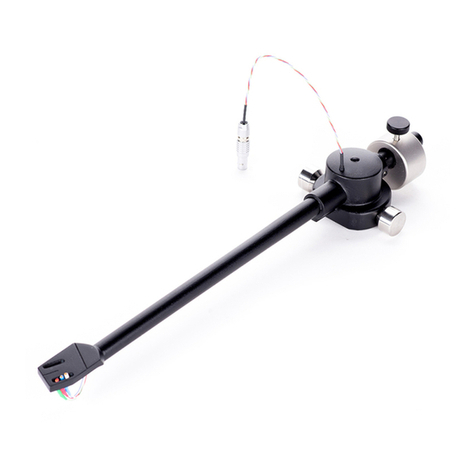
·Place the arm tube assembly on the lower bearing, taking care not to strain or
damage the 4-color wire and Lemo connector. Place the arm in its rest.
·At the rear of the arm base assembly is the connector block. Plug the Lemo
connector into its receptacle on top of the block. Notice that the connector can plug
in only one way. Align the red dots on the arms plug with the red dot on the
receptacle. Push gently, do not force the plug.
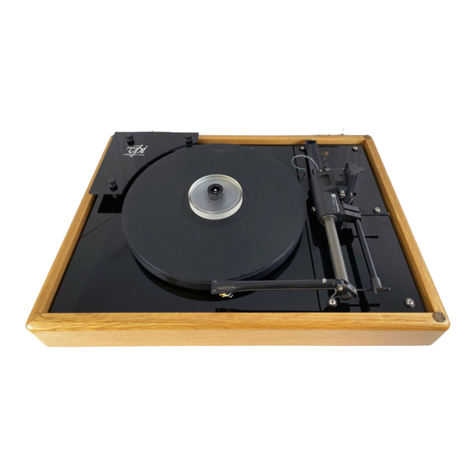
·Make sure the turntable is level. Refer to your turntable instructions and use a
bubble level to check level. In most cases, the best place to put the level is on the
platter.
·With a unipivot arm it is particularly important to level the turntable.
·Move the counterweight until the arm has a very slight downward tracking force,
just enough to keep it from moving sideways on the platter or enough to keep it in
the groove of the record
·Tracking force is adjusted by moving the counterweight forward and back just a bit
at a time. At least initially, you will be setting the tracking force twice. The first
time will be before the cartridge's overhang is set. After this is done, you will need
to double check the tracking force and adjust it as needed.
·The Classic 3 arm does not have a built-in tracking force gauge, but a Shure Stylus
Force Gauge is supplied with your arm. Following the gauge instructions set the
tracking force to the cartridge manufacturer recommendation plus 1/10 of a gram
more. We always recommend going to the high side when it comes to tracking
force. High frequency vibrations can cause a light-tracking cartridge to cause more
damage to the grooves than running a cartridge at a heavy setting. Make sure the
damping fluid is not installed when setting this force.
VERY IMPORTANT: MAKE SURE THE TONEARM IS PARALLEL TO THE PLATTER WHEN
SETTING THE TRACKING FORCE. IF IT IS NOT THE END RESULT WILL BE HIGHER OR
LOWER VTF THAN YOU WANTED.
·Next, the lateral balance or azimuth must be set. Because the phono cartridge is
offset, there is an unbalancing force that tilts the arm to one side. For the cartridge
to properly track the record groove, the stylus must be ninety degrees to the record
surface. Move the counterweight so a slight tracking force is applied and the stylus
just sits on the record surface.
·Use the azimuth ring to set correct azimuth. Lay the long thin rod supplied behind
the cartridge mounting screws into the V groove and use it as a guide for setting
azimuth. Rotate the flat part of the ring towards the side that is lower and that side
will become lighter causing it to rise. Playing with this will give very accurate
azimuth settings.