manuals.online logo
Brands
  1. Home
  2. •
  3. Brands
  4. •
  5. Watts
  6. •
  7. Control Unit
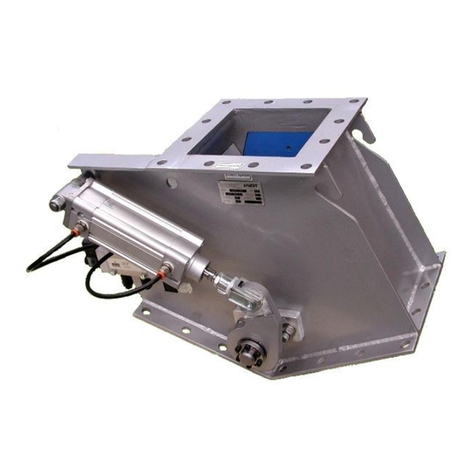
  8. •
  9. Watts AMES 950GD Installation and operating instructions

Watts AMES 950GD Installation and operating instructions

This manual suits for next models

2

Other Watts Control Unit manuals

Watts 980GD-16-19 User manual

Watts

Watts 980GD-16-19 User manual

Watts LFM116-32 Installation and operating instructions

Watts

Watts LFM116-32 Installation and operating instructions

Watts 008QT Series Instruction Manual

Watts

Watts 008QT Series Instruction Manual

Watts LF919-QT-FS Operating instructions

Watts

Watts LF919-QT-FS Operating instructions

Watts Golden Eagle 719 Series Instruction Manual

Watts

Watts Golden Eagle 719 Series Instruction Manual

Watts Ames 912GD-11 Owner's manual

Watts

Watts Ames 912GD-11 Owner's manual

Watts 1170 Series User manual

Watts

Watts 1170 Series User manual

Watts SENTINEL Hudrosolutions LEAK DEFENSE User manual

Watts

Watts SENTINEL Hudrosolutions LEAK DEFENSE User manual

Watts AMES 920GD-01-15 User manual

Watts

Watts AMES 920GD-01-15 User manual

Watts LFM110-10 User manual

Watts

Watts LFM110-10 User manual

Watts AMES 981GD User manual

Watts

Watts AMES 981GD User manual

Watts LFMMV Series User manual

Watts

Watts LFMMV Series User manual

Watts AMES Deringer 20X User manual

Watts

Watts AMES Deringer 20X User manual

Watts LF25AUB-Z3 Series Setup guide

Watts

Watts LF25AUB-Z3 Series Setup guide

Watts LFM118-3 User manual

Watts

Watts LFM118-3 User manual

Watts 972GD-20 User manual

Watts

Watts 972GD-20 User manual

Watts LFM110-14 Manual

Watts

Watts LFM110-14 Manual

Watts FRG3015-F RV User manual

Watts

Watts FRG3015-F RV User manual

Watts LFM115-11 Owner's manual

Watts

Watts LFM115-11 Owner's manual

Watts SOCLA BA BM User manual

Watts

Watts SOCLA BA BM User manual

Watts LFM113-32 User manual

Watts

Watts LFM113-32 User manual

Watts LFM110-AS Owner's manual

Watts

Watts LFM110-AS Owner's manual

Watts 994 Series Instruction Manual

Watts

Watts 994 Series Instruction Manual

Watts CIVIC4 User manual

Watts

Watts CIVIC4 User manual

Popular Control Unit manuals by other brands

Seitz 14A80 user manual

Seitz

Seitz 14A80 user manual

Wilo RS485 Installation and operating instructions

Wilo

Wilo RS485 Installation and operating instructions

Becker CentralControl CC41 Commissioning Instruction

Becker

Becker CentralControl CC41 Commissioning Instruction

SICK CDB650 operating instructions

SICK

SICK CDB650 operating instructions

Panduit NetKey NKP5E88M Series installation instructions

Panduit

Panduit NetKey NKP5E88M Series installation instructions

MX Options Concentric Petite Fitting instructions

MX

MX Options Concentric Petite Fitting instructions

Clean Water Systems Fleck 2510 Installation & start?up guide

Clean Water Systems

Clean Water Systems Fleck 2510 Installation & start?up guide

Fairchild FSB44104A user guide

Fairchild

Fairchild FSB44104A user guide

LEGRAND Wattstopper LMIN-104 installation instructions

LEGRAND

LEGRAND Wattstopper LMIN-104 installation instructions

PMK ATT10BNCS instruction manual

PMK

PMK ATT10BNCS instruction manual

Tektronix TDS3FFT user manual

Tektronix

Tektronix TDS3FFT user manual

Woodward easYgen Technical manual

Woodward

Woodward easYgen Technical manual

Balluff BNI EIP-502-105-R015 user guide

Balluff

Balluff BNI EIP-502-105-R015 user guide

NXP Semiconductors TWR-LS1021A Getting started

NXP Semiconductors

NXP Semiconductors TWR-LS1021A Getting started

Advantech PCM-3117 Startup manual

Advantech

Advantech PCM-3117 Startup manual

Danfoss MCO 101 manual

Danfoss

Danfoss MCO 101 manual

Moons' Lin Engineering R701P user manual

Moons'

Moons' Lin Engineering R701P user manual

Aventics RV1 operating instructions

Aventics

Aventics RV1 operating instructions

manuals.online logo
manuals.online logoBrands
  • About & Mission
  • Contact us
  • Privacy Policy
  • Terms and Conditions

Copyright 2025 Manuals.Online. All Rights Reserved.

Installation, Operation and Maintenance
Rate-of-Flow Control Valve
Sizes: 1¼" to 24"
NOTICE
For Australia and New Zealand: Pipeline strainers should be
installed between the upstream shutoff valve and the inlet of
the backflow preventer.
It’s important that this device be tested periodically in compli-
ance with local codes, but at least once per year or more as
service conditions warrant. If installed on a fire sprinkler system,
all mechanical checks, such as alarm checks and backflow
preventers, should be flow tested and inspected internally in
accordance with NFPA 13 and NFPA 25.
WARNING
!
Read this Manual BEFORE using this equipment.
Failure to read and follow all safety and use information
can result in death, serious personal injury, property
damage, or damage to the equipment.
Keep this Manual for future reference.
Table of Contents Page
Introduction............................................2
Installation ............................................2
Setting the Rate-of-Flow Controls ..........................3
Maintenance Schedule...................................6
Trouble Shooting Guide ..................................6
Valve Disassembly Instructions ........................ 8
ACV Schematic .......................................11
Local building or plumbing codes may require modifica-
tions to the information provided. You are required to
consult the local building and plumbing codes prior
to installation. If the information provided here is not
consistent with local building or plumbing codes, the
local codes should be followed. This product must be
installed by a licensed contractor in accordance with
local codes and ordinances.
WARNING
!
Need for Periodic Inspection/Maintenance: This product
must be tested periodically in compliance with local codes,
but at least once per year or more as service conditions
warrant. All products must be retested once maintenance
has been performed. Corrosive water conditions and/or
unauthorized adjustments or repair could render the product
ineffective for the service intended. Regular checking and
cleaning of the product’s internal and external components
helps assure maximum life and proper product function.
WARNING
!
Model 950GD / 650GD
IOM-A-ACV-950_650
Standard Components
Operation
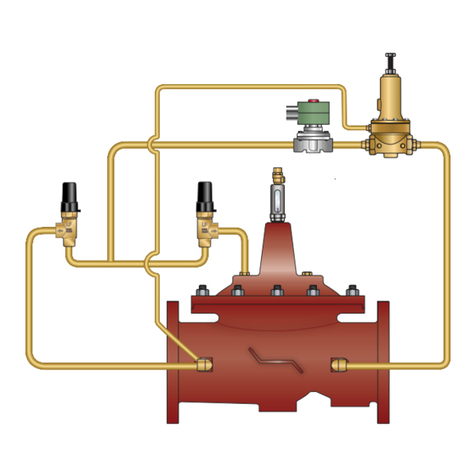
The Rate-of-Flow Control Automatic Control Valve (ACV) is designed
to automatically limit flow rate to a constant, adjustable, maximum. It
is controlled by a normally open, differential control pilot designed to:
1) Open (allowing fluid out of the main valve cover chamber) when the
differential pressure across the orifice plate is below the adjustable set
point, and, 2) Close (allowing fluid to fill the main valve cover cham-
ber) when the differential pressure across the orifice plate is above the
adjustable set point. A decrease in differential pressure causes the
valve to modulate towards an open position, increasing flow rate. An
increase in differential pressure causes the valve to modulate towards
a closed position, decreasing flow rate.
The Orifice Plate Assembly should be installed three to five pipe di-
ameters downstream of the Rate-of-Flow Valve, and field connected
with 3/8 " minimum copper tubing in accordance with factory piping
schematic.
Please specify desired flow rate PRIOR to ordering.
1
X
XX
Y/FC
3
2
4
CLOSES VALVE
OPENS VALVE
FLOW
(AOS)
1 - Main Valve (905GD – Single Chamber)
2 - Rate-of-Flow Control
3 - Adjustable Closing Speed
4 - Orifice Plate Assembly
X – Isolation Cocks
1. Prior to installation, flush line to remove debris.
2. Install valve so the flow arrow matches flow through the line, and gauges to monitor valve inlet and outlet pressures. A Position
Indicator can be installed to provide visual indication of valve position and operation without disassembly.
3. Install isolation valves upstream and downstream of the main valve.
4. Provide adequate clearance for valve servicing and maintenance. Refer to valve servicing dimensions on next page. Avoid installing
valves 6" and larger in the vertical position (main valve stem horizontal). Automatic Control Valves (ACVs) are designed for horizon-
tal in-line installation, with the cover facing up (main valve stem vertical). Slow operation or premature stem and guide wear may
occur if valve is not installed according to factory recommendations. Consult factory for detailed engineering review prior to order-
ing if valve is to be installed other than horizontally in-line.
5. If valve is equipped with a pilot control system, extra precautions should be made during installation to protect the piping circuit
from damage. Only remove the pilot control system from the valve if necessary. Tubing and fittings should be kept clean and
replaced exactly as removed. Consult appropriate hydraulic schematic to ensure proper re-assembly.
6. To accurately set flow rates, either a differential gauge or a flow meter should be installed.
7. Ensure that orifice plate is installed with flow arrow pointed downstream and assure that sense holes are free from obstruction.
8. After installation, vent entrapped air from valve cover and pilot system by following instructions on Technical Bulletin.
Start-up of an automatic control valve requires that proper procedures be followed. Time must be allowed for the valve to react to
adjustments and the system to stabilize. The objective is to bring the valve into service in a controlled manner to protect the system
from damaging over-pressure.
Installation
950GD (Globe) Rate-of-Flow Control Valve
2 IOM-A-ACV-950_650 2115 EDP# 1917070 © 2021 Watts
Setting the Rate-of-Flow Control Valves
STEP 1
Pre-set pilots as noted:
Rate of Flow – Adjust OUT, counterclockwise, to start valve at a lower flow rate.
Opening and Closing Speed - Turn the adjustment screws on the Closing Speed and Opening Speed Controls, if the main valve is so
equipped, OUT, counterclockwise, 1½ to 2½ turns from full closed position.
STEP 2
To ensure proper operation, any trapped air will need to be bled
off the valve cover during startup. The ACV includes a bleed valve,
use a flat head screwdriver to slowly open the valve (See Figure 1).
STEP 3
Pressure the line, by opening the upstream isolation valve slowly.
Air is vented through the air bleed valve. Tighten the fitting when
liquid begins to vent (See Figure 1).
Repeat the process until no air is trapped in the system
STEP 4
Slowly open downstream isolation valve to establish flow through
the system.
Globe
Angle
Size (in) 1¼ 1½ 2 2½ 3 4 6 8 10 12 14 16 20 24
A (in) 16 16 20 22 22 24 32 34 38 44 48 52 56 56
B (in) 10 10 12 14 14 16 24 26 28 30 34 40 48 48
Size (in) 1¼ 1½22½ 3 4 6 8 10 12 14 16
C (in) 16 16 20 22 22 24 32 34 38 44 48 52
D (in) 10 10 12 14 14 16 24 26 28 30 34 40
Counterclockwise to OPEN
bleed valve
The following tables detail the recommended minimum valve servicing dimensions.
A
B
C
FLOW FLOW
FLOW
D
FLOW
Valve Servicing Dimensions
Figure 1
Position Indicator
IOM-A-ACV-950_650 2115 EDP# 1917070 © 2021 Watts 3
STEP 7
Opening Speed Flow Control Adjustment: The Opening speed
flow control allows free flow into the cover and restricted flow out
of the cover of the main valve.
If valve opening is too slow, turn the adjustment screw OUT,
counterclockwise, increasing the rate of opening (See Figure 3B).
If valve opening is too quick, turn the adjustment screw IN, clock-
wise, decreasing the rate of opening (See Figure 3A).
Setting the Rate-of-Flow Pilot
STEP 5
With a demand for flow on the system, the valve can now be
adjusted for the proper flow rate. This requires a meter to read
the flow that the valve is providing.
STEP 6
While reading the meter register, adjust the Rate of Flow Control:
Turn the adjustment screw IN, clockwise, to increase the flow rate
regulated (See Figure 2A).
Turn the adjustment screw OUT, counterclockwise, to reduce or
lower the flow rate regulated (See Figure 2B).
STEP 8
Closing Speed Needle Valve Adjustment: The closing speed
needle valve regulates fluid pressure into the main valve cover
chamber, controlling the valve closing speed.
If valve closing is too slow, turn the adjustment screw OUT, coun-
terclockwise, increasing the rate of closing.
Counterclockwise to REDUCE
Flow Rate Limit
Clockwise to INCREASE
Flow Rate Limit
2A 2B
Figure 2
CP14-1 Rate-of-Flow Control Pilot
Counterclockwise to INCREASE
the rate of opening
Clockwise to DECREASE
rate of opening
3A 3B
Figure 3
Flow Control
4 IOM-A-ACV-950_650 2115 EDP# 1917070 © 2021 Watts IOM-A-ACV-950_650 2115 EDP# 1917070 © 2021 Watts 5

To ensure peak performance and longevity of your automatic
control valve, Watts/Ames recommends following the below
standard maintenance schedule.
• Monthly Maintenance
– Visual inspection of valve(s) for leaks
– Inspect for proper operation(s); exercise valve.
• Quarterly Maintenance
– Conduct monthly inspection.
– Validate/Re-establish necessary setpoints of controls/pilots.
• Annual Maintenance
– Conduct monthly & quarterly inspections.
– Inspect & clean all strainers.
– Inspect valve coating, touch up as required.
• 3-5 Year Maintenance
– Conduct monthly, quarterly, & annual maintenance.
– Inspect & replace valve elastomers (diaphragm, O-rings,
valve/pilot seats)
– Re-establish necessary set points of controls/pilots.
Automatic Control Valve Maintenance Schedule
Troubleshooting Guide
Warning: The valve cannot be serviced under pressure.
Upstream and downstream Isolation Valves must be installed
to protect system piping. Accurate diagnosis and trouble-
shooting requires the valve to open fully, and may subject
downstream piping and equipment to high pressure and/or
flow rates. The downstream Isolation Valve should be kept
closed while diagnosing the valve.
Extreme caution should be used while performing the
troubleshooting techniques listed below.
WARNING
!
Recommended tools for diagnosis: (3) PRESSURE GAUGES,
installed to monitor the inlet pressure, outlet pressure, and cover
chamber pressure. If included, a POSITION INDICATOR should
be installed to visually assess the position of the disc &
diaphragm assembly.
Test 1: Diaphragm Seal Test
1. Close upstream & downstream isolation valves. Close pilot
isolation valves or remove pilot control tubing to isolate valve
cover from incoming fluid & pressure. Remove uppermost
cover plug, test cock, or limit switch.
2. With the valve cover chamber vented to atmosphere,
partially open the upstream isolation valve, allowing incoming
pressure to lift the disc & diaphragm assembly. A volume of
water will be displaced from the cover chamber as the valve
opens; consult valve specification sheets for approximate
cover capacity. A continuous flow of water from the open port
indicates a damaged diaphragm or loose disc & diaphragm
assembly. Disassemble valve and replace diaphragm or tighten
disc & diaphragm assembly.
Test 2: Seat Seal Test
1. Close downstream isolation valve and install pressure gauges
on an open inlet and outlet port of main valve.
2. Open upstream isolation valve to allow pressure on to the
valve cover. Allow valve to fully close.
3. Monitor downstream pressure gauge; reading should hold
steady below incoming pressure. If pressure on downstream
side rises to match upstream pressure, leakage is occurring
through the seat of the main valve. Disassemble valve, inspect
and repair/replace any required parts.
a. If gauge pressure rises to match outlet pressure (down-
stream of closed isolation valve) yet remains below inlet
pressure, the isolation valve may be leaking as opposed to
main valve seat.
Test 3: Freedom of Movement/Valve
Travel Test
1. Close upstream and downstream isolation valves. Install valve
position indicator.
2. Partially open upstream isolation valve and allow cover to fill
with fluid & pressure, closing the valve fully. Mark the position
indicator’s full closed position.
3. Isolate cover chamber from receiving fluid and pressure by
closing isolation valves or removing control tubing.
4. Carefully vent cover chamber to atmosphere by opening test
cock or removing a cover plug. Observe the valve position
indicator as the valve travels to the full-open position. The disc
& diaphragm assembly should move freely from fully closed to
fully open position without binding or “grabbing” at any point
during its movement.
a. The disc & diaphragm assembly may momentarily “hesi-
tate” while travelling from fully closed to fully open position
– this is a normal characteristic of diaphragm operated
control valves, and does not indicate mechanical binding
or improper valve operation.
b. A continuous discharge of water from the cover chamber
after venting to atmosphere indicates leakage past the
diaphragm.
5. If necessary, disassemble valve and inspect/repair disc &
diaphragm assembly.
4 IOM-A-ACV-950_650 2115 EDP# 1917070 © 2021 Watts IOM-A-ACV-950_650 2115 EDP# 1917070 © 2021 Watts 5
Issue Possible Cause Corrective Action Notes
Main Valve will not
open
Closed isolation valves in pilot system. Check isolation valves, ensure
open.
Insufficient supply pressure. Check upstream pressure. Depending on water
source, supply pressure
may not be controlled by
valve operator.
Main valve stem assembly corroded/
damaged
Inspect stem assembly, clean/
replace if necessary.
Blockage in pilot system. Inspect & clean any installed
pilot system strainers, check
orifice/speed controls for
blockages.
Improperly configured opening speed
control.
Adjust opening speed control
to verify functionality, adjust as
required.
Standard setting for open-
ing speed control is 1 1/2
- 2 1/2 turns open from full
closed position. Can be
adjusted in field.
Main Valve will not
close
Closed isolation valves in pilot system Check isolation valves, ensure
open.
Diaphragm is damaged Conduct diaphragm seal test,
repair and replace if necessary.
Main valve stem assembly corroded/
damaged.
Inspect stem assembly, clean/
replace if necessary.
Blockage in main valve. Perform freedom of movement
test; if valve does not close,
disassemble and remove
blockage.
Worn/damaged valve seat. Perform seat sealing check;
disassemble and inspect/re-
pair seat if required.
Improperly configured closing speed
control.
Adjust closing speed control
to verify functionality, adjust as
required.
Standard setting for
closing speed control is
11/2 - 21/2 turns open from
full closed position. Can
be adjusted in field.
Field installed orifice lines are reversed Reinstall per schematic
Troubleshooting Guide
6 IOM-A-ACV-950_650 2115 EDP# 1917070 © 2021 Watts IOM-A-ACV-950_650 2115 EDP# 1917070 © 2021 Watts 7
Valve Disassembly Instructions
Before undertaking valve disassembly, it is recommended to gather the following tools to aid you during the process:
• Small & large adjustable wrenches
• Screwdriver set
• Machinist fine metal file
• Fine wire brush
• Bench vise
• Basic valve IO&M manual
• Hammer & dull cold chisel
• Heavy-duty ratchet & socket set
• Hexagonal wrench set
• 320 grit/fine Emery cloth
• Appropriate technical bulletins for
valve start-up procedures.
1. Isolate the valve from line pressure and depressurize it to ensure safe working conditions. Disconnect any electrical
connections if so equipped.
2. Carefully remove Position Indicator or Limit Switches if equipped. Remove all tubing, fittings, and Control Pilots
necessary to easily access and remove the cover. Remove cover nuts and washers.
3. Remove the cover. If cover is not free to be removed, loosen it by tapping upward along its outside edge with a dull cold chisel, pic-
tured above.
a. Large valves may require the installation of lifting “eye” bolts in order to facilitate cover removal; installation ports are provided on
the cover for this purpose.
4. Remove the Disc and Diaphragm Assembly from the valve body by lifting straight up.
a. Large diameter valves may require a lifting “eye” bolt to be installed in the valve stem accessory threads located on the very
top of the valve stem.
5. Before removing Stem Nut, examine stem threads for mineral build-up. Remove deposits with a fine wire brush. Extreme care should
be taken not to damage the finish on stem guiding surfaces when disassembling. Avoid applying pipe wrenches to top or bottom
stem guide surfaces.
VALVE COVER
BRASS BAR STOCK
(ANGLE UPWARD)
HAMMER
6 IOM-A-ACV-950_650 2115 EDP# 1917070 © 2021 Watts IOM-A-ACV-950_650 2115 EDP# 1917070 © 2021 Watts 7
Size A B C D E (Dia.) F
in Pipe Size (in) Min. Length (in) in in in in
1¼ 1 3.12 0.38 0.25 0.44 0.55
1½ 1 3.12 0.38 0.25 0.44 0.50
2 1¼3.38 0.38 0.25 0.44 0.50
2½ 2 4.0 0.38 0.38 0.56 0.62
3 2½4.5 0.50 0.38 0.56 0.62
4 3 5.0 0.50 0.44 0.56 0.62
6 5 6.50 0.62 0.44 0.56 0.62
6. After removing the Stem Nut, the remainder of the Disc & Diaphragm Assembly should disassemble easily. Polish stem guide
surfaces with fine emery cloth to remove any mineral deposits and inspect for excessive wear. Remove any mineral build-up from
other components with wire brush or by using a Mineral Dissolving Solution. Inspect parts for wear and replace if necessary.
7. Inspect valve seat. If seat is not damaged, removal is not necessary. Valve seats 6" and smaller are threaded into the body of the
valve and require a seat removal tool (Figure 4) (Table 1 details the tool dimensions for seat removal). Valve seats 8" and larger are
held in the valve body with stainless steel cap screws. Remove seat retaining screws and lift seat straight up (Figure 5).
Figure 5
*Schedule 40 steel pipe
Figure 4
Valve Body
Valve Seat
All-Thread
Nut and Washer
2PLCS
Angle or
Channel Iron
120
B (Min)
E Dia. 4 Holes
90 Apart
D
TYP <3 PLCS>
120 Apart
C TYP <3 PLCS>
F
A
Table 1: Seat Removal Tool Dimension
8 IOM-A-ACV-950_650 2115 EDP# 1917070 © 2021 Watts IOM-A-ACV-950_650 2115 EDP# 1917070 © 2021 Watts 9
Size (in) 3 4 6 8 10 12 16 20 & 24
P/N 0677-01 0677-01 0677-02 0677-03 0677-04 0677-05 0677-09 0677-11
8. Replace Seat Disc, Diaphragm and Spacer Washers provided in Main Valve repair kit (refer to Table 2 or 3 for correct repair kit part
number). Re-assemble in the reverse order of disassembly.
9. Re-Install Disc and Diaphragm Assembly in the valve, taking care not to damage the lower guide area in the center of the valve
seat.
10. Re-install Cover Spring. Replace Valve Cover and tighten Cover Nuts in a crossing pattern to ensure even distribution. Test the Disc
and Diaphragm Assembly for smooth travel by following the Freedom of Movement Test procedure in previous section.
11. Test the integrity of the Seat Seal by following the Seat Seal Test procedure in previous section.
12. Return valve to service by following instructions on the Technical Bulletin matching the valve function.
Size (in) 1¼ 1½22½ 3 4 6 8 10 12 14 16
P/N 0677-01 0677-01 0677-02 0677-03 0677-04 0677-05 0677-06 0677-07 0677-08 0677-09 0677-10 0677-11
Table 3: Reduced Port Valve (605GD/605AD) Repair Kits
Table 2: Full Port Valve (905GD/905AD) Repair Kits
8 IOM-A-ACV-950_650 2115 EDP# 1917070 © 2021 Watts IOM-A-ACV-950_650 2115 EDP# 1917070 © 2021 Watts 9
10 IOM-A-ACV-950_650 2115 EDP# 1917070 © 2021 Watts IOM-A-ACV-950_650 2115 EDP# 1917070 © 2021 Watts 11
Optional
Xylan
Coating
17A
6
1
2
3
4
5
7
8
9
11
12
13
14
15
16
17
18
10
Item Description Material
1Pipe Plug Lead Free Brass
2Cover ASTM A536 65-45-12 Epoxy Coated Ductile Iron
3Cover Bearing ASTM A276 304 Stainless Steel
4Stud with Cover Nut and Washer ASTM A570 Gr.33 Zinc Plated Steel
5Body ASTM A536 65-45-12 Epoxy Coated Ductile Iron
6Spring ASTM A276 302 Stainless Steel
7Stem Nut ASTM A276 304 Stainless Steel
8Lock Washer ASTM A276 304 Stainless Steel
9Stem Washer ASTM A276 304 Stainless Steel
10 Diaphragm Washer ASTM A536 65-45-12 Epoxy Coated Ductile Iron
11 Diaphragm* Buna-N (Nitrile)
12 Disc Retainer ASTM A536 65-45-12 Epoxy Coated Ductile Iron
13 Seat Disc* Buna-N (Nitrile)
14 Spacer Washer* x5 NY300 Fiber*
15 Disc Guide ASTM A743 CF8M (316) Stainless Steel
16 Shaft ASTM A276 304 Stainless Steel
17 Seat Ring** ASTM A743 CF8M (316) Stainless Steel
17A Seat Screw** (8" and Larger) ASTM A276 304 Stainless Steel
18 Seat Gasket* Buna-N (Nitrile)
* Contained in Main Valve Repair Kit
**Note: 6 inch and Smaller Valves, Seat Ring is threaded
Installation: If unit is installed in any orientation other than
horizontal (cover up) OR extreme space constraints exist,
consult customer service prior to or at the time of order.
NOTICE
ACV Assembly Diagram – Series 950GD