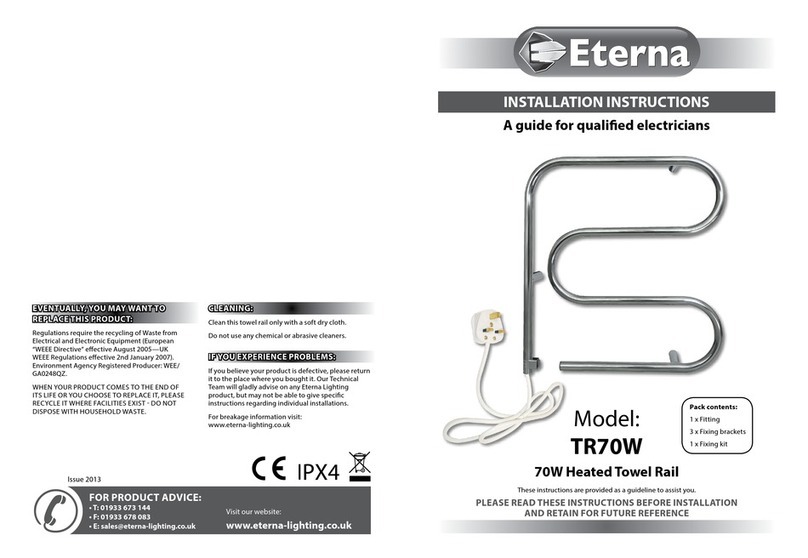
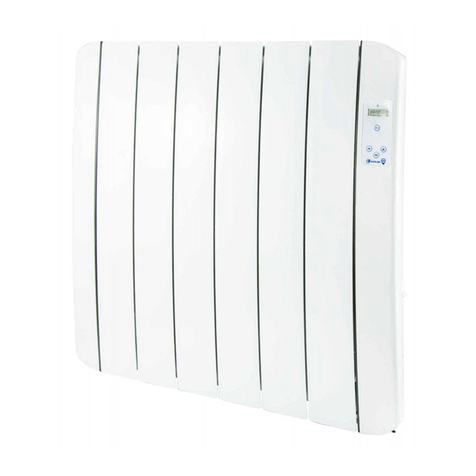
ASSEMBLY INSTRUCTIONS for the installer and the user
Read these instructions carefully before starting any assembly operation.
The radiator complies with the directives 2006/95/CEE, 89/336/CEE, 2005/32/CEE and the norms 60335-2-
30 : 2003+A1 ; 2004+A2 : 2007 ; 60335-2-43+A1: 2006, EN50336:2003+A1:2006.
1 - All the installation and maintenance operations must be carried out by qualified personnel.
This towel heating can’t use for the person (including the children) whose physical , sensory or mental
capabilities or lack of experience and knowledge .Prevents them from using the appliance safely without
supervision or instruction . It’s necessary to guard the children don’t playing with the appliance.
2 - The manufacturer declines all responsibility in the event of assembly which does not respect these
instructions, or the use of non original material or accessories.
3 - The radiator is filled with a special liquid. Repairs which require the opening of the tank must be carried out
exclusively by the manufacturer or his technical assistance service which must be contacted in the event of
leakage of liquid. If this heating appliance is to be scrapped, the regulations on the disposal of the heating
fluid
must be complied with.
4 - If the cable become damaged it must be replaced by the manufacturer, by the authorized assistance
service or by a technically qualified person in order to avoid all risks.
5 - The heating appliance must not be placed under an electric socket but in such a position that the switches
and other control devices cannot be touched by a person who is in the bath tub or under the shower.
6 – WARNING: in order to avoid a hazard for very young children, this appliance should be installed so that
the lo west heated rail is at least 600mm above the floor.
7 - During operation, it is normal for the first pipes at the bottom and the last one at the top not to be heated
(the lower part to facilitate the natural circulation of the fluid, the pipe at the top is empty to allow the
expansion of the fluid when heated).
8 - Avoid using the radiator in the presence of gas, explosives or inflammable products.
9 - Contact the manufacturer immediately if 4 of the 8 temperature indication leds are flashing, as this means
that the temperature probe is broken.
ELECTRICAL CONNECTION
Cables: grey (or blue) = neutral, brown = phase, black = pilot wire (only for mod. B – see fig.4).
Power supply for single-phase current 230V ~ 50 Hz.
The connection must be made in compliance with the regulations in force; before connecting the electric
resistance to the line, check the voltage and power values indicated on the data plate.
For the models not equipped with a plug (mod. B – fig. 4) – Specific for the French market
The electric supply circuit of the radiator must be protected by a 30 mA differential switch. The opening
distance between the contacts must be greater than 3 mm. Moreover, the circuit must be easily accessible.
The pilot wire (black) must be insulated, if it is not used.
INSTRUCTIONS FOR USE AND OPERATION (see fig. 1)
1 – Setting up the appliance
• When connecting the unit to the power supply control, if not warning light comes on, press the control key
(A) so that the warning light (L1) turns red. The appliance is now lit.
• To switch it off, press the key (A); the appliance is no longer heating, no warning light remains lit.
• Pressing in sequence the key (B) allows you to pass from “comfort” mode (green warning light) to “forced
operation” mode (light L3 lit 1 hour – light L4 lit 2 hours).
2 – Regulating the “comfort” temperature
• The “comfort” temperature corresponds to the room temperature desired by the user.
• The thermostat is set by pressing the + and - keys, the warning light L1 will be lit to indicate the set
temperature. The temperature may be selected in the range from 7 to 30° C.
• The red warning light (L2) of the thermostat is lit when the appliance is heating and switches off when the set
temperature is reached .
• After a few hours, the temperature becomes stable; if necessary, regulate the temperature, increasing or
decreasing the set value. If the set temperature corresponds to the temperature you wanted to obtain (if
necessary check the room temperature with a thermometer), determine this position definitively. Instead, if
you are not satisfied with the temperature, regulate it again.
3 – Forced operation
• While heating the room, the appliance also acts as a heated towel rail. However, if you want to boost the
heating of towels or raise the room temperature more rapidly, you can switch on forced operation.