PRO-PEDAL The Pro-Pedal damping has three levels of adjustment
and is controlled by the blue lever (formerly the lock-out lever). The
three different levels of damping are light, medium, and heavy Pro-Pedal.
We recommend setting the Pro-Pedal in the middle of its adjustment range.
If you feel like you the bike is to firm and is not absorbing the small bumps
flick the lever left to the light setting. If the bike feels sluggish and you
want the suspension to feel more efficient, turn the lever right to the stiffer
setting.
AIR PRESSURE The main air spring controls the sag of the shock.
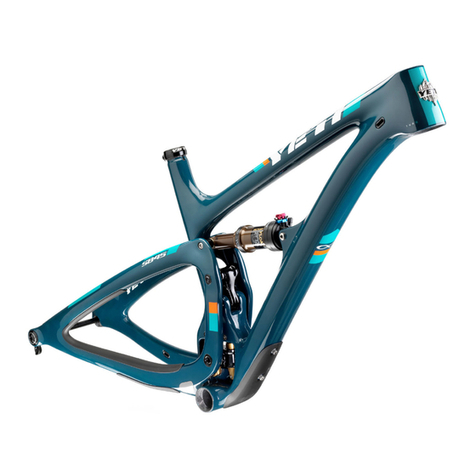
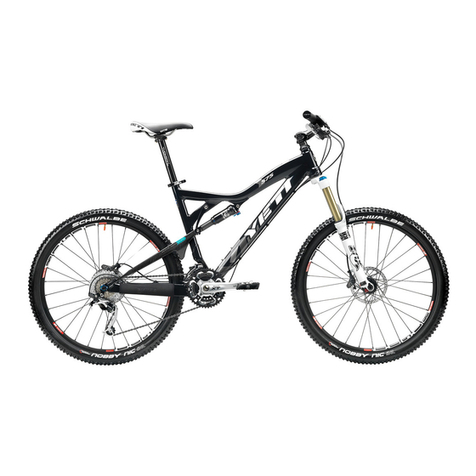
For the 575 to ride properly it is important to setup the shock with
the correct amount of sag. For general riding use 20-30% of the shock
stroke. To increase sag reduce the main spring air pressure. To reduce sag
increase the main spring air pressure. Refer to the quick start guide to get
your starting air pressure.
Firm Ride - 20-25% sag
Plush ride - 30% sag
SAG Once you have set your baseline air pressure you need to
measure the sag. To measure the sag slide the travel indicator (O-
ring) up against the shock body. With a friend supporting the bike, sit on
the saddle and allow your body weight to compress the shock. Once you
have compressed the shock, get off the bike and measure the distance
between the shock body and the new position of the travel indicator (O-ring)
is your sag. Refer to the guide below for the % of sag equivalents for the
measurement recorded.
REBOUND The rebound adjustment has a 9 click range. As a general
rule, adjustments that are too fast (counter-clockwise adjustment)
will produce a springy ride with excessive kick up of the rear end causing
bucking of the rider. Adjustments that are too slow (clockwise adjustment)
will cause packing of the rear wheel that is identified by a sluggish ride
feeling.
slower rebound - turn the knob clockwise
faster rebound- turn the knob counter-clockwise
4
SETUP OVERVIEW The DHX 5.0 employs both speed sensitive rebound damping and position sensitive
compression damping. There are three external adjustments that affect the compression and one external
adjustment for the rebound. The three compression adjustments are Bottom-Out Resistance, Boost Valve
and Pro-Pedal. The Pro-Pedal controls the anti-bob properties of the shock or the first part of the shocks
stroke, the Bottom-Out Resistance controls the end of the shock stroke, and the Boost Valve damping links
these two adjustments together to create a seamless transition through the entire stroke. The Boost Valve
also de-couples the Pro-Pedal and Bottom-Out Resistance making these adjustments independent on each
other.
AIR PRESSURE The main air spring controls the sag of the shock.
For the 575 to ride properly it is important to setup the shock with
the correct amount of sag. For general riding use 20-30% of the shock
stroke. To increase sag reduce the main spring air pressure. To reduce sag
increase the main spring air pressure. Refer to the quick start guide to get
your starting air pressure.
Firm Ride - 20-25% sag
Plush ride - 30% sag
1
Warning: Use of the shock with improper air pressure can cause loss of
dampening and malfunction of the shock.
BOOST VALVE The DHX 5.0 has an air pressure range of 75-200 psi,
and it must be pressurized for the shock to work properly. The Boost
Valve allows the Pro-Pedal (beginning compression) and the Bottom-Out
Resistance (ending compression) to work seamlessly together. Because
of this relationship the Boost Valve pressure affects both the Bottom-Out
Resistance and the Pro-Pedal Adjustments (see adjustment relation).
Lower pressures (75-100 psi) - will decrease bottoming resistance and
lessen Pro-Pedal stiffness at a given setting.
Higher pressures (110-200 psi) - will increase bottoming resistance and
stiffen Pro-Pedal at a given setting.
Warning: Use of the shock with improper air pressure can cause a loss of
dampening and shock malfunction could occur. Don not attempt to turn the
adjuster with more than 125 psi in the chamber.
2
1
3
3