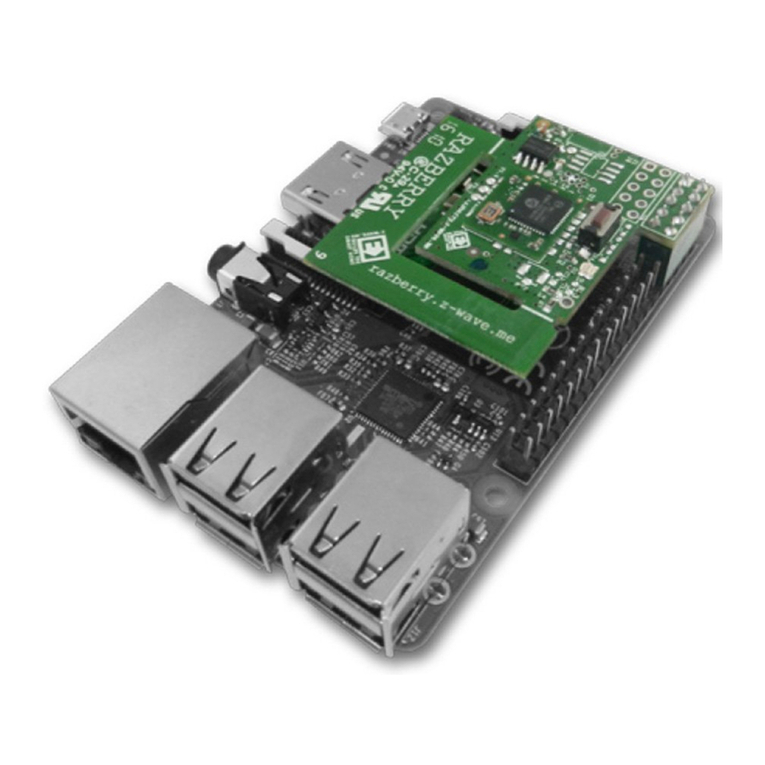
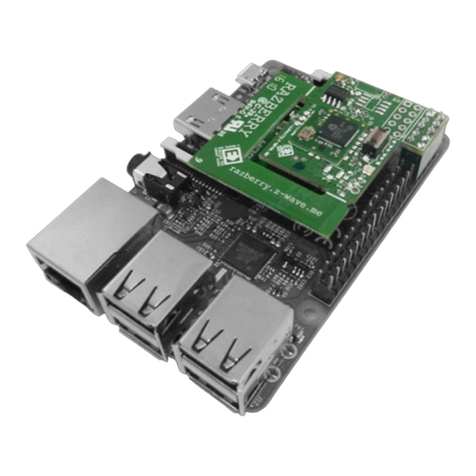
1. The connector sits on pins 1-10 on the Raspberry Pi
2. Duplicate connector
3. Two LEDs for operation indication
4. U.FLpad to connect an external antenna. When connecting
the antenna, turn the jumper R7 by 90°
SHIELD DESCRIPTION
1
2
3
4
Z-Wave TransceiverSilicon Labs ZGM130S
Wireless Range Min. 40 m indoor indirect line of sight
Self-Test
When powering on,both LEDs must shine for about
2 seconds and then go off. If they don’t, the device is
defective.
If the LEDs do not shine for 2 seconds: hardware problem.
If the LEDs are faintlyshining constantly: hardware
Dimensions/Weight 41 x 41 x12 mm / 16 gr
LED indicationRed: Inclusion and Exclusion Mode.
Green: Send Data.
Interface TTL UART (3.3 V) compatible with Raspberry Pi GPIO pins
Frequency range:
ZME_RAZBERRY7
(865...869 MHz): Europe (EU) [default], India (IN), Russia
(RU), China (CN), South Africa (EU), Middle East (EU)
(908...917 MHz): America, excluding Brazil and Peru (US)
[default], Israel (IL)
(919...921 MHz): Australia / New Zealand / Brazil / Peru
(ANZ), Hong Kong (HK), Japan (JP), Taiwan (TW), Korea
(KR)
MOBILE APP Z-WAVE.ME
LEARN MORE ABOUT RAZBERRY 7
Full documentation, training videos and technical
support can be found on the website https://z-wave.
me/raz.
You can change the radio frequency of the RaZberry 7
shield at any time by going to the Expert UI http://
RASPBERRY_IP:8083/expert, Network > Control and
select the desired frequency from the list.
The RaZberry 7 shield constantly improves and adds
new features.To use them, you need to update the
is done from the Z-Way Expert UI under Network >
Controller Information.
https://z-wave.me/raz
FCC STATEMENT
FCC Device ID: ALIB2-ZMERAZBERRY7
This device complies with Part 15 of the FCC Rules.Operation is subject to the following two conditions:
(1) This device may not cause harmful interference, and
(2) This device must accept anyinterference received,including interference that maycauseundesired
operation.
NOTE: This equipment has been tested and found to comply with the limits for Class B digital devices,
pursuant to Part 15 of the FCC rules.These limits are designed to provide reasonable protection against
harmful interference in aresidential installation. This equipment generates,usesand can radiate radio
frequency energyand, if not installed and used inaccordance with the instructions, maycause harmful
interference to radio communications. However, there is no guarantee that interference will not occur in
aparticular installation. If this equipment does cause harmful interference to radio or television reception,
which can be determined by turning the equipment off and on, the user is encouraged to try to correct the
interference by oneor more of the following measures:
1. Reorient or relocate the receiving antenna.
2. Increase the distance between the equipment and the receiver.
3. Connect the equipment into an outlet on a different circuit to which the receiver isconnected.
4. Consult the dealer or an experienced radio/TV technician for assistance.
Use of the shielded cable is required to comply with Class B limits in Subpart B of Part 15 of the FCC rules.
NOTE: If static electricity or electromagnetism causes data transfer to discontinue midway (fail),
restart theapplication or disconnect and connect the communication cable (USB, etc.) again.
Radiation Exposure Statement: This equipment complies with the set out FCC radiation exposurelimits
for anuncontrolled environment.
Co-location warning: This transmitter must not be co-located or operated in conjunction with anyother
antenna or transmitter.
OEM integration instructions: This module has a LIMITED MODULAR APPROVAL, and is intended only for
OEM integrators under the following conditions: As a single,non-colocated transmitter, this module has no
restrictions in relation to a safe distance from any user.The module shall be only used with the antenna(s)
met, further transmitter testing will not be required. However, the OEM integrator is still responsible for
testing their end-product for any additional compliance requirements necessary for this installed module
(for example, digital device emissions, PC peripheral requirements,etc.).