manuals.online logo
Brands
  1. Home
  2. •
  3. Brands
  4. •
  5. Zanussi Electrolux
  6. •
  7. Oven
  8. •
  9. Zanussi Electrolux Built-in oven User manual

Zanussi Electrolux Built-in oven User manual

Other manuals for Built-in oven

6

Other Zanussi Electrolux Oven manuals

Zanussi Electrolux ZCE 8021 User manual

Zanussi Electrolux

Zanussi Electrolux ZCE 8021 User manual

Zanussi Electrolux BST 6 W User manual

Zanussi Electrolux

Zanussi Electrolux BST 6 W User manual

Zanussi Electrolux BMX316 User manual

Zanussi Electrolux

Zanussi Electrolux BMX316 User manual

Zanussi Electrolux ZCG7540 User manual

Zanussi Electrolux

Zanussi Electrolux ZCG7540 User manual

Zanussi Electrolux ZCM 1030 X User manual

Zanussi Electrolux

Zanussi Electrolux ZCM 1030 X User manual

Zanussi Electrolux Electric oven User manual

Zanussi Electrolux

Zanussi Electrolux Electric oven User manual

Zanussi Electrolux ZCE 7550 User manual

Zanussi Electrolux

Zanussi Electrolux ZCE 7550 User manual

Zanussi Electrolux Built-in oven User manual

Zanussi Electrolux

Zanussi Electrolux Built-in oven User manual

Zanussi Electrolux MULTI BUILT-IN OVENS User manual

Zanussi Electrolux

Zanussi Electrolux MULTI BUILT-IN OVENS User manual

Zanussi Electrolux ZCE 7551X User manual

Zanussi Electrolux

Zanussi Electrolux ZCE 7551X User manual

Zanussi Electrolux ZCE 5000 User manual

Zanussi Electrolux

Zanussi Electrolux ZCE 5000 User manual

Zanussi Electrolux ZCM 8021 User manual

Zanussi Electrolux

Zanussi Electrolux ZCM 8021 User manual

Zanussi Electrolux ZCM 1030 X User manual

Zanussi Electrolux

Zanussi Electrolux ZCM 1030 X User manual

Zanussi Electrolux Built-in oven User manual

Zanussi Electrolux

Zanussi Electrolux Built-in oven User manual

Zanussi Electrolux ZCE 7702 User manual

Zanussi Electrolux

Zanussi Electrolux ZCE 7702 User manual

Zanussi Electrolux ZOU270 User manual

Zanussi Electrolux

Zanussi Electrolux ZOU270 User manual

Zanussi Electrolux Electric oven User manual

Zanussi Electrolux

Zanussi Electrolux Electric oven User manual

Zanussi Electrolux Built-in oven User manual

Zanussi Electrolux

Zanussi Electrolux Built-in oven User manual

Zanussi Electrolux ZCM 8021 User manual

Zanussi Electrolux

Zanussi Electrolux ZCM 8021 User manual

Zanussi Electrolux Built-in oven User manual

Zanussi Electrolux

Zanussi Electrolux Built-in oven User manual

Zanussi Electrolux ZCM 7902 User manual

Zanussi Electrolux

Zanussi Electrolux ZCM 7902 User manual

Zanussi Electrolux ZCGHL50 User manual

Zanussi Electrolux

Zanussi Electrolux ZCGHL50 User manual

Zanussi Electrolux ZOU580 User manual

Zanussi Electrolux

Zanussi Electrolux ZOU580 User manual

Zanussi Electrolux ZCE 5200 User manual

Zanussi Electrolux

Zanussi Electrolux ZCE 5200 User manual

Popular Oven manuals by other brands

Brandt FC 222 user manual

Brandt

Brandt FC 222 user manual

aumate TOA20M04N-1E instruction manual

aumate

aumate TOA20M04N-1E instruction manual

Maytag CWE4100AC - 24" Single Electric Wall Oven Dimension Guide

Maytag

Maytag CWE4100AC - 24" Single Electric Wall Oven Dimension Guide

Kernau KBO 1076 S PT B instruction manual

Kernau

Kernau KBO 1076 S PT B instruction manual

Bosch HB 37 N Series User manual and installation instructions

Bosch

Bosch HB 37 N Series User manual and installation instructions

Electrolux EOD5420AA user manual

Electrolux

Electrolux EOD5420AA user manual

Mx Onda MX-HC2183 instruction manual

Mx Onda

Mx Onda MX-HC2183 instruction manual

Daewoo F6EV19SM2 Service manual

Daewoo

Daewoo F6EV19SM2 Service manual

Blodgett MT3870 Specifications

Blodgett

Blodgett MT3870 Specifications

GE ZET2F owner's manual

GE

GE ZET2F owner's manual

GE JK3000DF3WW owner's manual

GE

GE JK3000DF3WW owner's manual

eka EKF 523 NT Operating and instruction manual

eka

eka EKF 523 NT Operating and instruction manual

AEG Electrolux E3191-5 user manual

AEG Electrolux

AEG Electrolux E3191-5 user manual

Pratica Rocket Express quick start guide

Pratica

Pratica Rocket Express quick start guide

Viking Professional VGSO260T user guide

Viking

Viking Professional VGSO260T user guide

FM RX203 instruction manual

FM

FM RX203 instruction manual

Bosch HBN331 9B Series instruction manual

Bosch

Bosch HBN331 9B Series instruction manual

NEFF B95M42N0MK Instructions for use

NEFF

NEFF B95M42N0MK Instructions for use

manuals.online logo
manuals.online logoBrands
  • About & Mission
  • Contact us
  • Privacy Policy
  • Terms and Conditions

Copyright 2025 Manuals.Online. All Rights Reserved.

43
Englis
Warnings - Built-in ovens
It is most important that the instruction book should be retained with the appliance for future
reference. Should the appliance be sold or transferred to another owner, or should you move
house and leave the appliance, always ensure that the book is supplied with the appliance in
order that the new owner can be acquainted with the functioning of the appliance and the
relevant warnings. These warnings are provided in the interest of safety. You must read
them carefully before installing or using the appliance.
Installation
lAny installation work must be undertaken
by a qualified electrician or competent
person.
lInstallation and initial adjustment of your
oven MUST be carried out by qualified
personnel in compliance with current
re ulations. Specific installation
instructions for the installer are iven in this
booklet.
During use
lThis appliance has been desi ned for
cookin edible foodstuffs only, and must
not be used for any other purposes.
lIt is dan erous to alter the specifications
or modify the product in any way.
lAppliances become very hot with use, and
retain their heat for a lon period after use.
lAlways ensure that the control knobs are
in the off position when not in use.
lFor hy iene and safety reasons, this
appliance should be kept clean at all times.
A build-up of fats or foodstuffs could result
in a fire.
lNever line any part of the oven with
aluminium foil.
lEasy clean-liners (if provided) should never
be cleaned with any other than soapy water.
lBefore any maintenance or cleanin work
is carried out on the appliance, always turn
off the isolator switch at the cooker point,
and allow to cool.
lDurin oven cookin and rillin , the
appliance door and the surroundin parts
are warmed up to a very hi h temperature.
Be careful and keep children away from
the appliance while you are usin it. When
you connect other appliances to a plu near
the oven, check carefully that the wire does
not touch warm parts of the oven and does
not et taken in the oven door.
lEnsure that the shelves are put in place in
the correct way.
lThis oven (even if it is linked to an electrical
cookin table) is made to function at 230 V
mono, double or three-phase with neutral.
lA polyphase linkin without neutral (400 V)
can induce the distruction of the oven and
of the eventual cookin table.
Child safety
lThis appliance is desi ned to be operated
by adults. Children should not be allowed
to tamper with the controls or play with the
product.
lChildren should be supervised at all times
and should not be allowed to touch the hot
surfaces or be in the vicinity when in use
or until the appliance has cooled after use.
Technical assistance
lThis appliance should be serviced by an
authorized Network Service Centre, and
only enuine spare parts should be used.
lUnder no circumstances should you
attempt to repair the appliance yourself.
Repairs carried out by inexperienced
persons may cause injury or serious
malfunctionin . Refer to your local Service
Centre. Always insist on enuine spare
parts.
44
Guide to Use the
instructions
Safety Instructions
Step by step instructions for an
operation
Hints and Tips
F
Once the oven has been installed:
a) set the thermostat knob to (25 ) MAX;
b) allow the oven to run empty for
approximately 45 minutes;
c) open a window for ventilation.
During this time, an unpleasant odour may
be emitted. This is absolutely normal, and
is caused by residues of manufacturing.
Repeat this operation for the grill and fan
cooking function.
Once this operation is carried out, let the
oven cool down, then clean the oven cavity
with a soft cloth soaked in warm soapy
water.
Before cooking for the first time,
carefully wash the oven
accessories.
W en t e oven is first installed
F
MANUFACTURER:
ELECTROLUX ZANUSSI S.p.A.
Viale Bologna, 298
471 FORLÌ (Italy)
FO 0799
Fig. 1
To open the oven door, alwa s
catch the handle in its central part
(Fig. 1).
45
Description of t e appliance
72356
1
9
8
1. Control panel
2. Control knob for front right cooking plate
3. Control knob for rear right cooking plate
4. Control knob for rear left cooking plate
5. Control knob for front left cooking plate
6. Oven Function control knob
7. Oven thermostat control light
8. Overall control light
9. Oven lamp
46
Oven function control knob
(fig 2)
It enables to select the most appropriate
type of heating for the different cooking
requirements by appropriately connecting
the heating elements and adjusting
temperature to the required level.
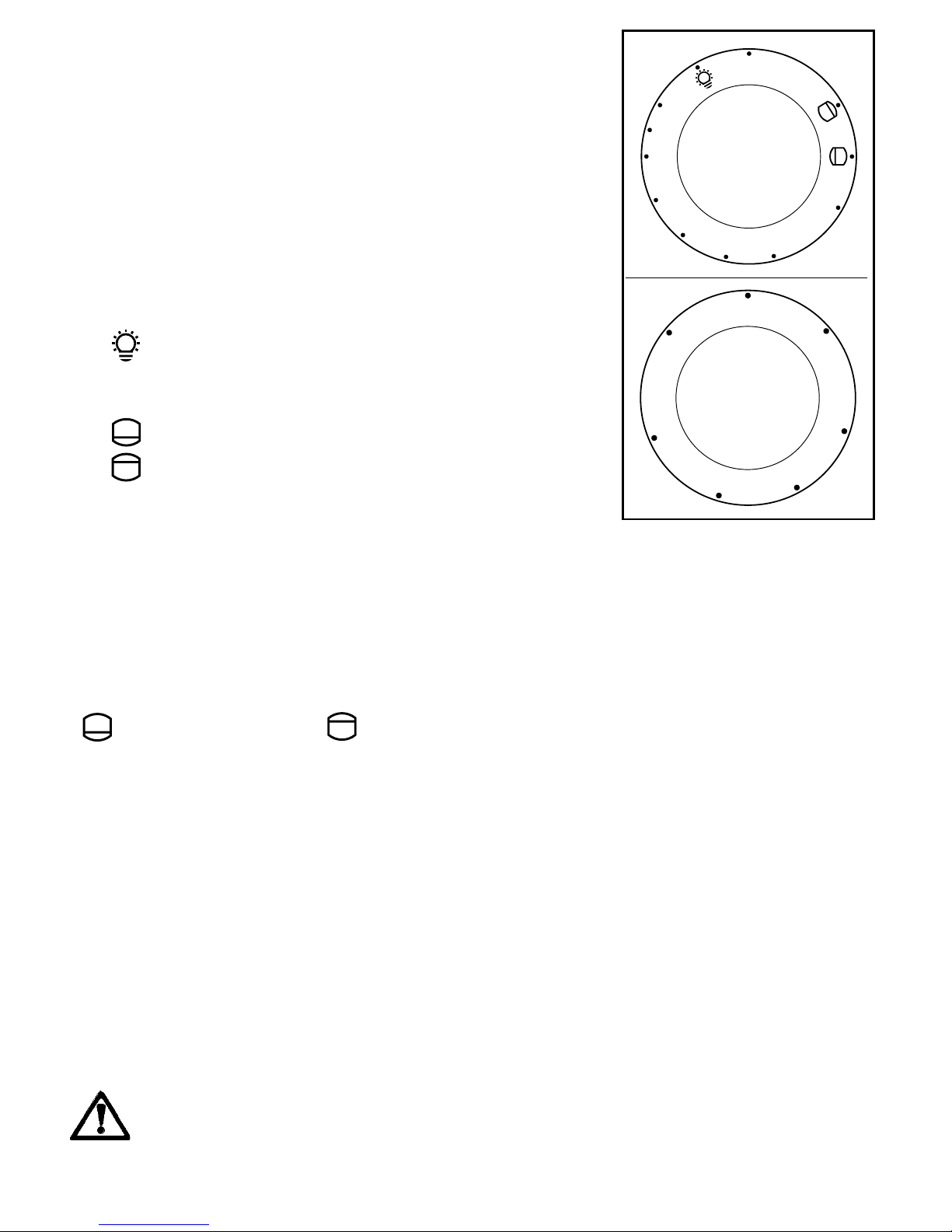
Meaning of the symbols:
Oven lamp
50-250 Range of temperature regulation
for conventional cooking
Bottom heating element
Top heating element
To select the temperature turn the switch in
a clockwise direction and place sign in front
of the symbol corresponding to the
temperature required, included between 5
and 25 °C.The temperature will be
maintained constant by the thermostat.
If a different type of heating is required, for
example more heat on the bottom or the top,
you should turn the switch to the symbols
(heat from below) or (heat from
above). In these conditions the temperature
will never exceed 25 °C.
Hotplate control knobs
The Control Knobs for the hotplates (Fig. 3)
can be found on the oven control panel. The
energy regulator of the hotplates can be set
by means of a 7-position control knob:
0=Off
1= Minimum
3= Maximum
The intermediate positions give an increasing
heating power.
Carefully supervise cookings with oil
or fats, since these types of food can
result in a fire, when over-heated.
Electric oven
0
0
10
0
5
5
10
0
20
5
20
FO 2623
Fig. 2
Fig. 3
Control lights
Oven thermostat control light: This light
goes off when the oven heats up to the
temperature set and comes on again every
time the thermostat cuts in to stabilize
temperature.
Operating control light: It indicates that
one or more of the heating elements are
turned on.
Safety thermostat
In order to avoid excessive overheating due
to incorrect use of the appliance or else to a
faulty component, the oven is equipped with
a safety thermostat which cuts off the power
supply if necessary. Operation is restored
automatically when the oven temperature
decreases to normal values. Therefore, if the
thermostat cuts in because you have not
been using the appliance correctly, the oven
can be used again simply by waiting for the
appliance to cool down. If, instead, the
thermostat cuts in because of a faulty
component, you should call the Service
Department.
0
1
2
3
FO 2143
47
Hints and tips for using t e oven
Alwa s cook with the oven door
closed.
Conventional cooking
Heat comes from the top and from the
bottom, therefore it is preferable to use the
central runners. If cooking requires more
heat from the top or from the bottom use
the top or the bottom runners.
Some hints
For baking cakes
Cakes require a moderate temperature
(normally between 15 and 2 °C). In
addition, the oven must be heated up
beforehand - for about 1 minutes.
The oven door should not be opened before
at least 3/4 of the set cooking time is up.
Normal short pastry dough should be cooked
in a mould or tin for 2/3 of total cooking time
required and then garnished as desired
before being cooked completely.
Clearly, the remaining cooking time depends
on the type of garnish used (jam, fruit, etc.).
Care should be taken to ensure that any
dough and cake mixes are of the right
consistency since an unduly moist mix
lengthens cooking time unnecessarily. The
raw dough or mix should therefore be fairly
difficult to detach from the spoon or beater.
For cooking meat and fish
Meat cooked in the oven should weigh at
least 1 kg to prevent it from becoming too
dry during cooking. Very tender red meat to
be cooked rare, i.e. well cooked on the
outside but extremely juicy inside, requires
high-temperature cooking (2 -25 °C).
White meat, poultry and fish instead require
low-temperature cooking (15 -175°C).
The ingredients for the accompanying sauce
or gravy should be put in the baking pan at
the very beginning only when cooking times
are short.Otherwise they should be added
during the last half hour. A simple way of
checking whether meat is done or not is to
press it with a spoon; if the meat does not
yield under this pressure it means that it is
done to a turn. In the case of roast beef and
fillet steaks, the inside of which should
remain fairly pink in color, cooking times
must be short. The meat can be cooked in
a baking pan or else directly on the shelf -
in this case a dripping pan must obviously
be placed underneath the shelf to collect
the juice. Once the meat is cooked, it is
advisable to let it rest for at least 15 minutes
before carving so that the juice does not seep
out. To prevent the formation of too much
smoke in the oven during roasting, it is a
good idea to pour a little water into the
dripping pan andto prevent steamto add
a little bit more during cooking if the original
amount dries up too much.
Before serving, the various courses can be
kept hot in the oven which should be turned
down to the minimum temperature.
Attention! - Do not place pans,
dripping pans, biscuit pans or
aluminium foil on the oven bottom.
This could cause a heat build-up
which would affect the baking results
and damage the oven enamel.
Cooking times
Cooking times vary according to the type of
food to be cooked, its consistency, and
volume.We suggest that you take particular
note of your first cooking experiments with
the oven, since operating in the same
conditions for the same dishes you will of
course obtain similar results.
Only experience will enable you to make
the appropriate changes to values given on
charts.

48
Roasting and baking table
Temperature
Shelf Cooking time
Type of dish
°C position in minutes
Mixture with beaten egg whites 175-2 1° 55-65
With raised mixture 175-2 2° 6 -7
White bread 175-2 1° 6 -7
Bread rolls 175-2 1° 3 -45
Shortpastry - pie base 175-2 3° 3 -4
Jam tarts 175-2 2° 5 -6
Tarte avec garniture sèche 175-2 2° 4 -5
Strudel 175-2 2° 8-1
Cheesecake 175-2 2° 25-35
Apply pie 175-2 2° 25-35
SMALL CAKES
Biscuits 15 -17 3° 15-2
Macaroni 15 -17 3° 25-35
Small quiches 15 -17 2° 25-3
Meringues 8 -1 2° 5 -7
MEAT
Roast beef 175-2 2° 12-15
every cm
of thickness
Duck 1 1/2 - 2 kg 22 -225 2° 12 -18
Goose 3 kg 2 -225 2° 15 -21
Chicken 1 kg 2 -21 2° 6 -9
Turkey 5 kg 175-2 2° 24
Rabbit 175-2 2° 9 -18
FLANS 17 -19 1° 35-4
Fish 17 -19 2° 4 -5
4
3
2
1
49
Before an cleaning switch the
oven off and let it cool down. This
appliance cannot be cleaned with
steam or with a steam cleaning
machine.
Important! Before carr ing out
maintenance and cleaning
operations, make sure that our
oven is disconnected from the
mains power suppl .
Cleaning must be carried out after the oven
has cooled down. Wash the enamelled parts
with lukewarm water and detergent. Do not
use abrasive products, such as steel wool
pads, acids etc. since these could damage
the various surfaces. Rinse stainless steel
parts with water after use, and dry them with
a soft cloth or chamois leather.
In the case of persistent stains, you can
use normal non-abrasive detergents or
products specific for stainless steel readily
available on the market. Another alternative
is a drop of hot vinegar.
When cleaning the oven door with the glass
top cover use just hot water, taking care to
avoid using coarse cloths or abrasive
products.
The hot acids of fruit (e.g. Iemons, stewed
prunes, etc.) leave difficult-to-remove stains
on the enamelled surfaces; this inconvenient
may remove enamel gloss, but, it does not
impair oven operation.
Clean the oven thoroughly after use; in this
way it will be possible to remove cooking
residuals more easily, thus avoiding these
from burning the next time the oven is used.
Replacing the oven light
Disconnect the appliance from its power
supply point. Push in and unscrew the glass
cap (Fig. 4). Unscrew the light bulb and
replace it with a new heat-proof bulb (3 °C)
having the following features: - Operative
Cleaning and Maintenance
FO 0030
Fig. 4
FO 0452
Fig. 5
tension: 23 V (5 Hz); - Power: 25 W; -
Fitting: E 14. Reconnect the appliance.
Oven door cleaning
For a better cleansing of the oven door, you
are suggested to remove it from the
appliance with the following procedure: open
tho door completely; lift the small levers
placed on the two hinges and turn the levers
towarde the inside (Fig. 5). Slowly close the
oven door, until it touches the two levers,
then push it towards the oven and remove it
by pulling it towards the outeide. Place the
door on a horizontal level. After cleaning,
assemble the door again by carrying out the
procedure described above backwards.
When the two small levers are placed again
on the hinges, the door will have been
accurately fit.
50
Tec nical Data
This appliance complies with the
following E.E.C. Directives:
- 73/23 - 90/683 (Low Voltage Directive);
- 89/336 (Electromagnetical Compatibility
Directive);
- 93/68 (General Directives)
and subsequent modifications.
This appliance can be connected to
variuos cast iron or ceramic hobs
lTraditional hobs
T p e : ZME 3 27
Maximum powerabsorbed 5,5 kW
Power supply voltage (5 Hz) 23 V
lCeramic hobs
T pe: ZME 3043 - LOGO 1
Maximum powerabsorbed 5,8 Kw
Power supply voltage (5 Hz) 23 V
Nominal heating power
lOven with traditional hob 7,325 kW
lOven with ceramic hob 7,625 kW
Dimension of the oven
recess
Height 59,5 cm
Width 56, cm
Depth 5 , cm
Dimensions of the oven
cavity
Height 32,5 cm
Width 44, cm
Depth 4 , cm
Capacity 58 dm3
Oven thermostat regulation: from 5 up to
25 °C
Heating elements
Oven lamp 25 W
Top Heating Element 8 W
Bottom Heating Element 1 W
Top + Bottom Heating Elements 18 W
Maximum Power absorbed: 1825 W
Operating Voltage (5 Hz) 23 V - 4 V
51
Instructions for t e installer
The instructions given below are
designed specifically for a qualified
installer and should aid him or her to
perform all installation, adjustment,
and maintenance operations with
absolute precision and in compliance
with all current legislation and
regulations. We strongly recommend
that all operations for the installation
of your cooker be carryed out by
Qualified Personnel in accordance
with existing rules and regulations.
Electrical connection
Prior to making the electrical connection,
make sure that:
 the protection fuse and the domestic
wiring system are suitable to carry the
total electric load of the oven (see rating
plate);
 your domestic wiring system has an
efficient earth connection in compliance
with rules and laws in force;
 the wall socket or the omnipole switch
used for the electrical connection can
easily be reached after the oven is built
in.
This appliance is delivered without an electric
supply cable, therefore, you will have to fit
to it a supply cable with standard plug,
suitable for the total electric load shown on
the rating plate. The plug is to be inserted
into a suitable wall socket. If you require a
direct connection to the electric network
(mains), it will be necessary to fit between
the appliance and the mains an omnipole
switch, with a minimum gap between
contacts of 3 mm, suitable for the required
load and in compliance with rules in force.
The green & yellow ground wire must not be
interrupted by the switch. The supply cable
must in all cases be laid out in such a way
as to ensure that it does not reach at any
given point a temperature 5 °C higher than
the ambient temperature.
Suitable power supply cables are the
following types, considering the respective
necessary section of cable: H 7 RN-F, H 5
RN-F, H 5 RR-F, H 5 VV-F, H 5 V2V2-F
(T9 ), H 5 BB-F.
Connecting the terminal
board
The appliance incorporates an easily
accessible 6-pole terminal board whose
jumpers (bridges) are already pre-set for
operation on 4 V tri-phase with neutral wire
(Fig.6). In case a different mains voltage is
present, the jumpers on the terminal board
must be rearranged as shown in the diagram
(Fig.7). The ground cable must be connected
FO 0330
Fig. 6
230V 3~ 1 2 3 4 5
L1 L2 L3 PE
230V 1~ 1 2 3 4 5
L1 N PE
400V 2N~
1 2 3 4 5
L1 L2 N PE
400V 3N~
1 2 3 4 5
L1 L2 L3 N PE
FO 0584
Fig. 7
52
to terminal . After connecting the supply
cable to the terminal board, secure it with a
junction clamp.
Electrical connection with
the hob
This oven can be connected to hobs
indicated in the paragraph "Technical data".
The socket for connecting the hob is located
at the top of the oven cabinet. The hobs come
complete with connecting leads for the hot
plates/heat areas and ground cable; these
leads feature plug-in connectors. Connection
of the hob to the oven is carried out by
plugging-in these connectors to the cor-
responding oven socket.
The plug-to-socket connection design is
such as to prevent possible wrong
plugging-ins.
The Manufacturer disclaims an liabilit
in case these accident-preventing rules
are not observed.