Wiring the vehicle:
If your car does not incorporate a 12S supplementary plug you are strongly
recommended to fit one. The 12N socket is fully utilised for road lighting, and the cable
used with the 12S system is of larger diameter and current capacity, more suited to the
needs of a modern caravan. Connections are made as in Figure 3.
The cable used must be minimum 2.5mm2 (50/0.25) cross sectional area. The
connection to terminal 4 on the 12S must be taken right back to the vehicle battery and
a 25 amp line fuse MUST be fitted in this line as near to the battery as possible. If you
are fitting a cable for a refrigerator, this goes to terminal 6 on the 12S, noting that a
separate cable must be run back to the battery again with a 25 amp line fuse. Do not
attempt to join terminal 6 to terminal 4, this will severely limit the charging current
available and will result in the fridge flattening the caravan battery.
A much better method is to wire the fridge through a relay so that it will operate only
when the ignition is on. A suitable relay is the ZIG RM.14 which comes complete with
fitting instructions and is simple to fit.
When the car wiring is complete, the caravan can be connected and the ZIG system
checked out as described in the "INSTRUCTIONS FOR USE".
Connecting the Mains:
The mains supply should be obtained from a domestic supply of 200 to 240 volts from a
fused connection point. If a 13amp household plug is used, this should be fitted with a 3
amp fuse. The cable used to connect the mains should be 3 core sheathed flexible
mains cable not less than 1.5mm2 cross sectional area and should be regularly
inspected for damage. When the mains supply is connected, switch on the MAINS ON /
OFF control on the C.F.8 and check that it lights up. Set the "TOURING/ON-SITE"
switch* to “ON SITE”, and temporarily disconnect the batteries (by removing the fuses).
Check that the12 volt equipment is working correctly. Re-connect the two batteries. The
installation is now complete.
Positive Earth Vehicles:
The ZIG C.F.8 is designed for use with negative earth systems, but can be modified if
required for use with positive earth systems. Further information is available on request
if required.
9
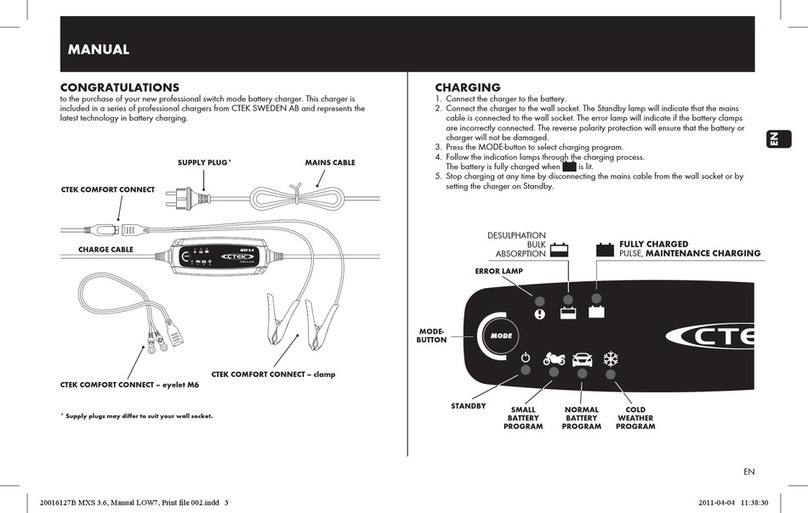
3. Charging from the Mains:
Ensure that a mains supply is available to your caravan through the external
mains input socket and set the "MAINS ON-OFF" to "ON". The "TOURING/
ON-SITE*" switch should be set to the "ON-SITE*" position. Automatic electronic
charging regulation is fitted to the C.F.8. This means that it will only charge
the battery as required and will not overcharge the battery.
N.B. Do not leave the charger switched on for long periods, when the caravan is
not is use.
4. Charging from the Vehicle:
When the vehicle is attached to the caravan and the "TOURING/ON-SITE"
switch* is set to the "TOURING" position (up position), charging of the auxiliary
battery will take place when the vehicle engine is running. The amount of charge
depends on a number of factors –the state of charge of both batteries, the
cable in use and the distance between the two batteries. Note that in
motorised caravans, charging from the vehicle requires only the setting of
the "TOURING/ON-SITE" switch* to "TOURING" and running the engine.
5. The Battery Condition Monitor*:
The purpose of this device is to warn that the caravan is becoming
discharged. The red light will glow when the battery voltage is below 11
volts, above this voltage the green light will glow. No harm will come to the
system or the battery if the accessories are used when red light is on, and it
will be found that possibly another few days reserve of current is available
after the red light first appears. A true reading will only be given when all the 12
volt equipment is switched off and when neither charging system is in
operation. The red light may come on when an appliance is switched on.
This is normal - current surges cause momentary voltage drop. It is important to
remember that the battery monitor is not a charging indicator. The fact that the
green light is on does not mean that the battery is fully charged. Even with a flat
battery the green light will glow if either charging system is operating, due to the
high terminal voltage present at the battery.
6. The Fuses*:
There are 4 fuses fitted to the C.F.8. The mains fuse is fitted in the smallest of
4 fuse-holders on the front panel and is rated at 2 amp (5 amp for 110V units): it
is a standard 20mm x 5mm glass quick blow fuse. This fuse-holder can only be
removed with a screwdriver (this is to comply with electrical safety regulations).
The three 10 amp fuses mounted on the right of the panel protect the various
accessories connected to the ZIG system and are standard 11/4" glass quick-
blow fuses. The fuses are removed by turning the cap anticlockwise. All the
fuses are available worldwide from electrical and radio dealers. Under no
circumstances should a fuse of a different type or value be fitted.
WARNING
In the event of a fuse blowing there is a fault in the circuit protected by that
fuse, and the cause should be ascertained before replacing the fuse. It is
important to remember that a fuse is fitted for the protection of the circuit
and is a safeguard against fire and injury. Never remove the front panel with
mains, battery or car connected. There are no user serviceable parts inside.
2