The NMEA 0183 Information sheet
Page 7© 2006 Active Research Limited
Connecting devices together
Actisense™ produces a full range of products to solve
all NMEA interfacing and interconnection requirements,
including:
PC OPTO-Isolation cables
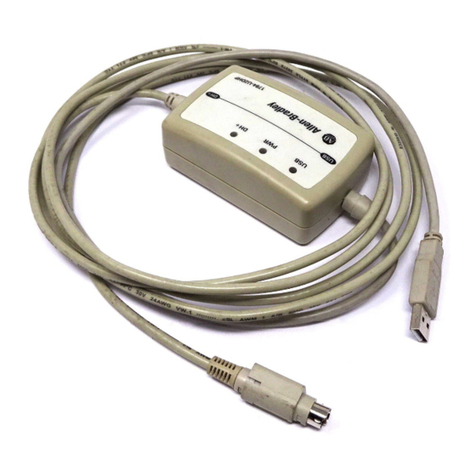
The Actisense™ PC-OPTO-1 & 2 allow a PC to safely
receive data from an NMEA 0183 system, protecting
against high voltage spikes and preventing dangerous
ground loops. The cable converts neatly between the
differential system used on the NMEA 0183 and the
“single-ended” RS232 system to provide the best quality
of data for the PC port.
NMEA Data Multiplexers / Combiners
The Actisense™ NDC-2 & NDC-3 can allow multiple
“Talkers” to easily share their data with other NMEA 0183
“Listener” devices.
The NDC-2 also allows for filtering of the NMEA 0183 data
to remove any unwanted data, and has a wide range of
input / output Baud rates to match any NMEA device.
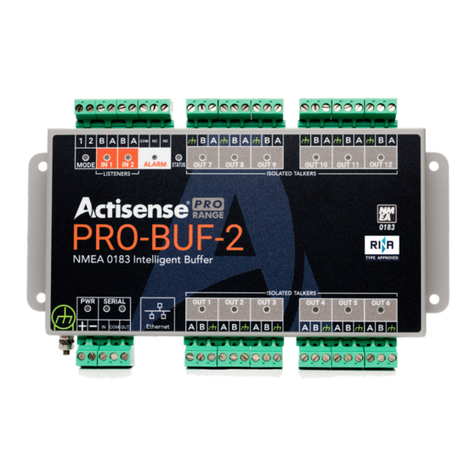
NMEA Buffers
The Actisense™ NBF-1 can allow many more NMEA
0183 devices to receive the data from one source by
buffering and amplifying the signal. If you require more
than one source (“Talker”) of data, an Actisense™ NDC
can easily be used before the NBF.
NMEA Autoswitches
The Actisense™ NSW-1 can enable automatic switching
of two or more NMEA 0183 source (“Talker”) devices to
select the highest priority device with valid data - in effect
- automatic backup protection.
This can be used to select the highest priority GPS unit,
and automatically switch to the next highest priority GPS
device if the first fails for one of a number of reasons.
Please visit the Actisense™ website for full details on
these and other Actisense™ interfacing, Depth sounding
and Sonar product ranges.
The NMEA 0183 signals
The NMEA 0183 system v2.0 and later uses a ”differential”
signalling scheme, whereby two wires are used to transmit
the NMEA data. These connections will be labelled as
either NMEA “A” and “B“ or NMEA “+” and “-“ respectively,
depending on the instrument and manufacturer.
When connecting between different manufacturers, there
can be some confusion, but it is simple and easy to
remember: NMEA “A” connects to NMEA “+” and NMEA
“B“ connects to NMEA “-“.
The different versions of the
NMEA 0183 standard
As the NMEA 0183 specification has slowly evolved over
the years, connecting one device to another is not always a
simple matter. The earlier versions of NMEA 0183 (before
v2.0, as detailed above), used slightly different connection
methods and signal levels: devices had just one “NMEA”
data line (‘Tx’ or ‘Out’), and used the ground as the other
line - similar to a computer serial port. This connection
method is referred to as “single ended” instead of the
“differential” method used by NMEA 0183 v2.0 devices.
The data format is largely the same between both
systems, with v2.0 adding some extra sentence strings,
and removing older (redundant) sentence strings from the
specification. The situation is further complicated, as many
manufacturers still use the old (“single ended”) method of
connection because it is cheaper to implement.
So how can an older type NMEA device be connected
to a newer type device? Care is needed – it is possible
to damage or overload the output of a newer differential
device if it is incorrectly connected to an older device. This
is because the older devices used ground as the return,
whereas the newer devices actually drive the NMEA “-/
B” line between 5v and 0v. Thus, connecting this output
to ground will result in high currents being drawn by the
driver instrument, resulting in potential overheating and
damage to the driver circuits.
To connect a new type differential talker to an old type
single-ended listener, connect the NMEA “+/A” output
from the differential driver of the talker to the single-ended
NMEA “Rx” or “In” input of the listener. Leave the NMEA “-/
B” output floating. Connect the ground line of the differential
output device to the ground of the single-ended device.
This provides the required data signal return current path.
To connect an old type single-ended talker to a new type
differential listener, connect the NMEA ”Tx” or “Out” output
from the single-ended talker to the differential NMEA “+/
A” input of the listener. Connect the ground line of the
single-ended output device to the NMEA “-/B” input of the
differential device. This provides the data signal return
current path. If the NMEA “-/B” input is left floating, then
data corruption / errors may occur.