manuals.online logo
Brands
  1. Home
  2. •
  3. Brands
  4. •
  5. AMX
  6. •
  7. Keypad
  8. •
  9. AMX MIO-ATTACHE User manual

AMX MIO-ATTACHE User manual

Other manuals for MIO-ATTACHE

2

This manual suits for next models

2

Other AMX Keypad manuals

AMX Metreau MET-7 User instructions

AMX

AMX Metreau MET-7 User instructions

AMX Mio Modero DMS User manual

AMX

AMX Mio Modero DMS User manual

AMX AXD-MSP16 User manual

AMX

AMX AXD-MSP16 User manual

AMX METREAU MET-13E User manual

AMX

AMX METREAU MET-13E User manual

AMX Novara CP-1008-US User manual

AMX

AMX Novara CP-1008-US User manual

AMX Metreau MET-13 User manual

AMX

AMX Metreau MET-13 User manual

AMX PLK-DMS Guide

AMX

AMX PLK-DMS Guide

AMX PLK-SBR Guide

AMX

AMX PLK-SBR Guide

AMX PRO-DP16 DECOR PROLINK FLUSH MOUNT KEYPAD... User manual

AMX

AMX PRO-DP16 DECOR PROLINK FLUSH MOUNT KEYPAD... User manual

AMX MIO-ATTACHE User manual

AMX

AMX MIO-ATTACHE User manual

AMX MIO-CLASSIC-D User manual

AMX

AMX MIO-CLASSIC-D User manual

AMX Novara 1000 Series Parts list manual

AMX

AMX Novara 1000 Series Parts list manual

AMX WPU4 User manual

AMX

AMX WPU4 User manual

AMX Mio Modero Prestige User manual

AMX

AMX Mio Modero Prestige User manual

AMX Mio Modero Classic User manual

AMX

AMX Mio Modero Classic User manual

AMX Metreau MET-7 User manual

AMX

AMX Metreau MET-7 User manual

AMX PLK-MSP16 User manual

AMX

AMX PLK-MSP16 User manual

AMX Metreau MET-13 User instructions

AMX

AMX Metreau MET-13 User instructions

AMX RSP Guide

AMX

AMX RSP Guide

AMX Novara 1000 Series Parts list manual

AMX

AMX Novara 1000 Series Parts list manual

AMX MIO-DMS Guide

AMX

AMX MIO-DMS Guide

AMX MIO-PRESTIGE-S Guide

AMX

AMX MIO-PRESTIGE-S Guide

AMX Mio Modero DMS User manual

AMX

AMX Mio Modero DMS User manual

AMX DMS Pinnacle Guide

AMX

AMX DMS Pinnacle Guide

Popular Keypad manuals by other brands

AAA 6150RFAAA Installation and setup guide

AAA

AAA 6150RFAAA Installation and setup guide

Fermax MDS Installation and programming manual

Fermax

Fermax MDS Installation and programming manual

ACT ACT PRO 1030 manual

ACT

ACT ACT PRO 1030 manual

Cardin SSB Series manual

Cardin

Cardin SSB Series manual

Harman Kardon KP 1 Specifications

Harman Kardon

Harman Kardon KP 1 Specifications

CYP CR-KP1 Operation manual

CYP

CYP CR-KP1 Operation manual

Aeware k-35 Series Quick reference card

Aeware

Aeware k-35 Series Quick reference card

Aritech CS-175 Series user guide

Aritech

Aritech CS-175 Series user guide

Lenze AC Tech MC SERIES installation instructions

Lenze AC Tech

Lenze AC Tech MC SERIES installation instructions

Burg Wächter secuENTRY 7711 operating instructions

Burg Wächter

Burg Wächter secuENTRY 7711 operating instructions

Aeware in.k450 Tech book

Aeware

Aeware in.k450 Tech book

Lenze EPM-H410 operating instructions

Lenze

Lenze EPM-H410 operating instructions

Toshiba RKP007Z user manual

Toshiba

Toshiba RKP007Z user manual

Elmes Electronic KB1 quick start guide

Elmes Electronic

Elmes Electronic KB1 quick start guide

Clare Controls ClareOne CLR-C1-PNC Installation sheet

Clare Controls

Clare Controls ClareOne CLR-C1-PNC Installation sheet

FM Electronics 4180 quick start guide

FM Electronics

FM Electronics 4180 quick start guide

why pro WHY-KP user manual

why pro

why pro WHY-KP user manual

GE NetworX NX-1500E user manual

GE

GE NetworX NX-1500E user manual

manuals.online logo
manuals.online logoBrands
  • About & Mission
  • Contact us
  • Privacy Policy
  • Terms and Conditions

Copyright 2025 Manuals.Online. All Rights Reserved.

Installation Guide
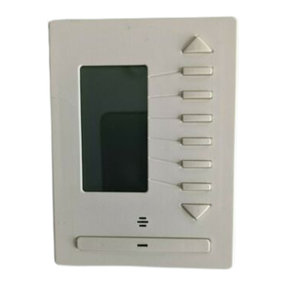
Mio Attaché Remote Keypad Device
Overview
The Mio Attaché (FG5799-01) is a remote keypad device that uses both 38 and
455 KHz AMX IR frequencies. The Attaché also has an LCD fixed menu system
that doubles as a button.
Specifications
The Mio Attaché Wake Up State
The Mio Attaché offers a programmable sleep mode to conserve battery life
when the unit is not in use. The Mio Attaché wakes upon the user's touch of the
metal trim ring or when a button is pressed, and remains in an active state for a
set period of time. After a predefined amount of time of inactivity, the unit returns
to the sleep mode and all button lights are turned off to conserve battery life.
Note: While charging directly through the PS4.4 power supply, the Mio Attaché
will not enter sleep mode.
Installing The Battery
The Mio Attaché is equipped with a lithium-ion rechargable battery. The battery
is charged from a PS4.4 power supply through either a DC power jack located
under the kickstand or through the optional Docking Station.
1. Extend the kickstand on the Mio Attaché to the upright position, exposing
two screws on the battery door (FIG. 2).
2. Remove the two screws holding the battery door in place.
3. Plug in the connector attached to the battery pack. The mating connector is
located at one end of the battery compartment and is "keyed" to prevent it
from being plugged in the wrong way.
Charging The Attaché with the Provided Power Supply
The Mio Attaché can receive power for charging from an AMX PS4.4 power
supply through a barrel-plug connector. When the battery is charging from
complete depletion, the battery does a trickle charge where it starts gradually
and ramps up to full charge.
1. Extend the kickstand on the Mio Attaché to the upright position, exposing
an external power port, 2.1 mm barrel-style power jack (FIG. 2).
2. Connect the terminal end of the PS4.4 power supply to the external power
port on the Mio Attaché.
3. Connect the PS4.4 AC power cord to an external power source. The
charging LED on the Attaché illuminates red to indicate it is charging and
turns blue when it is done. The LED is off after completion of charge cycle.
Full charge cycle for a depleted battery is approximately 3 hours.
Changing Buttons
The Mio Attaché is shipped with "installation" buttons; they are intended to be
place holders until your engraved buttons, designed with KeypadBuilder, arrive.
To switch out "installation" buttons:
1. Pry the button using the slot on the front of the "installation" buttons to
remove them from the Mio Attaché.
2. Select the location of the custom buttons and snap them into place. Be
sure to note the orientation of the white insert on the back of the button, the
notch must be down. Insert the bottom of the button first and then push the
top into place.
To change custom buttons:
1. Using a thin, nonconductive probe, pry between the buttons to pop one
free.
2. Snap the desired custom buttons into place. Be sure to note the
orientation of the white insert on the back of the button, because the notch
must be down. Insert the bottom of the button first and then push the top
into place.
Be certain to reprogram the Mio Attaché to match the new button arrangement;
use KeypadBuilder to assign the locations. Please refer to the KeypadBuilder
Instruction Manual, available at www.amx.com.
KeypadBuilder
Most functionality of the Mio Attaché is handled using the application,
KeypadBuilder. Go to www.amx.com for the KeypadBuilder Instruction Manual.
FIG. 1 The Mio Attaché
Mio Attaché (FG5799-01) Specifications
Battery Lithium-ion, with approximately a 3-hour charge time.
Transmission Frequencies AMX 38 KHz/455 KHz IR
Transmission Range
(distance) with Mio IR
Receiver
• 100 feet at 38KHz (direct line of sight)
• 40 feet at 455KHz (direct line of sight)
Transmission Range
(angle)
• 270° horizontally and vertically from an axis
extending from the end of the remote.
Top Components • LCD - SPI controlled 96 x 96 pixel resolution,
monochrome FSTN display with an
Electroluminescent backlight; an active button.
• Pushbuttons - a maximum of 20 backlit custom
buttons.
• LEDs - blue backlit buttons with red indicating a
button press
Front Component • Charging LED - Red; ON indicates active charging.
Blue; ON indicates charged. OFF indicates charge
complete.
Rear Component • Programming Port - 2.5 mm stereo female
conductor jack
• External Power Port - 2.1mm barrel-style, DC power
jack
Operating Environment: • Operating Temperature: 0° to 50° C (32° to 122° F)
• Storage Temperature: -10° to 70° C (14° to 158° F)
Dimensions (HWD) 2.47 (62.74 mm) x 9.63 (244.60 mm) x 5.38 (136.65
mm)
Supported Languages: • Arabic
• English
• French
•German
•Greek
• Hebrew
• Hindi
• Italian
• Japanese
• Korean
• Mandarin
Chinese
• Portuguese
• Russian
• Spanish
• Thai
Weight 1.90 lbs (0.86 kg)
Included Accessories • PS4.4 Power Supply (13.5 VDC) (FG423-44)
• Lithium-ion Battery Pack (FG5799-20)
Other AMX Equipment • Custom buttons: FG5796-21BL (4 single buttons);
FG5796-22BL (2 double buttons)
• Blank buttons: FG5795-07BL
• Lithium-ion Battery Pack (FG5799-20)
• Programming Cable - a 3 wire, 2.5 mm stereo jack
(FG10-817)
• Docking Station (FG5799-10)
FIG. 2 Mio Attaché Bottom Components
Kickstand extended
Battery door screws
Power jack
Battery door
Programming jack
Battery pack connector

For full warranty information, refer to the AMX Instruction Manual(s) associated with your Product(s).
4/08
©2008 AMX. All rights reserved. AMX and the AMX logo are registered trademarks of AMX.
AMX reserves the right to alter specifications without notice at any time.
3000 RESEARCH DRIVE, RICHARDSON, TX 75082 • 800.222.0193 • fax 469.624.7153 • technical support 800.932.6993 • www.amx.com
93-5799-01 REV: B
Using Connector Ports on The Attaché
The programming jack is used for communication between the device and
KeypadBuilder. The programming jack uses a three-wire, 2.5 mm stereo jack;
you can order the programming cable (FG10-817) from AMX if you do not
currently possess one. The baud rate is 115200.
To download KeypadBuilder Configuration Files:
1. Extend the kickstand on the Mio Attaché to the upright position, exposing
two screws on the battery door. Remove the two screws holding the
battery door in place, exposing the programming port within the battery
compartment, 2.5 mm stereo female conductor jack.
2. Connect the 2.5 mm stereo plug (male) end of the programming cable
(FG10-817) into the programming port shown in FIG. 3.
3. If necessary, connect the DB-9 end of the programming cable to the
female DB-9 connector on the DB-9 extension cable (FG10-727).
4. Connect the female DB-9 terminal end of the extension cable to the port
on the back of your computer.
5. Configure the communication parameters in KeypadBuilder.
Setting The IR Frequency
The Mio Attaché is set to the IR frequency 38KHz by default. Use the IRMODE
Serial Command to change the frequency to 455KHz. To set the frequency to
455KHz:
1. Establish a HyperTerminal session with your device.
2. Send "IRMODE 455" to the device.
3. Close the HyperTerminal session.
The command, "IRMODE 38" switches the device back to 38KHz.
Persistent Serial Commands
The Attaché recognizes a select number of persistent commands. Establish a
HyperTerminal session with your device to use the following commands:
Sending Firmware to The Mio Attaché
NetLinx Studio is required to update firmware located on the Mio Attaché. To
send firmware to the device:
1. Open NetLinx Studio.
2. Go to Tools > Firmware Transfers > Send to Axcess Device... This
opens the Send to Axcess Dialog Window .
3. Browse to the location of the firmware file.
4. Select the file within the Files frame.
5. Click Query for Devices.
6. Select the Mio Attaché within the Devices frame.
7. Click Send and then Close.
8. Upon confirmation of a successful send, exit NetLinx Studio.
FIG. 3 Connecting The Keypad Device to Your PC
Serial Commands
BATT Display Battery Level
Syntax:
"'BATT,#'"
Variables:
# = 0 through 4; 0 turns the display off, 1 - 4 indicates the line of
display on the LCD.
Example:
"'BATT,2'"
Displays the battery level on line 2 of the LCD.
Stereo plug male DB-9 connector
Cable FG10-817 to cable FG10-727
to PC
programming
cable
Keypad device
Programming
jack
Power
jack
Serial Commands (Cont.)
@BRT Set Brightness level
Syntax:
"'BRIT-<tag>,<awake brightness level>,<sleep
brightness level>'"
Variables:
brightness level # = a value from 0 - 32.
tag = Red or Blue; affected LCDs
"'@BRT-#'" (Set LED Awake brightness level)
"'@BRT-#,#'" (Set LED Awake brightness level, sleep brightness
level)
"'@BRT-tag#'" (Set Red or Blue LED, brightness level)
"'@BRT-tag,#,#'" (Set Red or Blue LED, awake brightness level, and
sleep brightness)
Example:
(1) "'@BRT-16'"
Sets the awake brightness level to 50%.
(2) "'@BRT-32,5'"
Sets the awake brightness level to 100% and sleep brightness level
to approximately 15%
(3) "'@BRT-RED,32'"
Sets the red LED awake brightness level to 100%.
(4) "'@BRT-BLUE,32,5'"
Sets the Blue LED awake brightness level to 100% and sleep
brightness level to approximately 15%
^CFG
Not
Persistent
Combine/Uncombine adjacent buttons
Syntax:
"'^CFG- <command value>'"
Variables:
command value = (1= configuration ON, 0= configuration OFF).
Example:
"'^CFG-1'"
Set the Key Pad to button combine mode
@CST- Sets the display contrast for the device.
Syntax:
"'@CST-<Contrast Level>'"
Variables:
Contrast Level = a value from 0 - 31.
Example:
"'@CST-15'"
Sets the display contrast to approximately 50%.
IRMODE # Sets the IR transmission frequency to either 455KHz or 38KHz.
Syntax:
"IRMODE #"
Variables:
# = 455 or 38
Example:
"IRMODE 455"
Sets the IR transmission frequency to 455KHz.
SLEEP-# Force the device into screen saver mode.
Syntax:
"'SLEEP-#'" (timed sleep; a persistent command)
Variables:
# = 0 - 60 in seconds; time to wait before going to sleep. Default is 30.
0 sets the device to never sleep.
Example:
"'SLEEP-45'"
Forces the device into screen saver mode after 45 seconds.