manuals.online logo
Brands
  1. Home
  2. •
  3. Brands
  4. •
  5. ATIGO
  6. •
  7. Intercom System
  8. •
  9. ATIGO A3200 User manual

ATIGO A3200 User manual

Other ATIGO Intercom System manuals

ATIGO A3101 User manual

ATIGO

ATIGO A3101 User manual

ATIGO A901S User manual

ATIGO

ATIGO A901S User manual

ATIGO A1001 User manual

ATIGO

ATIGO A1001 User manual

ATIGO A3203 User manual

ATIGO

ATIGO A3203 User manual

ATIGO A1712 User manual

ATIGO

ATIGO A1712 User manual

ATIGO A1701 User manual

ATIGO

ATIGO A1701 User manual

ATIGO A3101 User manual

ATIGO

ATIGO A3101 User manual

ATIGO A3101 User manual

ATIGO

ATIGO A3101 User manual

Popular Intercom System manuals by other brands

Videx VRDK1 (25H) Technical manual

Videx

Videx VRDK1 (25H) Technical manual

Auta COMPACT VISUALTECH manual

Auta

Auta COMPACT VISUALTECH manual

Aiphone LC-10S instructions

Aiphone

Aiphone LC-10S instructions

Aiphone PD-1 instructions

Aiphone

Aiphone PD-1 instructions

Aiphone JF-DVF-HID-I instructions

Aiphone

Aiphone JF-DVF-HID-I instructions

Comelit 4893M Technical manual

Comelit

Comelit 4893M Technical manual

MGL Avionics V16 manual

MGL Avionics

MGL Avionics V16 manual

SSS Siedle BVI 750-0 Installation & programming

SSS Siedle

SSS Siedle BVI 750-0 Installation & programming

urmet domus AIKO 1716/1 quick start guide

urmet domus

urmet domus AIKO 1716/1 quick start guide

urmet domus IPerVoice 1039 Installation

urmet domus

urmet domus IPerVoice 1039 Installation

Alpha Communications STR QwikBus TT33-2 Installation, programming, and  user's manual

Alpha Communications

Alpha Communications STR QwikBus TT33-2 Installation, programming, and user's manual

Monacor ICM-20H instruction manual

Monacor

Monacor ICM-20H instruction manual

Logenex A202CR Installation & programming

Logenex

Logenex A202CR Installation & programming

Quantum QR5 Installation and programming manual

Quantum

Quantum QR5 Installation and programming manual

EVGA XR1 quick guide

EVGA

EVGA XR1 quick guide

CyberData 011211 series Installation quick reference

CyberData

CyberData 011211 series Installation quick reference

Vidos duo M1021 user manual

Vidos

Vidos duo M1021 user manual

Savant DOR-SMS-00 Deployment guide

Savant

Savant DOR-SMS-00 Deployment guide

manuals.online logo
manuals.online logoBrands
  • About & Mission
  • Contact us
  • Privacy Policy
  • Terms and Conditions

Copyright 2025 Manuals.Online. All Rights Reserved.

Page | 1
2-Wire Audio
System
Installation Manual
2 | P a g e
Introduction
The Atigo door entry system is a simple 2-
wire solution that can be expanded up to 4
entrance panels and 32 handsets.
Programming of the audio module is done via
built in DIP switches and touch keys.
The audio module has built in visual and
audible status indictors.
Installation Notes:
Wire up the system in accordance with the
Wiring diagram supplied.
Make sure A2300 is installed local to the
Power supply when installing multiple
Entrances
Set each Door Station ID as per instructions
on Page 3
Set the address for each handset by following
programming instructions supplied with the
unit.
System Layout:
Maximum of 4 handsets can be connected to
a single call button.
Maximum of 32 handsets can be connected in
Daisy-Chain or Star configuration.
3 | P a g e
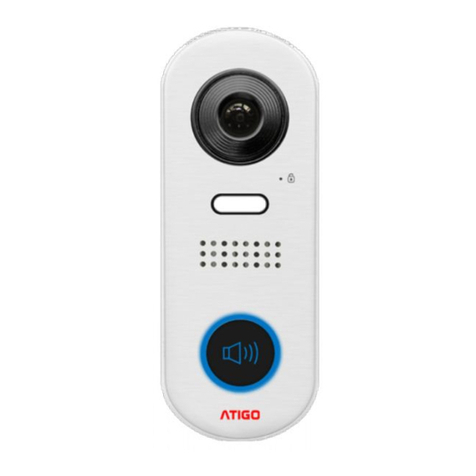
Audio module A3200
1. SET
DIP switches for system configuration.
2. JP-LK
Jumper for setting state of the NO contact
3. CN/KMB
Call button module A2400 connection port
4. CN/T-COIL
Not in use
5. BUS
L1, L2 bus line connecting to terminal
BUS(DS) on the power supply
6. CN-LK
+12V 12VDC power output.
LK- Power ground.
LK+ Common contact of the relay.
NO Normally open/closed contact (use
JP-LK jumper to set)
EB+ Exit button connection port.
EB- Exit button connection port.
7. CN/FUN
Not in use
8. CN/WGN
Not in use
DIP switch settings for A3200
The audio module is configured by 6 DIP
switches.
The DIP switches can be modified either
before or after installation. Restarting the
Audio module is necessary whenever the DIP
switches have been modified.
DIP switches 1 and 2 are for addressing door
station(s).
When multi door stations are installed on the
system, these two DIP switches must be set
correctly.
Door station DIP switch setting:
No.1 = 00 (Default setting)
No.2 = 10
No.3 = 01
No.4 = 11
DIP switch 3 needs to be set to 0 for
mechanical call button operation.
DIP switch 4 is for call button automatic
allocation. Call buttons are automatically
assigned to the indoor unit. The default setting
for this DIP switch is 0
DIP switch 5 is for setting door unlock time. 0
is the default setting for one second delay and
1 is the setting for five seconds delay.
DIP switch 6 is for activating keys A and B
which are used for programming audio module
functions.
The default setting for this DIP switch is 0.
4 | P a g e
Audio module functions and
programming
Restore factory settings
With Audio Module in standby, short out the
Exit Button Ports (EB+ and EB-) and toggle
DIP switch 6 four times.
A long Beep will sound, and allthree indicators
will blink at the same time meaning the
Restore Factory Settings is in progress.
Once the three Indicators turn off with a
warning sound of a long Beep, it means the
Restore Factory Settings is complete.
Activate Programming mode and
touch keys, A and B
Key A and key B cannot be used on the audio
module until activated.
To activate the keys and set the unit to
programming mode, put DIP switch 6 to ON
position.
DIP switch 6 must be set to ON.
Other DIP switches must be set to OFF.
When programming is finished, put DIP switch
6 back to OFF position.
Sound theme settings.
When the Audio Module is in programming
mode:
1. Press and hold Key A for 3 seconds to
enter the Sound Theme Mode.
2. The Status indicator will turn on and
current theme sound, will play.
3. Press Key A again to play the next theme.
4. Press Key B to exit.
Sound volume settings.
When the Audio Module is in programming
mode:
1. Press Key B to enter Tune Volume
Setting, theTalk indicator will turn on and
play the sound at the current volume.
2. Press Key A to increase/decrease the
volume (loop setting)
3. Press Key B to exit.
Talk volume settings.
1. During the conversation, press and hold
Key B for 3 seconds to enter the Talk
Volume Setting.
The Talk indicator will turn on with a long
Beep followed by a short Beep.
2. Press Key A to increase/decrease the
volume (loop setting).
3. Press Key B to exit.

5 | P a g e
Electric lock mode settings
Set the Audio Module in to Programming
mode:
1. Press Key A, the Unlock Indicator will
turn on with the warning sound of a long
Beep followed by a short Beep!
2. Press Key A again to select lock mode:
a. Fail Locked Lock Mode = 0 (default)
Contact status: Normally Open
The Status indicator blinks once with the
warning sound of a single long Beep.
b. Fail Unlocked Lock Mode = 1
Contact status: Normally Closed
The Status indicator blinks twice with the
warning sound of a long Beep followed by
a short Beep.
Lock time delay setting
When the Audio Module is in programming
mode:
1. Press Key A. The Unlock indicator turns
on with the warning sound of a long Beep
followed by a short Beep.
2. Press Key B and hold for desired lock
opening time.
The Unlocking Time delay is indicated by the
number of times that the Status indicator
blinks (set in seconds). For example: The
Status indicator blinks four times, that means
the unlocking time is 4 seconds.
Electric lock with additional
power supply.
1. Contact rating is limited to 24V DC and
MAXIMUM CURRENT of 1000mA.
2. The jumper JP-LK must be taken off
before connecting.
3. Set electric lock mode using touch keys A
and B
Fail Locked Lock Mode = 0
(default)
Fail Unlocked Lock Mode = 1
6 | P a g e
Electric lock powered by internal
12V DC output.
Internal output is limited to 12V DC and
MAXIMUM CURRENT of 200 mA.
Jumper setting JP-LK:
1-2 Normally Closed (Fail Unlocked)
2-3 Normally Open (Fail Locked)
Normally Closed (Fail Unlocked)
12V DC 200mA MAX
Normally Open (Fail Locked)
12V DC 200mA MAX
Triggering a Gate automation:
When triggering a gate, must use A2601
auxiliary relay.
NOTE: Do not connect Gate contacts to
Video module as this will cause permanent
module damage.
7 | P a g e
Terminals
1. INPUT
Connect to CN/KMB port on audio module
2. OUTPUT
Connect to next call module.
3. J3
Call buttons 1, 3, 5, 7
4. J4
Call buttons 2, 4, 6, 8
Single module connections
Connecting multiple modules
(Max. 4)