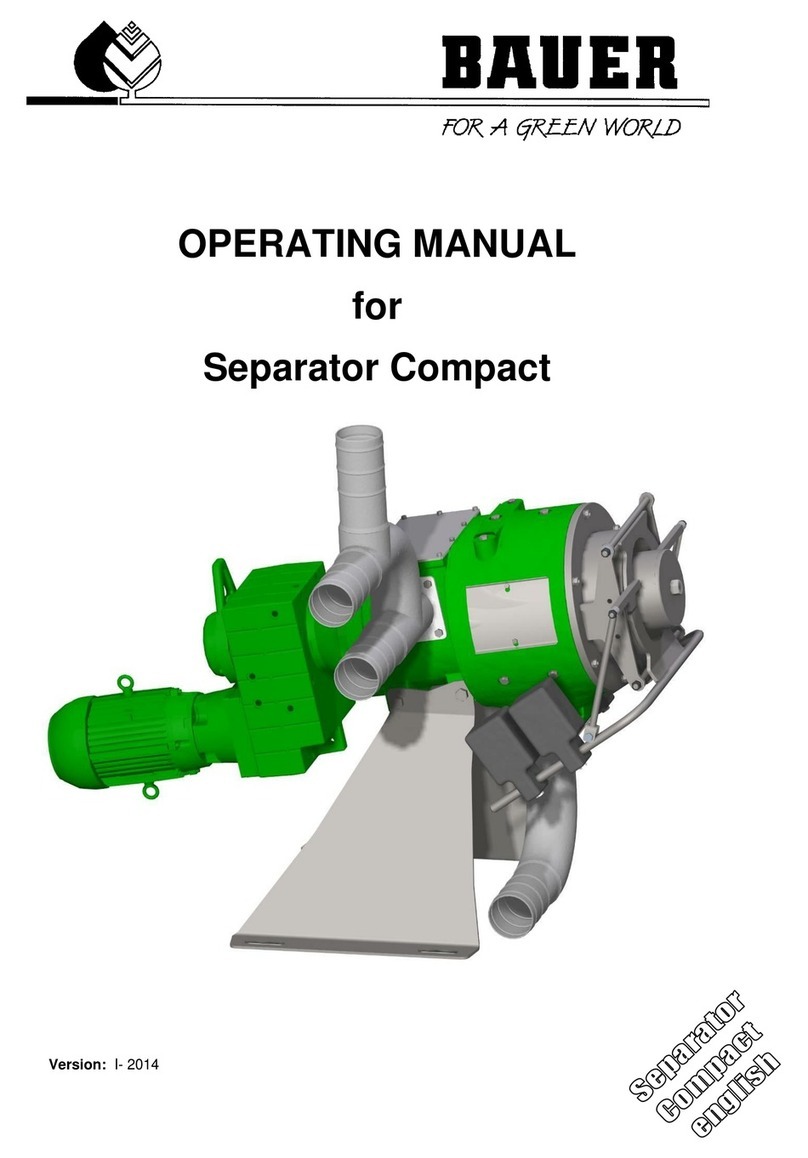
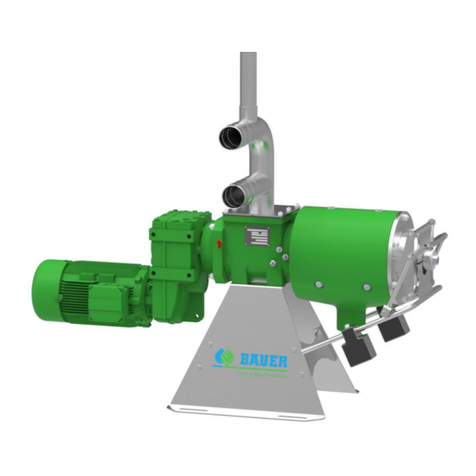
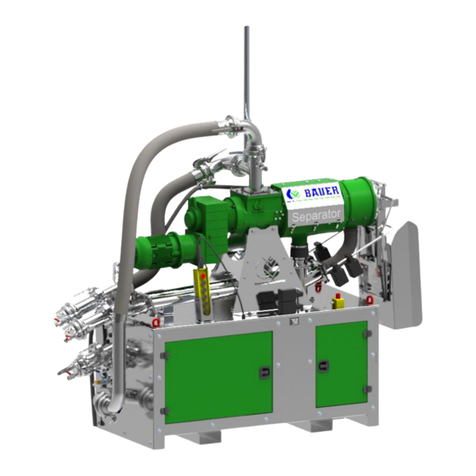
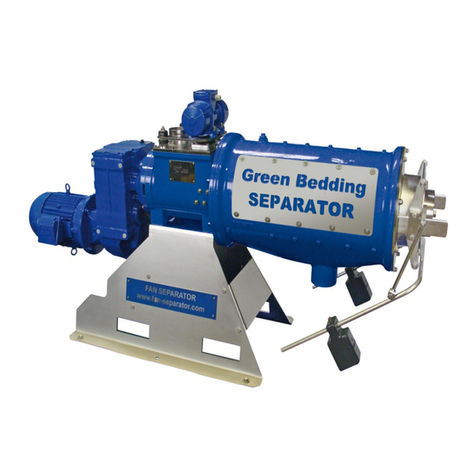
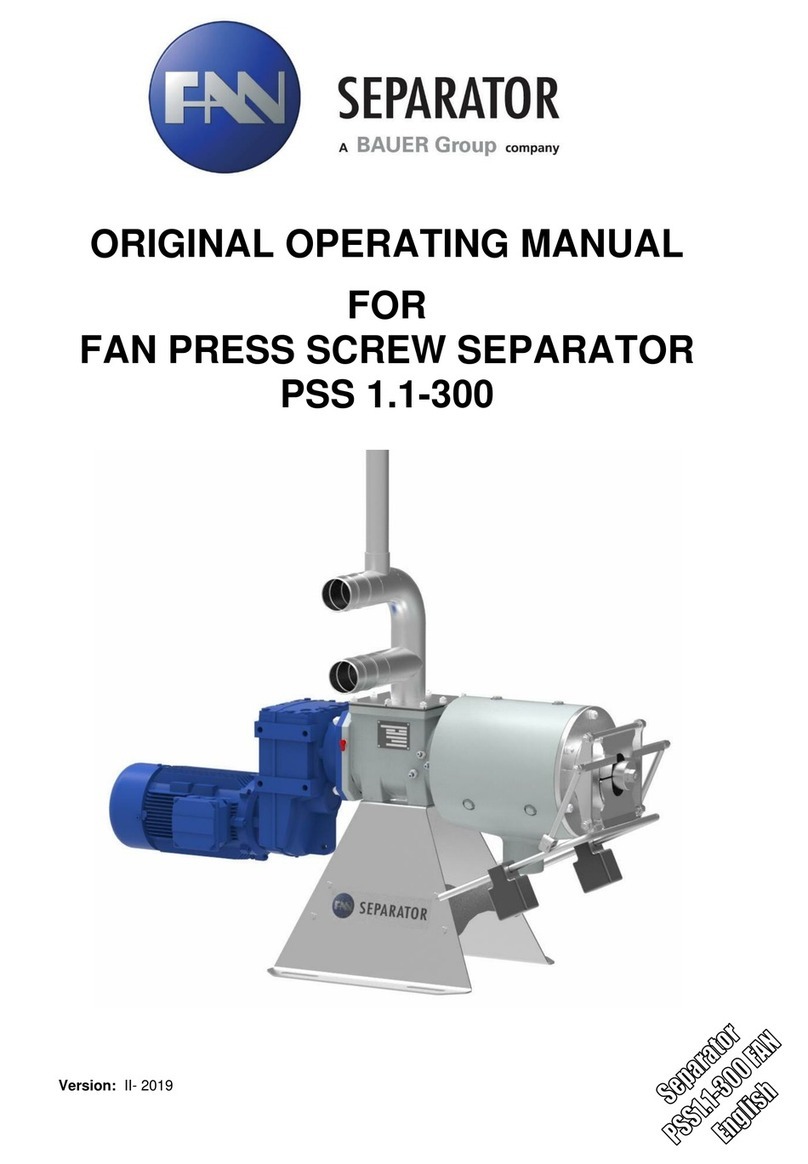
Bauer PSS 1.2 Installation instructions

ORIGINAL OPERATING MANUAL
FOR
FAN PRESS SCREW SEPARATOR
Version: I- 2019
PSS 3.3
PSS3.3-780
PSS 5.2
PSS5.2-520
PSS5.2-780
PSS5.2-1040
PSS 1.2
PSS 1.2-520
PSS 1.2-780
PSS 3.2
PSS3.2-520
PSS3.2-780
PSS3.2-1040

II
Betriebsanleitung für FAN Press Schnecken Separator PSS 1.2/3.2/3.3/5.2
/5.2S
Thank you for buying a FAN PRESS SCREW SEPARATOR!
This operating manual is an important document that describes the operation and maintenance of
the FAN PRESS SCREW SEPARATOR.
All information contained in this manual is based on the latest product details available at the time of
printing. If you need still more information, please ask your dealer or contact the FAN Separator
company directly.
Please note that the content of this manual neither constitutes part of nor alters in any way any previ-
ous or existing agreement, promise or legal relationship. FAN’s obligations are based solely on the
respective purchase contract, which also contains the complete and only valid warranty agreement.
Said contractual warranty is neither extended nor limited by the content of this manual.
The FAN PRESS SCREW SEPARATOR is designed for safe and reliable operation provided it is
operated in accordance with this operating manual.
You should therefore study this manual thoroughly before starting your FAN PRESS SCREW SEPA-
RATOR! Strictly observe all instructions pertaining to system handling, operation and service!
If these conditions are ensured, the FAN PRESS SCREW SEPARATOR will operate to your com-
plete satisfaction for many years to come.
The content of this operating manual is the intellectual property of the company FAN Separator
GmbH and/or its supplier companies. The available information may only be used in connection with
the creation of specification-compliant documents in the course of an order from the FAN company.
Without express written permission from the FAN company, no reproduction or sharing of this operat-
ing manual is permitted, even in excerpts.
The FAN company reserves the right to make changes at any time without notice and without assum-
ing any liability!
In the interests of a clearer presentation and due to the large number of possibilities, this operating
manual does not contain all detailed information and, in particular, cannot address every conceivable
operating and maintenance situation.
WARNING
Failure to follow this manual may cause personal injury or damage the
equipment!
NOTE
This manual is to be considered an integral part of the FAN PRESS SCREW SEP-
ARATOR. Suppliers of both new and used systems are advised to put down in writ-
ing that they delivered the manual together with the system.
Please make this manual available to your staff. State the pump type and serial number of your FAN
PRESS SCREW SEPARATOR in all inquiries, correspondence, warranty problems or parts orders.
You will find this information on the type plate riveted onto the screen housing of the separator.
We wish you great success with your FAN PRESS SCREW SEPARATOR!

Operating Manual for FAN Press Screw Separator PSS 1.2/3.2/3.3/5.2
1
PRODUCT DETAILS
Type designation:
Press Screw Separator
Type number:
PSS 1.2-520; PSS 1.2-780
PSS 3.2-520; PSS 3.2-780; PSS 3.2-1040
PSS 3.3-780;
PSS 5.2-520; PSS 5.2-780; PSS 5.2-1040
Serial number1:
Dealer:
Name:
Address:
Tel./Fax:
Shipping date:
Producer of the machine:
FAN Separator GmbH
Bernecker Straße 5
D-95509 Marktschorgast/Germany
Tel: +49/9227/938-400
Fax: +49/9227/938-444
Owner or operator:
Name:
Address:
Tel. / Fax:
Note: Make a note of the type designation and serial number of your press screw separator and its
accessories. Include these numbers along with all contact with your dealer.
1
It is very important to include with all guarantee claims and all correspondence related with this ma-
chine the entire serial number, including all letters, both for the machine and for its relevant compo-
nents. This point cannot be stressed enough.

2
Operating Manual for FAN Press Screw Separator 1.2/3.2/3.3/5.2
S
TABLE OF CONTENTS
1GENERAL SAFETY INSTRUCTIONS...............................................................................................................4
1.1 Warnings and Symbols................................................................................................................................4
1.2 Duty to Furnish Information .........................................................................................................................4
1.3 Product Liability............................................................................................................................................4
1.4 Qualified Operators .....................................................................................................................................5
1.5 Intended Use ...............................................................................................................................................5
1.6 Unauthorized Modification and Manufacture of Replacement Parts ...........................................................5
1.7 Disposal.......................................................................................................................................................5
2GENERAL INSTRUCTIONS FOR SAFETY AND ACCIDENT PREVENTION..................................................6
3FUNCTION DESCRIPTION................................................................................................................................9
4SETUP OF THE SEPARATOR........................................................................................................................10
4.1 Installation Diagram..................................................................................................................................10
4.2 Condition of the FAN PRESS SCREW Separator upon Delivery..............................................................10
4.3 Required Tools ..........................................................................................................................................10
4.4 Features, Identification and Information....................................................................................................11
4.5 Type plates - Information Signs.................................................................................................................12
4.5.1 Information on the Separator Type Plate ...........................................................................................12
4.5.2 Information Signs................................................................................................................................12
4.6 Separator Technical Data..........................................................................................................................12
4.7 Setup and Assembly..................................................................................................................................13
4.8 Complete System ......................................................................................................................................15
4.8.1 Standard Setup...................................................................................................................................16
4.8.2 Alternative Setup................................................................................................................................16
4.8.3 Drainage Line.....................................................................................................................................16
5ELECTRICAL CONNECTION..........................................................................................................................17
5.1 Setup and Operation of the Motor .............................................................................................................18
5.2 Condensate Hole.......................................................................................................................................18
5.3 Installation Without Switch Cabinet...........................................................................................................18
6PREPARATION FOR INITIAL START-UP.......................................................................................................19
7INITIAL START-UP..........................................................................................................................................19
7.1 Configuration Instructions..........................................................................................................................19
7.2 Solid cake formation..................................................................................................................................20
7.3 Configuration to Stabilize the Solid Cake ..................................................................................................21
7.3.1 Cake Too Firm....................................................................................................................................21
7.3.2 Cake Too Soft ...................................................................................................................................21
7.4 Additional Instructions for Flawless Operation ..........................................................................................22
8WINTER OPERATION .....................................................................................................................................22
9TEST FOR SEPARATION CAPABILITY.........................................................................................................23
10 LIQUID CLEANING..........................................................................................................................................24
11 IMPORTANT ASPECTS TO BE CONSIDERED DURING OPERATION........................................................24
12 TAKING THE SEPARATOR OUT OF OPERATION .......................................................................................24

Operating Manual for FAN Press Screw Separator PSS 1.2/3.2/3.3/5.2
3
13 MAINTENANCE AND INSPECTION................................................................................................................25
13.1 Gearbox and Motor................................................................................................................................25
13.1.1 Supply of sealing medium ..................................................................................................................25
13.1.2 Supplemental Seal..............................................................................................................................26
13.2 Inspection of the SCREEN and the Guide Rails....................................................................................27
13.3 Inspecting and Reinstalling the SCREEN..............................................................................................29
13.4 Inspecting and Reinstalling the AUGER ................................................................................................30
13.5 Evaluation Criteria for the AUGER and SCREEN with Regard to Wear and RECOATing....................31
13.6 Summary of Maintenance and Inspection Intervals...............................................................................32
14 PROBLEMS - TROUBLESHOOTING..............................................................................................................33
14.1 Principles of a “Normal” Operating Condition ........................................................................................33
14.2 Troubleshooting .....................................................................................................................................34
15 ACCESSORIES................................................................................................................................................37
15.1 Separator Control...................................................................................................................................37
15.2 Fill Level Sensor.....................................................................................................................................37
15.3 CAKE BREAK-UP PROTECTION .........................................................................................................38
15.4 MOUTH PIECE EXTENSION ................................................................................................................38
15.5 HOUSING SPACER RING.....................................................................................................................38
15.6 INNER TUBE EXTENSION ...................................................................................................................39
15.7 RINSING DEVICE..................................................................................................................................39
16 NOTES: ............................................................................................................................................................40
17 CONFORMITY DECLARATION.......................................................................................................................41

4
Operating Manual for FAN Press Screw Separator 1.2/3.2/3.3/5.2
S
1GENERAL SAFETY INSTRUCTIONS
This operating manual contains important information that must be observed during setup, operation
and maintenance. For this reason, it must always be read and observed very carefully by the installa-
tion technician as well as the qualified personnel. It must always be available at the usage location of
the machine.
If the installation and maintenance are not carried out according to the operating manual, all warranty
claims due to faults become void.
The customer is responsible for the proper setup of all equipment. Read the instructions before as-
sembling or installing the machine. Promised performance characteristics of the machine and the add-
on components as well as the fulfillment of any warranty claims are dependent on compliance with
these instructions.
The CE mark applied by the manufacturer provides external verification of the ma-
chine’s conformity with the provisions of the Machinery Directive and with other
pertinent EC directives.
1.1 WARNINGS AND SYMBOLS
The following notes and warnings are used in this operating manual for especially important instruc-
tions:
DANGER
Information, requirements or prohibitions to protect against serious injury or
property damage.
WARNING
Special information on preventing minor injuries or requirements and prohibi-
tions to prevent damage to the machine.
NOTE
Special instructions to simplify working with the machine or to aid in efficient use
of the machine.
To prevent malfunctions that could directly or indirectly result in serious injuries or property
damage, it is equally important to comply with any other instructions concerning transport,
assembly, operation and maintenance as well as reference data (in the operating manual, the
product documentation or on the equipment itself).
1.2 DUTY TO FURNISH INFORMATION
When passing the machine on to a new owner, the customer is obliged also to hand over the operating
manual to the new owner. The recipient of the machine must be instructed with reference to the men-
tioned regulations.
Should you encounter difficulties in understanding this manual or other instructions, contact the re-
spective dealer or the FAN company for any necessary clarifications.
1.3 PRODUCT LIABILITY
In accordance with Section 9 PHG (Product Liability Act), liability for damage to physical property
caused by defective products is expressly excluded. This exclusion of liability also applies to parts not
manufactured by FAN itself but purchased from external suppliers.

Operating Manual for FAN Press Screw Separator PSS 1.2/3.2/3.3/5.2
5
1.4 QUALIFIED OPERATORS
These are persons who on behalf of their training, experience and instruction as well as their
knowledge of relevant standards, rules, precautions to be taken for accident prevention and prevailing
operating conditions have been authorized by the person in charge of system safety to perform the
respective tasks required and in doing so are able to recognize and avoid potential hazards. The statu-
tory minimum age for the operating and maintenance personnel must be observed. Among other
things, knowledge of first aid procedures is also required.
1.5 INTENDED USE
The FAN press screw separator is designed exclusively for fiber suspension separation in agricul-
tural and industrial applications (intended use).
Any use of the machine beyond this intended use is considered non-conforming. The manufactur-
er is not liable for damage resulting from such non-conforming use, the sole liability for damage
from non-conforming use lies with the user.
Intended use also includes compliance with manufacturer’s operating, maintenance and service
instructions.
The FAN press screw separator may be used and operated only by persons who are familiar with
the system and aware of the hazards involved.
All relevant rules for accident prevention as well as any other generally accepted rules and regula-
tions relating to safety, occupational medicine and traffic laws must be strictly observed.
Unauthorized modifications to the machine release the manufacturer from liability for damage re-
sulting from such modifications.
1.6 UNAUTHORIZED MODIFICATION AND MANUFACTURE OF REPLACEMENT PARTS
Modifications or alterations to the machine are only permitted after consultation with the manufacturer.
Original replacement parts and authorized accessories from the manufacturer serve the interests of
safety. The use of other parts voids the manufacturer’s liability for any resulting consequences.
The replacement parts used must correspond to the technical requirements established by the manu-
facturer of the system. The replacement and wearing parts delivered with the machine or via subse-
quent orders satisfy this condition.
1.7 DISPOSAL
The machine must be disposed of according to the local disposal regulations.
The user must ensure safe and environmentally friendly disposal of operating materials and ancillary
materials as well as replaced parts. Dispose of oil, grease, and filters in accordance with regulations!

6
Operating Manual for FAN Press Screw Separator 1.2/3.2/3.3/5.2
S
2GENERAL INSTRUCTIONS FOR SAFETY AND ACCIDENT PRE-
VENTION
Check the operational safety of the machine before every start !
All regulations of public authorities that apply to the operation and maintenance of the system must be strict-
ly observed.
In addition to the operating manual, all generally applicable statutory and otherwise mandatory regulations
on accident prevention and environmental protection must be separately prescribed and observed.
Such obligations may concern, for instance, the handling of hazardous substances, the provision and wear-
ing of personal protective gear or traffic and road safety regulations.
The operating manual should be extended with the instructions for taking into account special operating
conditions, such as with regard to the work organization, work processes and the active personnel. The su-
pervisory and reporting obligations of the operator must also be clearly regulated.
To ensure your safety and the safety of your employees, every person who is responsible for operating the
system must also be familiar with these obligations. It is too late for this when the system is already running!
The personnel assigned to operating the plant must have read the operating manual and in particular the
section “General Instructions for Safety and Accident Prevention" before starting work.
Every person must be aware of the safety measures that must be complied with during work on electro-
mechanical components and machines.
Only trained personnel may enter the hazard zone of the machine.
Only trained personnel may be assigned to work with the machine. The respective competencies of the
personnel for the operation, setup, maintaining and repair of the machine must be clearly defined. It must
also be ensured that only appropriately authorized personnel work on the system.
Personnel who are being trained, taught, instructed or are participating in a general training program may
only work on the system under the constant supervision of a person experienced in operation of the system.
The safety- and risk-conscious work by the personnel in compliance with the operating manual must be
checked at least at certain intervals.
The personnel assigned to operate the machine may not have:
Exposed long hair
Loose clothing
Jewelry, including rings and drop earrings
Such items could get stuck and/or drawn into the machine, resulting in possible injuries.
The operating personnel of the system must be familiarized with the fire alarm and fire-fighting options.
The wearing of personal protective gear such as hearing protection, safety glasses, safety shoes, etc. dur-
ing operation of the system must be required by means of rules or regulations.
All safety information and warnings present on the machine must be pointed out, and these must be kept on
the system in a clearly visible and legible condition.
In event of safety-relevant changes to the system or its operating behavior, the system must be immediately
shut down and the fault must be reported to the competent person or office.
Replace pipelines and hoses in the specified or otherwise reasonable intervals, even if no operationally rel-
evant defect is discernible.
Intervals that are required or specified in the operating manual for regular daily, weekly and monthly inspec-
tions and tests must be complied with. Appropriate tools and equipment must be kept available for the per-
formance of such work.
Any potentially unsafe work on the machine must be avoided. The system may only be used in accordance
with its intended use. All necessary measures must be taken to ensure that the system is only operated in a
safe and fully functional condition.
The system may only be started up if all protective and safety-related features are fully functional. This in-
cludes the fact that all removable protective features, EMERGENCY STOP buttons and covers must be
present and functional.
WARNING

Operating Manual for FAN Press Screw Separator PSS 1.2/3.2/3.3/5.2
7
The system must be inspected for externally identifiable defects before it is started up each time. Any
changes that occur, including changes to the operating behavior and functional disruptions, must be imme-
diately reported to the competent party. The system must be immediately shut down and secured.
Procedures for switching the machine on and off as well as inspection of the control indicators must be car-
ried out as described in the operating manual.
Before switching on or starting up the machine, it must be ensured that no one will be endangered by the
starting up of the machine.
The correct functioning of the controller must be checked before the start of work. Before start-up, all tools
and assembly aids must be stored safely to prevent accidents.
The maintenance, configuration and inspection activities and deadlines specified in the operating manual
must be complied with. The specified deadlines are maximum deadlines and may not be exceeded. Such
work as well as the replacement of components may only be performed by qualified personnel.
During transport of the separator, measures must be taken to ensure sufficient securing of the transport ar-
ea.
The required switch-on and switch-off procedures according to the operating manual and the instructions
for maintenance work must be observed during all work involving the operation, production adaptation, con-
version or configuration of the system and its safety-related features as well as all work involving inspection,
maintenance and repair.
The operating personnel must be informed of special work, repair work or conversion work in a timely fash-
ion prior to starting the work. A supervisor must always be appointed during the performance of such work.
The work area must be blocked off and secured by a wide margin during such work, if necessary. Unau-
thorized persons must be prevented from entering.
As a rule, maintenance and cleaning work as well as repairs of malfunctions may take place only with the
drive switched off and the motor at rest (switch off and lock the main switch or disconnect the supply of
electricity).
Watch out for the unexpected starting of the system.
It must be noted that a pressed EMERGENCY OFF button does not provide any protection against unau-
thorized starting of the machine.
During disassembly and assembly, large individual parts and entire assemblies must be carefully fastened
and secured to lifting equipment. Only suitable lifting equipment and load handling devices with sufficient
carrying capacity and no technical operating defects may be used. Standing or working under suspended
loads is not permitted. Grips, steps, railings, landings, platforms and ladders must be cleaned of oil, dirt,
snow and ice before all activity on the system.
If the FAN press screw separator is installed on an elevated platform, this must be equipped with a railing.
The platform should be sufficiently dimensioned to allow maintenance and service work.
Any openings in the platform must be sufficiently secured against tripping or falling through.
Access stairs must be equipped with hand rails in accordance with applicable regulations.
If access stairs cannot be used due to tight space conditions, permanently mounted ladders with back pro-
tection must be used.
Securing of personnel with suitable supporting elements is required during all maintenance work on an ele-
vated system.
During assembly work above head height, climbing aids and work platforms intended for such work or spe-
cially adapted for purposes of safety must be used. Never use system components as climbing aids. The
system and, in particular, connections and bolt connections must be cleaned of oil, grease or care agents
prior to the start of maintenance or repair work. No aggressive cleaning agents may be used. Only fiber-free
cleaning cloths may be used.
Before cleaning the system with water, steam, high-pressure cleaners or other cleaning aids, cover / tape
over all openings into which no water, steam or cleaning agents may enter for safety and/or functional rea-
sons. Electric motors and electronic switch cabinets are at particular risk. After cleaning, the applied covers
/ tape must be completely removed again.
Wear appropriate protective gear to protect against flying particles while cleaning with compressed air or
steam jets.
After cleaning, all gear oil and media lines as well as all electrical connections must be inspected for leaks,
loosened connections, abrasions and damage. Identified defects must be corrected immediately.

8
Operating Manual for FAN Press Screw Separator 1.2/3.2/3.3/5.2
S
The bolt connections loosened during maintenance and repair work must be tightened again. Observe the
required tightening torques.
If it is necessary to remove safety features during maintenance, setup or repairing, the safety equipment
must be re-installed and inspected immediately after completion of the work.
Do not start the machine unless all guards and safety devices are mounted completely and in proper work-
ing position!
Protective caps and covers may not be removed.
The stickers affixed to the device with safety and warning signs provide important instructions for safe op-
eration; following these instructions is intended to keep you safe! These may not be removed.
Check the proper seat of nuts and bolts regularly, and tighten them, if needed!
When replacing operating elements with blades, use a suitable tool and wear gloves.
The system is electrically operated. Take special care when performing work in the area of electrically op-
erated system components.
Work on electrical and electronic components of the system may only be performed by a trained electrician
or otherwise appropriately trained personnel under the guidance and supervision of a trained electrician in
accordance with the applicable electrical and electronic regulations.
With regard to an ATEX 95 zone 22 certification, see the special remarks.
Never touch rotating or moving parts of the machines with hands or feet.
Never reach with hands, tools or other parts over the inflow or hopper in the area of the auger while the ma-
chine is running.
In handling slurry, always remember that the gases produced by the slurry are highly toxic and explosive in
combination with oxygen. Open flame, light checks, spark creation and smoking are therefore prohibited!
When using the retention or alternating retention method, special care must be taken in the area of the
opened sliding gates to the pre-pool before the main tank or to cross channels due to the formation of gas-
es. In addition, special care is required at stirring and withdrawal points while the stirring machines or
pumps are active!
Keep the machine clean to decrease the risk of fire!
Always ensure sufficient ventilation when working with slurry!
When working with biologically active materials in connection with the FAN press screw separator or con-
nected components, the decomposition of these materials can lead to the production of life-threatening
gases, especially in enclosed spaces. Always ensure sufficient supply and exhaust ventilation and/or ap-
propriate protective clothing before entering such areas.
DANGER
In addition to the mechanical dangers of moving parts or parts under pressure, the opera-
tion of slurry handling machines also poses risks in connection with gases produced by
liquid manure. These gases (carbon dioxide CO2, ammonia NH3, hydrogen sulfide H2S, me-
thane CH4) can result in poisoning as well as explosions.
Especially when operating mixers, stirring machines, recirculation systems, pipe nozzles
and slurry aeration systems, care must be taken that no gases can flow into the stall from
exterior tanks or containers (install siphons or sliders).
Sufficient forced ventilation of the stall area must be ensured while handling slurry in the
stall area.

Operating Manual for FAN Press Screw Separator PSS 1.2/3.2/3.3/5.2
9
3FUNCTION DESCRIPTION
The FAN press screw separator serves for separating solid-liquid-fiber suspension with relatively low
solid matter content and no foreign bodies such as metal parts, stones, wood or rags into solid and
liquid fractions. As a compact device, it combines the functions of two separators, specifically the func-
tions of a screen and a press.
The FAN press screw separator is designed for sustained operation outdoors. It operates unimpaired
in a temperature range of 0-40 °C; in event of freezing temperatures, it must be ensured that the sepa-
rator is cleaned completely each time before being taken out of operation. Conditions of high humidity
(e.g. locations near to the coast) and extreme sunlight as well as installation in areas at risk to explo-
sion (gas: max. zone 2 (G)) require special designs for the gears and motors. Consult the manufactur-
er concerning such designs.
When selecting the feed pump and the overflow line, make certain that the separator is operated under
no pressure.
In the inflow area, the mixture is drained of water via gravity inside the screen. The interior auger
transports the pre-drained material horizontally toward the solid outlet. Along the last section of the
transport path, the auger presses out additional liquid, which escapes the separator through the screen
as effluent. The required contact pressure is applied to the escaping solid by a system consisting of a
cap loaded by a weighted lever.
The separating result depends mainly on the viscosity and on the composition of the media. Users of
the FAN separator have with this machine many options for optimizing the separating result.
The throughput can be increased be selecting a larger screen gap width.
The residual moisture in the separated solid decreases as the contact pressure of the output
regulator is increased.
The solid matter content in the separated liquid can be reduced with a smaller screen gap width.
The degree of solid separation is improved by smaller screen gap widths.
More information about the configuration options can be found in section 7 “Initial Start-up”.
Fig. 3-1 Function description
Figure 1
Contact pressure
Medium to separate
Transport and pressing auger (30 rpm)
screen element
Solid phase
Liquid phase

10
Operating Manual for FAN Press Screw Separator 1.2/3.2/3.3/5.2
S
4SETUP OF THE SEPARATOR
4.1 INSTALLATION DIAGRAM
4.2 CONDITION OF THE FAN PRESS SCREW SEPARATOR UPON DELIVERY
The FAN PSS was developed by the company FAN Separator GmbH. The separator is delivered as a
unit, including installed electric motor, on a pallet. The inflow T-piece and the ventilation pipe are en-
closed separately for easier transport and must be installed before the initial start-up.
You must connect the geared motor and the vibrator (if included) of the separator to the power supply
of the optionally available switch cabinet and connect this to the electricity supply. It is recommended
that the corresponding electrical control for the separator or for the separator and the FAN submersed
motor pump be purchased from FAN since it will be already adapted to the corresponding drive mo-
tors.
Connecting the supplied hoses, if included, to the inflow and discharge connections of the machine
completes the installation of the FAN press screw separator.
DANGER
Work on electrical and electronic components of the system may only be per-
formed by a trained electrician or otherwise appropriately trained personnel under
the guidance and supervision of a trained electrician in accordance with the ap-
plicable electrical and electronic regulations.
4.3 REQUIRED TOOLS
Special tools are not required for setting up the FAN press screw separator.
Standard tools for assembly and electrical tools are required for assembly, setup and disassembly.
The customer must check based on the dimensions and weight of the separator whether the available
lifting equipment (forklift, tractor with front loader, crane with corresponding belts or chains) is sufficient
for setting up the separator.
Distibution of dhe
solid phase
Sale oft he solid
phase
Composting oft
the solid phase
FAN
Separator
PSS 1.2;3.2,5.2
FAN MAGNUM
pump system
Distribution of the
liquid phase via
BAUER slurry
injector Cerres
Distribution of the
liquid phase via
BAUER
Pivot oder Rainstar
FAN
submersed
motor pump
MAGNUM S
BAUER slurry
mixer
Überlauf
FAN
submersed
motor stirrer
TMRW
eccentric spiral
pump Helix
Liquid
phase
solid
phase
inflow
oberflow
BIOGASANLAGE
Fig. 4-1 Installation diagram

Operating Manual for FAN Press Screw Separator PSS 1.2/3.2/3.3/5.2
11
4.4 FEATURES, IDENTIFICATION AND INFORMATION
To make it easier for you to familiarize yourself with your new FAN press screw separator, Fig. 4-2
shows you a longitudinal section of the internal machine design.
We assist every customer in optimally selecting the right main separator components for the specific
application before it is purchased, manufactured, assembled and shipped.
The precise article numbers of the wearing parts and the organization of the main components can be
found in the replacement parts list.
Item Part Item Part
1 Geared motor 10 Screen 520 (780)
2 Screen housing 11 Wearing profile 520 (780)
3 Mouth piece 12 Screen guide rails 520 (780)
4 Output regulator with rod 13
Housing extension (only for PSS1.2-780, PSS3.2-1040 and PSS5.2-1040)
5
inflow options: Oscillator, Oscillator
with hopper, inflow-cover or Hopper
14
Screen 260 (only for PSS 1.2-780, 3.2-780, 3.3-780, 3.2-1040, 5.2-780,5.2-1040)
6 Auger 15 Wearing profile 260 (only if screen 260)
7 Auger bolt 16 Screen guide rails 260 (only if housing extension is mounted)
8 Weights 17 Supplemental seal
9 Housing protection ring
Abb.4-2 Main components

12
Operating Manual for FAN Press Screw Separator 1.2/3.2/3.3/5.2
S
4.5 TYPE PLATES - INFORMATION SIGNS
When you contact your dealer or communicate directly with FAN GesmbH about wearing parts or for
technical support for your press screw separator, you will be asked for your serial number and machine
number in order to ensure faster and more effective assistance.
The type, year of manufacture and serial number of the separator is indicated on the type plate riveted
to the screen housing near the inflow. Another type plate is located on the geared motor. Associated
details can be found in the enclosed geared motor documentation.
4.5.1 Information on the Separator Type Plate
The FAN Press screw separator type plate contains the following information:
Separator type: PSS1.2-520;PSS1.2-780;PSS3.2-520;PSS3.2-780;PSS3.2-1040;
PSS 3.3-780;PSS5.2-520;PSS5.2-780, PSS 5.2-1040
Screen used: e.g. 0.5 mm or 1.0 mm
Serial number: e.g. 1409431 (14 is a year, 09 is a month, 431 is a counter)
4.5.2 Information Signs
The following information signs are located on the FAN press screw separator:
Red arrow on the mouth piece; indicates the correct rotation direction of the auger shaft
Yellow text field on the mouth piece; warns of a turning part
Yellow warning symbols on the housing shell; indicate that turning parts should not be
touched
Yellow text field on the geared motor; indicates the lubrication interval for the sealing
grease
Any damaged signs must be replaced. These can be ordered from your dealer.
4.6 SEPARATOR TECHNICAL DATA
Part name
Data
Material
Auger, auger shaft
Auger with special surface hard-
ening
Steel, stainless (PSS 5.2 V4A)
screen
Available gap widths 0,1,0,15,0.25
/ 0.35 / 0.5 / 0.75 / 1.0 mm
Steel, stainless (PSS 5.2 V4A)
Bearing housing
Grey cast iron, painted
Separator housing
Grey cast iron, painted
Inflow
Inflow-flange, hopper, oscillator
with and without hopper
Steel, galvanized (PSS 5.2-V4A)
Bottom discharge connection
1.2-520,5.2-520
Bottom discharge connection
3.2-520; 3.2-780,3.3-780 5.2-780
Pipe connection DN100
Pipe connection DN125
integrated into separator housing
Bottom discharge connection 1.2-780
3.2-1040, 5.2-1040
Pipe connection DN100/DN100
Pipe connection DN125/DN100
separator housing/housing extension
Motor
4kW, 50Hz 400V IP55 F
5.5 kW, 50 Hz, 400 V, IP55, F
7.5 kW, 50 Hz, 400 V, IP55, F
f. PSS1.2-520
f. PSS1.2-780; 3.2-520; 3.2-780; 5.2-520; 5.2-780
f. PSS3.3-780; PSS3.2-1040; f. PSS5.2-1040
Underframe
Steel, stainless (5.2 V4A)
Gearbox
Cylindrical gearing (50 Hz)
Oil quantity and type – see type
plate on gearbox
Grey cast iron
ATTENTION!
ROTATING PARTS

Operating Manual for FAN Press Screw Separator PSS 1.2/3.2/3.3/5.2
13
4.7 SETUP AND ASSEMBLY
The basic dimensions of the FAN Press Screw Separator for determining the dimensions of the setup
location are shown in Fig. 4-3.
The Separator has a dead weight of:
PSS 1.2-520 ca. 490kg PSS 1.2-780 ca. 530kg
PSS 3.2-520 ca. 540kg PSS 3.2-780 ca. 630kg PSS 3.2-1040 ca. 955kg
PSS 3.3-780 ca. 680kg
PSS 5.2-520 ca. 490kg PSS 5.2-780 ca. 530kg PSS 5.2-1040 ca. 870kg
Abb 4-3 Dimension of Separator PSS 1.2/3.2/3.3 /5.2
PSS with Oscillator
PSS with inflow cover
PSS with Oscillator with Hopper
PSS with Hopper

14
Operating Manual for FAN Press Screw Separator 1.2/3.2/3.3/5.2
S
Fig. 4-4 illustrates a suggestion for determining the size of the separator setup location.
It is very important that a clearance of at least 1500 mm or more is ensured in front of the mouth piece
of the separator. This clearance is required to remove the auger and the screen for maintenance. It
must be possible to remove the auger and the screen for regular inspections.
Width of the setup area: No less than 2000 mm
Length of the setup area: No less than 4000 mm
The surrounding clearance around the separator should be at least 1 m.
Handrail height of the setup area: No less than 1000 mm
Make sure that the mouth piece and the functioning of the separator can be clearly seen from the
switch cabinet. (It must be possible to watch the solid cake and its discharge speed.)
Fig. 4-4 Size of the setup location

Operating Manual for FAN Press Screw Separator PSS 1.2/3.2/3.3/5.2
15
Fig. 4-7 Supply via hopper
4.8 COMPLETE SYSTEM
The complete system of the press screw separator also includes the material supply and discharge
handling.
The incoming material can be delivered by pump or from an elevated tank by means of gravity. Be-
cause the pump delivery rate cannot be precisely determined, an overflow is absolutely required in
order to protect the separator from an overload.
The pump should be designed to slightly ex-
ceed the capacity of the separator, but the
pressure on the separator should not exceed
2 m water column [0.2 bar]. A higher pressure
would damage the seal in the separator
In order to obtain a homogeneous mixture of
solid and liquid, a stirring machine is required
when supplying the slurry via a pump or from
an elevated tank.
It is very important that the supply of material to
the separator is always controlled by the switch
cabinet.
The correct selection of the pump, the stirring
machine and the supply and disposal lines is
critically important.
When supplying the press / auger separator
from an elevated tank by means of gravity, a
flow regulator may be required in some circum-
stances to limit the pressure on the separator.
In this case, an overflow is not required.
The effluent should be disposed of via an open
(and thereby ventilated) drain channel or col-
lected in a drainage pit and then pumped out in
order to avoid generating a suction effect on
the separator. The ventilation is required be-
cause otherwise particles are drawn into the
screen gap and remain stuck there, blocking
the open screen surface and impairing the
function of the separator.
The separated solid can be piled up and trans-
ported away as needed, brought away on a
conveyor belt or disposed of by container or
truck.
The supply line available with the FAN press screw separator as an accessory is a reinforced yet flexi-
ble tube. This reinforced tube is resistant to negative pressure. Ventilation openings can be added to
the inflow line through the connection of a breather pipe to the T-piece. The ventilation is required for a
pump with a very high pump capacity since the high flow speed in the overflow line would otherwise
produce a siphon effect that would limit the supply to the separator and impair the separation process.
Fig. 4-5 Supply via pump
Fig. 4-6 Supply via gravity from an elevated tank
solid
Open drainage

16
Operating Manual for FAN Press Screw Separator 1.2/3.2/3.3/5.2
S
The separator must be set up so that the solid can be freely
discharged. There must be a corresponding height difference
between the solid discharge point and the ground. The volume
of the cone of discharged material can be determined based on
the setup height.
The overflow line for the raw medium as well as the drainage
line of the separated medium should drain without pressure into
the corresponding storage tanks.
The overflow line should be run without a “siphon” in order to
avoid a lifting effect and to ensure good separator throughput
(see also section 14 “Problems - Troubleshooting”).
Avoid winding, dipping and twisting of the pipeline and use tub-
ing that is resistant to negative pressure.
4.8.1 Standard Setup
With the standard execution of inflow –oscillator with inflow tube –
the inflow tube DN100 is vertically integrated in the inflow flange.
(separator housing on top)
For supply with a pump, see Fig. 4.8, a T-piece available on option
must be connected with the vertical inflow tube. The supply line is
connected to the T-piece on top. To do so, you need a hose di-
mensioned DN100. Coupling pieces for the hose lines as well as
bows are available as accessories.
The overflow line is connected to the T-piece laterally. To do so,
you also need a hose dimensioned DN100.
The ventilation tube is to be mounted to the overflow line at the T-
piece. It avoids an underpressure in the separator when the medi-
um makes a vacuum in the return line.
The ventilation pipe shall project the supply and/or the overflow line
by approx. 1,5 m. Connection: 1 ½” external thread.
It is also possible to mount two T-pieces available on option, see
Fig. 4.9. The supply line is connected to the bottom T-piece lateral-
ly. The overflow line is connected to the top T-piece laterally and
the vertical line is used for ventilation. (To do so, you also need
hoses dimensioned DN100.)
For supply from an elevated tank, see Fig. 4.10, the supply line is
connected directly to the inflow tube with a hose DN100. In this
case, no overflow is needed, however, a ventilation tube must be
mounted in the supply line.
4.8.2 Alternative Setup
Alternatively an oscillator with hopper (Fig. 4-11) or only a big hop-
per (Fig. 4-11) can be mounted on the supply side. These compo-
nents are available on option.
In this case neither an overflow line nor a ventilation line is needed.
4.8.3 Drainage Line
The drainage line is connected to the outlet tube DN100(PSS1.2-
520, PSS1.2-780, PSS5.2-520) DN125(PSS3.2-520,PSS3.2-780,
PSS3.2-1040,3.3-780,PSS5.2-780,PSS5.2-1040) DN125 on the bot-
tom of the separator housing. (see Abb.4-12)
Inflow
Overflow
Ventilation
Inflow
Fig. 4.8 Standard setup:
pump supply
Ventilation
Inflow
Fig. 4-11 Alternative setup:
oscillator with Hopper
Fig. 4-12 Alternative
setup: with hopper
Inflow
Ventilation
Inflow
Overflow
Fig.4-9 Standard setup: 2 T-
piece one upon the other
Fig.4-10 Standard setup:
supply from elevated tank
Note
Fig. 4-13 Drainage Line
Open overflow
Open drainage
Overflow
Inflow
Ventilation

Operating Manual for FAN Press Screw Separator PSS 1.2/3.2/3.3/5.2
17
NOTE
If no FAN pump is installed, the pump for supplying the separator should have a pump
rate of at least 35 m³/h for PSS1.2-520/PSS3.2-520/PSS5.2-520 (50 m³/h for PSS1.2-
780/PSS3.2-780/PSS3.3-780/PSS5.2-780 and 70 m³/h for PSS3.2-1040/PSS 5.2-1040 )
since the capacity of the separator otherwise cannot be fully utilized. To keep pressure
losses due to pipe friction low, the pipes should have a diameter of at least 100 mm (4").
5ELECTRICAL CONNECTION
The electric motor is equipped with a terminal strip. Like all electrical connections, the external motor
control must be connected properly by a qualified electrician.
DANGER
Work on electrical and electronic components of the system may only be per-
formed by a trained electrician or otherwise appropriately trained personnel under
the guidance and supervision of a trained electrician in accordance with the ap-
plicable electrical and electronic regulations.
WARNING
Fuses do not protect the motor from overloads; they only protect the electrical
supply lines or switching systems from damage in event of a short-circuit.
The electric motor must always be protected with a motor protection circuit breaker that must be set to
the rated current shown on the type plate depending on the motor wiring. Only motor protection circuit
breakers certified according to the following standards may be used: IEC, UL, CSA.
WARNING
Set the motor protection circuit breaker to the correct value, never above the max.
rated current according to the type plate.
It is recommended that the corresponding electrical control for the separator or for the separator and
the submersed motor pump be purchased from FAN since it will be already adapted to the correspond-
ing drive motors.
WARNING
Ensure the correct rotation direction of the auger shaft when making the electrical
connection!
In forward motion, the auger shaft turns counter-
clockwise
(as viewed from the output regulator toward the geared
motor).
If this is not the case, two of the current-carrying conduc-
tors at the geared motor connection or in the switch cabi-
net must be swapped.
Viewing direction
Fig. 5-1 Rotation direction of the auger

18
Operating Manual for FAN Press Screw Separator 1.2/3.2/3.3/5.2
S
5.1 SETUP AND OPERATION OF THE MOTOR
The motors in the standard design are suitable for operation up to a maximum ambient temperature of
+40 °C (104 °F) as well as an elevation of up to 1000 m above sea level.
Conditions of high humidity (e.g. locations near to the coast) and extreme sunlight as well as installa-
tion in areas at risk to explosion (gas: max. zone 2 (G)) require special designs for the gears and mo-
tors. Consult the manufacturer concerning such designs.
The motors must be set up to allow unimpeded inflow of fresh air and dispersal of warm air. Removal
of the fan blade and the fan housing or enclosing the motor in a housing are prohibited since the sup-
ply of cooling air would be reduced in both cases. This would cause the motor to overheat.
DANGER
Before making changes or inspecting the motor or switch cabinet, the machine
must be disconnected on all sides and all poles and secured against reactivation!
Always keep the switch cabinet closed!
DANGER
It must be noted that a pressed EMERGENCY OFF button does not provide any
protection against unauthorized starting of the machine.
5.2 CONDENSATE HOLE
We recommend a condensate hole on motors that are subjected to high temperature fluctuations or
extreme climatic conditions.
DANGER
A motor protection circuit breaker or a protective device with overload relay must always
be installed to protect the motor winding (for the explosion-protected separator design,
suitable motor protection must be selected). Fuses do not protect the motor from over-
loads; they only protect the electrical supply lines or switching systems from damage in
event of a short-circuit.
5.3 INSTALLATION WITHOUT SWITCH CABINET
If the FAN press screw separator was delivered or ordered without a switch cabinet, a few
basic rules must be followed in controlling the separator; otherwise, the warranty is void:
The motor must be equipped with electrical protection to prevent impermissible current loads
exceeding the rated current on the type plate.
Operating the press screw separator without an inflow of material must be prevented by means
of electrical control since dry running would otherwise result in increased wear on the screen
and auger, which would significantly reduce their service lives. For this reason, the separator
should be started up along with the start of the medium supply and stopped between 1 to 2
minutes after the medium supply is stopped.
This manual suits for next models
12
Table of contents
Other Bauer Water Filtration System manuals
Popular Water Filtration System manuals by other brands

Pulsar
Pulsar Infinity PS-2SD Installation and operation manual

Philips
Philips WP3889 user manual

Aquion
Aquion IQ-WHF Series Installation & operating instructions

Premier
Premier ZeroWaste Zero Pure Plus Installation, operation and maintenance manual

ControlOMatic
ControlOMatic MegaChlor operating instructions

NaturalSof
NaturalSof 6L installation manual

Adey
Adey MagnaClean Professional3 Sense Installation and servicing

Atlas Filtri
Atlas Filtri HYDRA M Installation, use and maintenance manual

Danfoss
Danfoss VLT AHF 005 instruction manual

Brita
Brita WHS-201 installation instructions

Puricom
Puricom Haktiva user manual

Hayward
Hayward C85075XES owner's guide