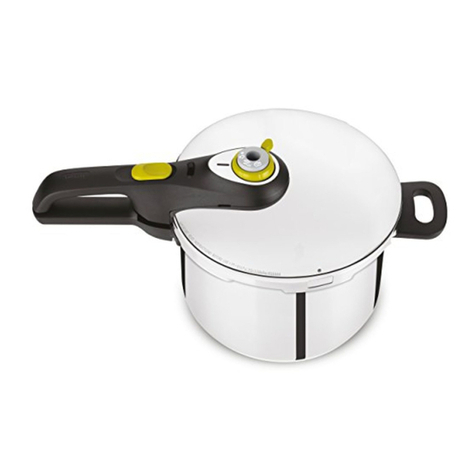
Figure 1
Important Safety Instructions
When you use this pressure cooker, you must follow the fundamental safety rules below:
1. Read the instructions for use carefully, particularly on assembling, disassembling and cleaning the safety parts.
2. Do not touch the hot surfaces. Use the handles and, if necessary, protect your hands as usual (pot holders, oven gloves etc.). Always
make sure that the handles are properly assembled and adequately fixed.
3. Always keep a close watch when the pressure cooker is used in the presence of children.
4. Do not put the pressure cooker in a heated oven.
5. Take great care when you move the pressure cooker containing boiling liquids.
6. Do not use the pressure cooker for purposes other than those for which it was designed. It has been designed for domestic use only.
The manufacturer cannot be held responsible for damage caused by improper or incorrect use.
7. This cooking utensil works in pressure. Improper use can cause burns. Before use, please ensure that the pressure cooker is perfectly
closed.
8. Each time you use the pressure cooker, check carefully first that the safety and pressure release devices (valves) are not clogged and
check the state of the gasket. Use the heat source/s with a diameter which is the same or less than the diameter of the base of the pressure
cooker.
9. Do not alter or modify in any way the safety devices. Use original Aeternum spare parts only and regularly replace the parts subject to
wear and tear. The body and the lid must be compatible and made by the same manufacturer.
10. Never fill the pressure cooker more than 2/3 of its capacity. When you cook food that expands as it cooks, such as rice or legumes,
always put less into the pressure cooker (never exceed half of its capacity). The minimum level for filling the pressure cooker must always
be at least 1/4 (25 cl) of a litre of liquid.
11. Do not use the pressure cooker to cook food such as apple purée, rhubarb, semolina, oat flour or flour of other cereals, dry peas, pasta,
macaroni or spaghetti. These types of food tend to create froth and bubbles and to spurt and can clog the pressure release device.
12. Never open the pressure cooker using force before the pressure inside has been completely discharged. Follow the instructions carefully
to open the pressure cooker safely.
13. Shake the pressure cooker lightly before opening it. This will avoid spurting, in particular by boiled, thick and very soft foods.
14. Avoid the complete evaporation of the liquid in the pressure cooker, to avoid possible damage.
15. Do not use this pressure cooker to pressure-fry in oil.
16. Do not cook food wrapped in cloth, paper or similar. During cooking and under the effect of the pressure, meat with surface skin (for
example ox tongue) may swell. Do not press the meat when the skin looks swollen to avoid the risk of burns.
17. If the safety devices are malfunctioning, do not use the pressure cooker. Use original spare parts, available on sale. If these are com-
plicated to replace, please contact your supplier.
Opening
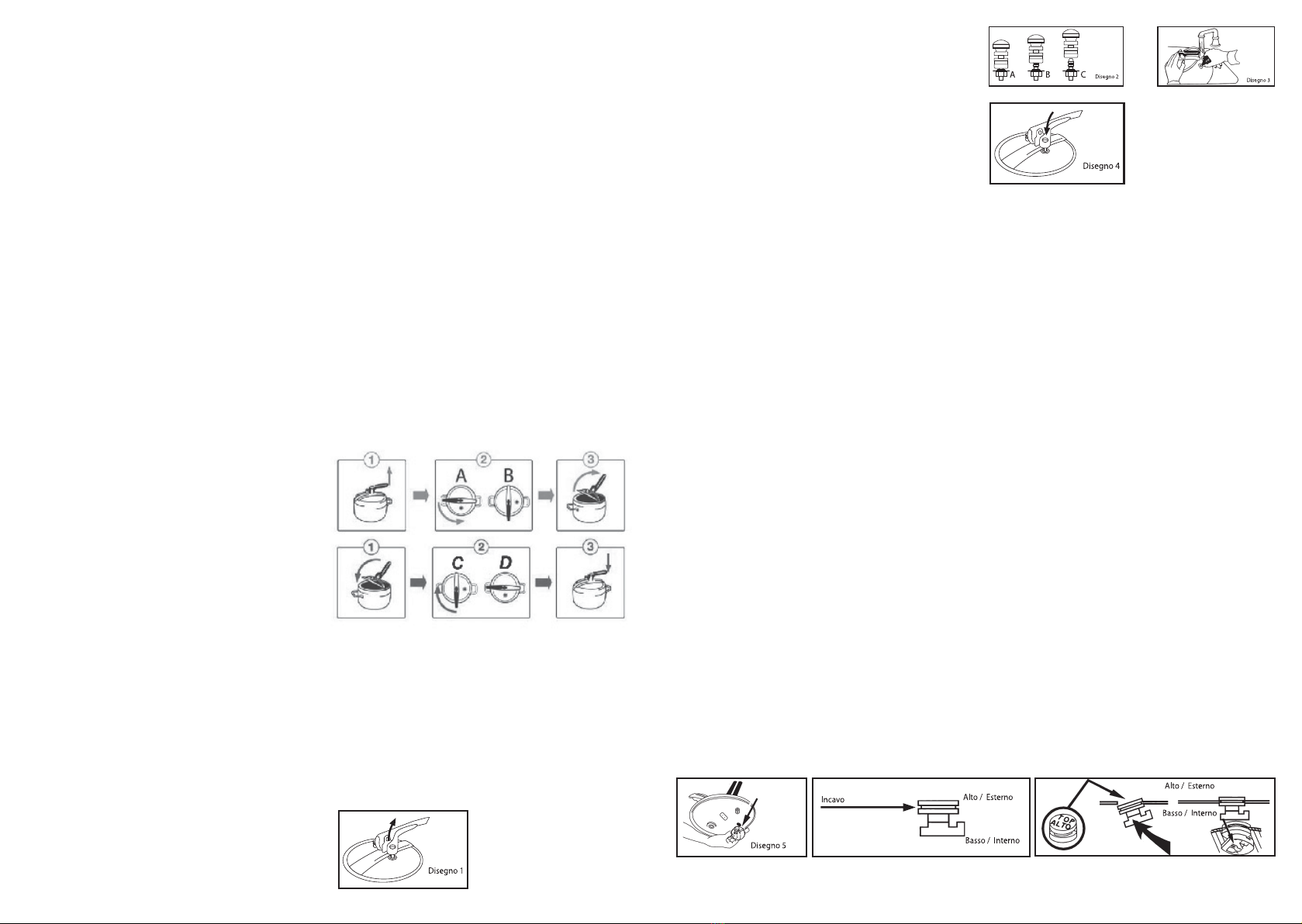
1. Lift up the handle lever.
2. Rotate the lid a quarter of a turn (90°) from position “A” to “B”.
3. Move the lid to the right and tilt it. Then slide out the lid upwards.
Closing
1. Slide the lid into place keeping the crosspiece at 90° with re-
spect to the handles (Fig. C).
2. Rotate the lid a quarter of a turn (90°) from position “C” to “D”.
3. Lower the lever handle.
Instructions and recommendations for use
First check that the pressure cooker is complete as originally intended and has not been damaged by the transport or improper handling
(if you have any doubts, do not use it and contact the retailer). Do not leave the packaging (plastic bags, expanded polystyrene etc.)
within reach of children. Wash the pressure cooker and the lid in warm water and normal washing-up detergent, drying them thoroughly
after rinsing. For better hygiene, wash again with hot water and vinegar, rinse and dry thoroughly. Before placing the pressure cooker
on the heat, check that the operating valve is not clogged, removing any residuals with a needle. Make sure that the lid is closed cor-
rectly - the steel crosspiece must be aligned with the two handles and its ends must be fitted into the appropriate slots (see figure D)
- and that the operating valve is in the correct position (see figure 2 - A). The pressure cooker must always be filled to a level between
a minimum of a quarter of a litre and two-thirds of its capacity. Thanks to the special Thermoradiant®heat-radiating base, this pressure
cooker can be used on all the sources of heat shown on the base of the pressure cooker and/or on the packaging.
Cooking
When there is pressure inside the pressure cooker, the Sys-
temblock®rises up and fits into its seat on the lever handle,
preventing the lid opening accidentally and showing that there is
pressure inside the pressure cooker (see figure 1). When steam
starts to come out of the valve, this shows that the pressure
cooking is beginning. Reduce the heat to a minimum and start to
calculate the cooking time.
I tempi di cottura sono indicativi e vanno calcolati dall’inizio del sibilo dell valvola di
esercizio.
MINESTRE DI VERDURA:
da 20 a 45 min. a seconda del tipo di verdura, adottando il tempo della verdura più
lunga da cuocere.
MINESTRONE:
come per la minestra di verdura aggiungendo la pasta o il riso circa 5 minuti prima della
fine della cottura.
quantità acqua tempo
MILANESE RISOTTO ½ kg 1 litro 5 min.
POLENTA (*) ½ kg 1 ½ litro 20 min.
(*) dopo aver rimestato fino alla durezza voluta la farina versata in acqua bollente.
CARNI BRASATE
quantità acqua tempo
MANZO 700 g 2 bicchieri 20-30 min.
BOILED MEAT
quantità acqua tempo
VITELLO ½ kg 1 litro 30-35 min.
MANZO ½ kg 1 litro 40-45 min.
POLLO ½ kg 1 litro 20-25 min.
POLLO NOVELLO ½ kg 1 litro 14-16 min.
COTECHINO ½ kg 1 litro 20-22 min.
LINGUA VITELLO 800 g 1 litro 55-60 min.
LINGUA DI MANZO salmistr. 1 kg 1 ½ litro 60 min.
CARNI STUFATE (o in umido)
quantità acqua tempo
POLLO ½ kg ½ bicchiere 20-25 min.
AGNELLO ½ kg ½ bicchiere 20-25 min.
VITELLO ½ kg ½ bicchiere 30-35 min.
MANZO ½ kg ½ bicchiere 50 min.
ARROSTI
quantità acqua tempo
VITELLO ½ kg ½ bicchiere 20-25 min.
MANZO ½ kg ½ bicchiere 30-35 min.
POLLO ½ kg ½ bicchiere 15 min.
POLLO NOVELLO ½ kg ½ bicchiere 10 min.
MAIALE ½ kg ½ bicchiere 15 min.
AGNELLO ½ kg ½ bicchiere 15-20 min.
ROAST-BEEF ½ kg ½ bicchiere 25-30 min.
PESCI LESSATI
quantità acqua tempo
ARAGOSTA 1 kg 1 ½ bicchiere 10 min.
COZZE 1 kg 1 ½ bicchiere 10 min.
GAMBERETTI ½ kg 1 ½ bicchiere 6-8 min.
MERLUZZO ½ kg 1 bicc. abb. 14-15 min.
PESCE PERSICO 1 kg 1 ½ bicchiere 6-8 min.
SCAMPI ½ kg 1 ½ bicchiere 5 min.
TROTA INTERA 1 kg 1 ½ bicchiere 1- 1 ½ min.
LEGUMI SECCHI (*)
quantità acqua tempo
CECI ½ kg 3 bicchieri 40-50 min.
FAGIOLI ½ kg 3 bicchieri 40-50 min.
FAVE ½ kg 3 bicchieri 40-50 min.
LENTICCHIE 300 g 3 bicchieri 20-30 min.
(*) messi a bagno in precedenza per 10, 12 ore in acqua.
TEMPI DI COTTURA
VERDURE FRESCHE
quantità acqua tempo
ASPARAGI INTERI 1 kg 1 ½ bicchiere 4-5 min.
BARBABIETOLE INTERE 1 kg 1 ½ bicchiere 18-20 min.
BARBABIETOLE TAGLIATE 1 kg 1 bicchiere 15-18 min.
BROCCOLI 1 kg 1 bicchiere 10 min.
CARCIOFI A PEZZI 1 kg 1 bicchiere 12-14 min.
CARCIOFI INTERI 1 kg 1 ½ bicchiere 12-15 min.
CAROTE A PEZZI 1 kg 1 bicchiere 4-6 min.
CAROTE INTERE 1 kg 1 ½ bicchiere 5-6 min.
CAVOLFIORE A PEZZI 1 kg 1 bicchiere 4-5 min.
CAVOLFIORE INTERO 1 kg 1 ½ bicchiere 6-8 min.
CAVOLO 1 kg 1 ½ bicchiere 10-12 min.
CICORIA 1 kg 1 bicchiere 3-4 min.
CIPOLLE A PEZZI e CIPOLLINE 1 kg 1 bicchiere 5-6 min.
CIPOLLE INTERE 1 kg 1 ½ bicchiere 8-10 min.
COSTE 1 kg 1 bicchiere 7-8 min.
FAGIOLI FRESCHI 1 kg 1 ½ bicchiere 15-20 min.
FAGIOLINI VERDI 1 kg 1 bicchiere 3-4 min.
FAVE 1 kg 1 bicchiere 5-6 min.
FUNGHI 1 kg 1 bicchiere 4-5 min.
MELANZANE 1 kg 1 bicchiere 7-8 min.
PATATE A PEZZI 1 kg 1 bicchiere 5-6 min.
PATATE INTERE 1 kg 1 ½ bicchiere 12-14 min.
PATATE NOVELLE 1 kg 1 bicchiere 10-12 min.
PISELLI VERDI 1 kg 1 bicchiere 2-3 min.
POMODORI 1 kg ½ bicchiere 2-3 min.
PORRO 1 kg 1 ½ bicchiere 5-6 min.
RAPE A PEZZI 1 kg 1 bicchiere 12-14 min.
RAPE INTERE 1 kg 1 ½ bicchiere 14-16 min.
SCORZANERA 1 kg 1 ½ bicchiere 7-8 min.
SEDANO A PEZZI ½ kg 1 bicchiere 7-8 min.
SPINACI 1 kg ¾ bicchiere 3-4 min.
VERZA 1 kg 1 bicchiere 4-5 min.
ZUCCA A PEZZETTINI 1 kg 1 ½ bicchiere 3-4 min.
ZUCCA A FETTE 1 kg 1 ½ bicchiere 5-6 min.
ZUCCHINI 1 kg ¾ bicchiere 2-3 min.
FRUTTA FRESCA
quantità acqua tempo
ALBICOCCHE ½ kg 1 bicchiere 2 min.
CILIEGIE ½ kg ¾ bicchiere 2 min.
PESCHE ½ kg ½ bicchiere 2 min.
MELE ½ kg 1 bicchiere 4-5 min.
PERE ½ kg ½ bicchiere 2-3 min.
FRUTTA SECCA (*)
quantità acqua tempo
ALBICOCCHE 200 g ½ bicchiere 5-6 min.
CASTAGNE ½ kg ½ litro 40-45 min.
FICHI 200 g ¾ bicchiere 10-12 min.
PESCHE 200 g ½ bicchiere 5-6 min.
PRUGNE 200 g ½ bicchiere 8-10 min.
(*) lasciata in precedenza a bagno per circa 1 ora; le castagne 4-5 ore.