7
ENGLISH
(Original instructions)
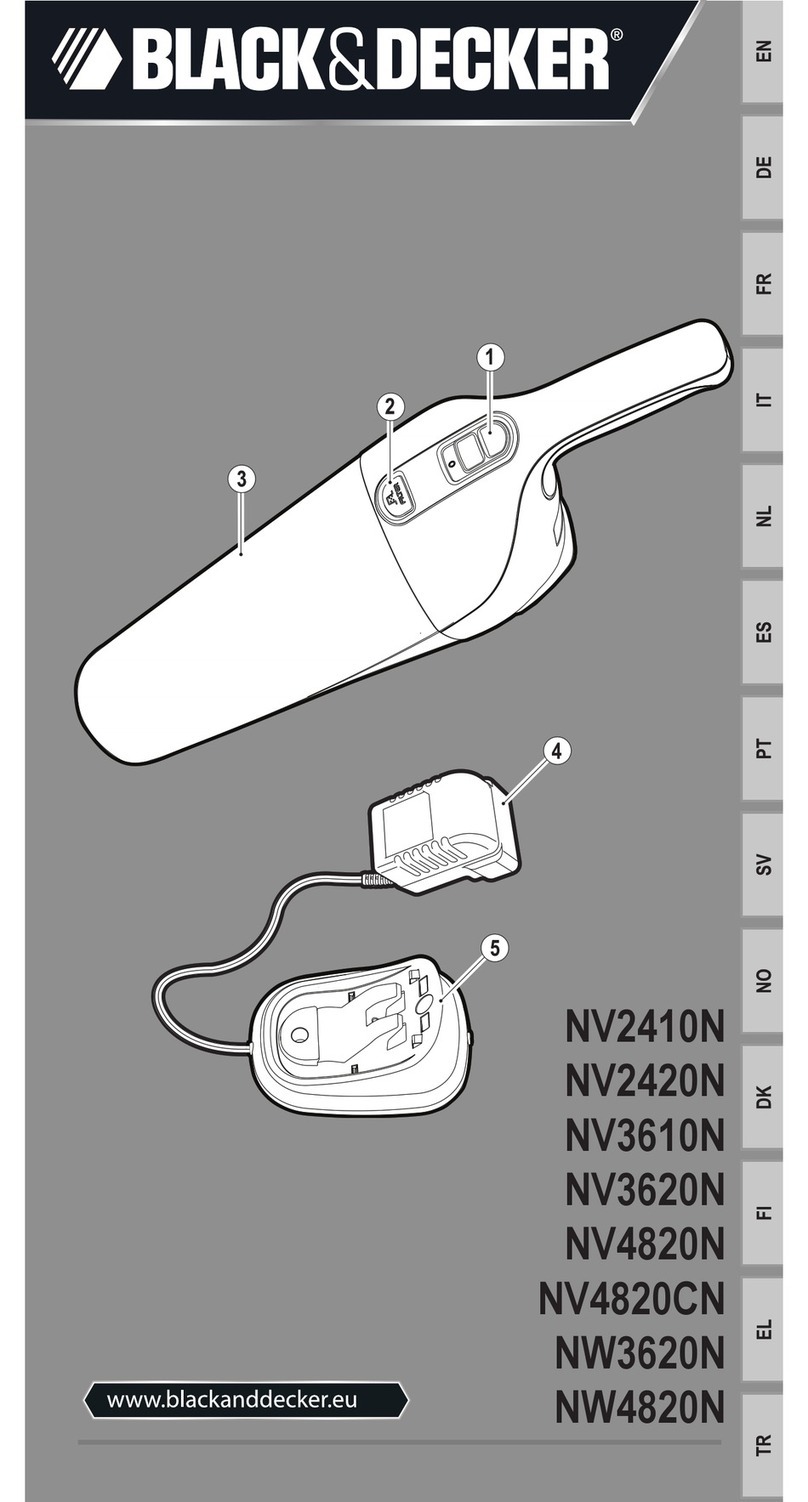
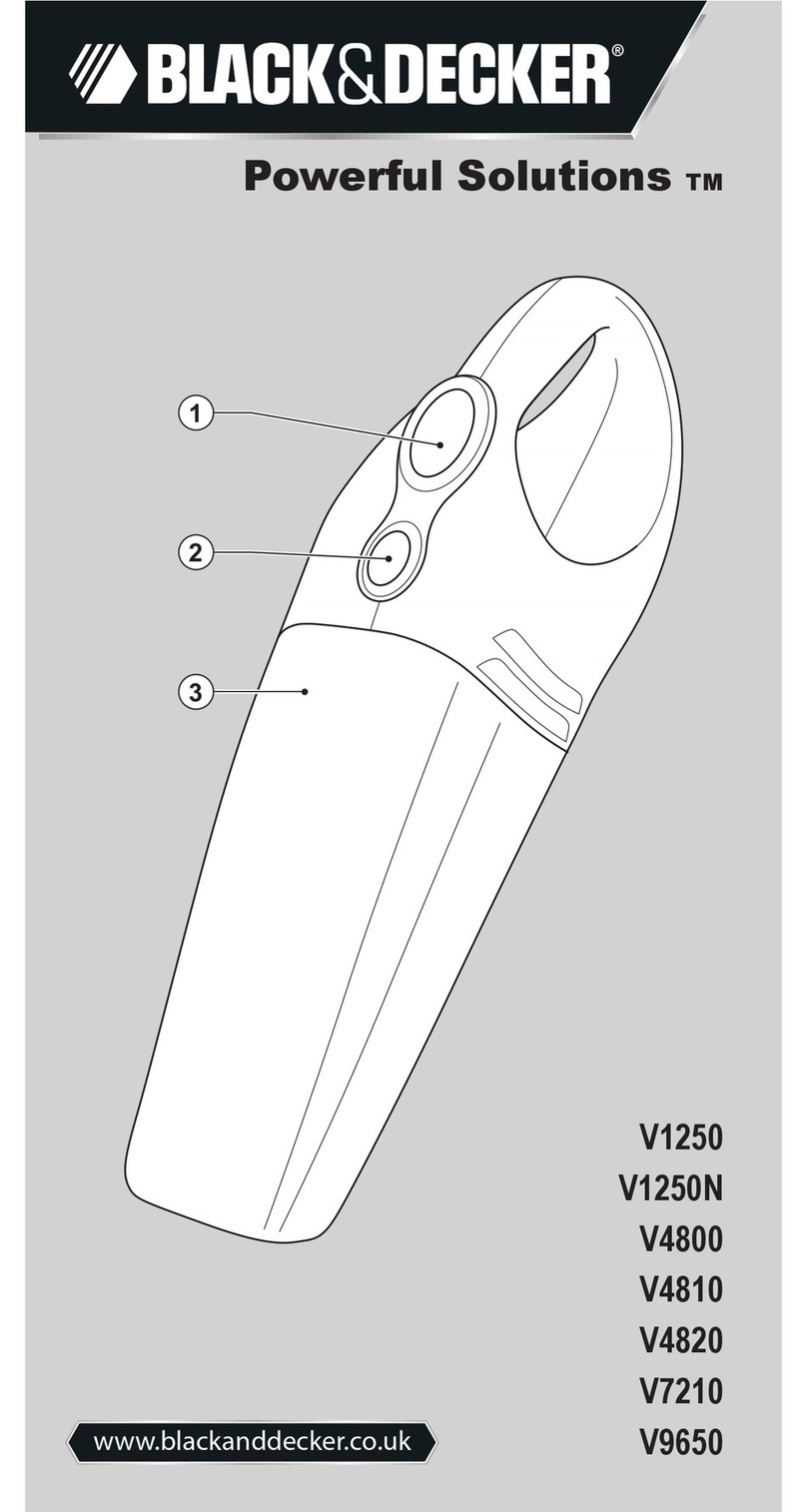
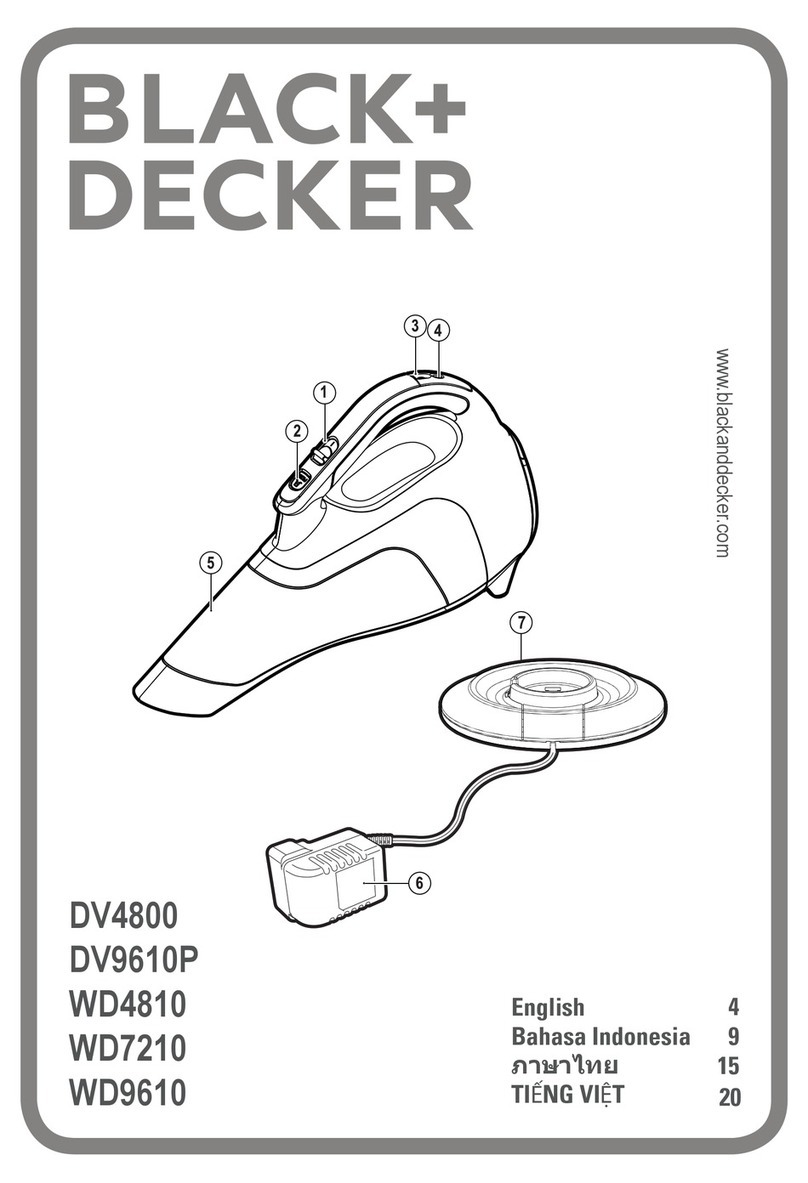
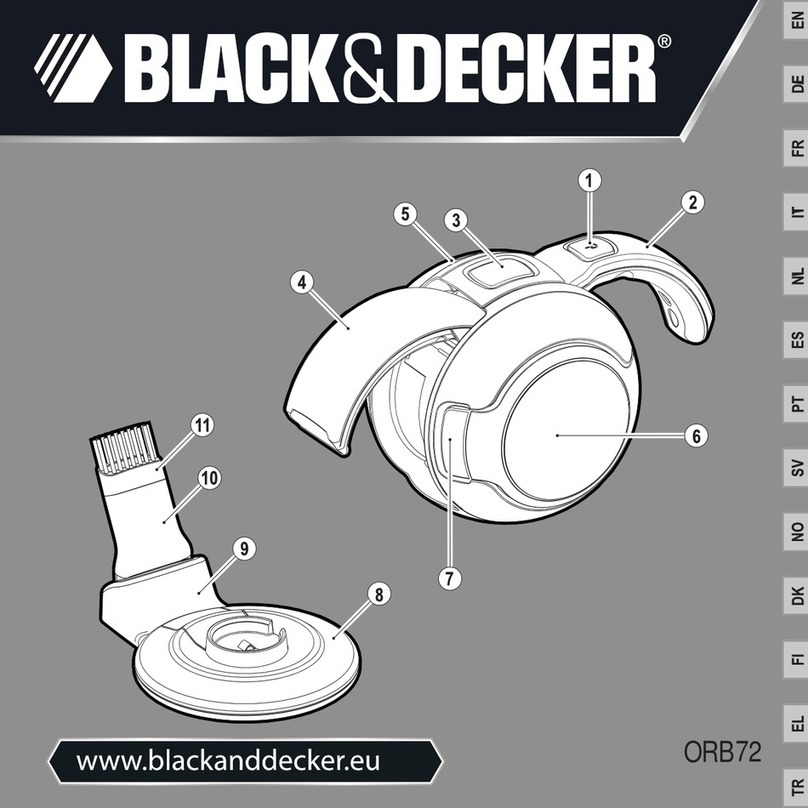
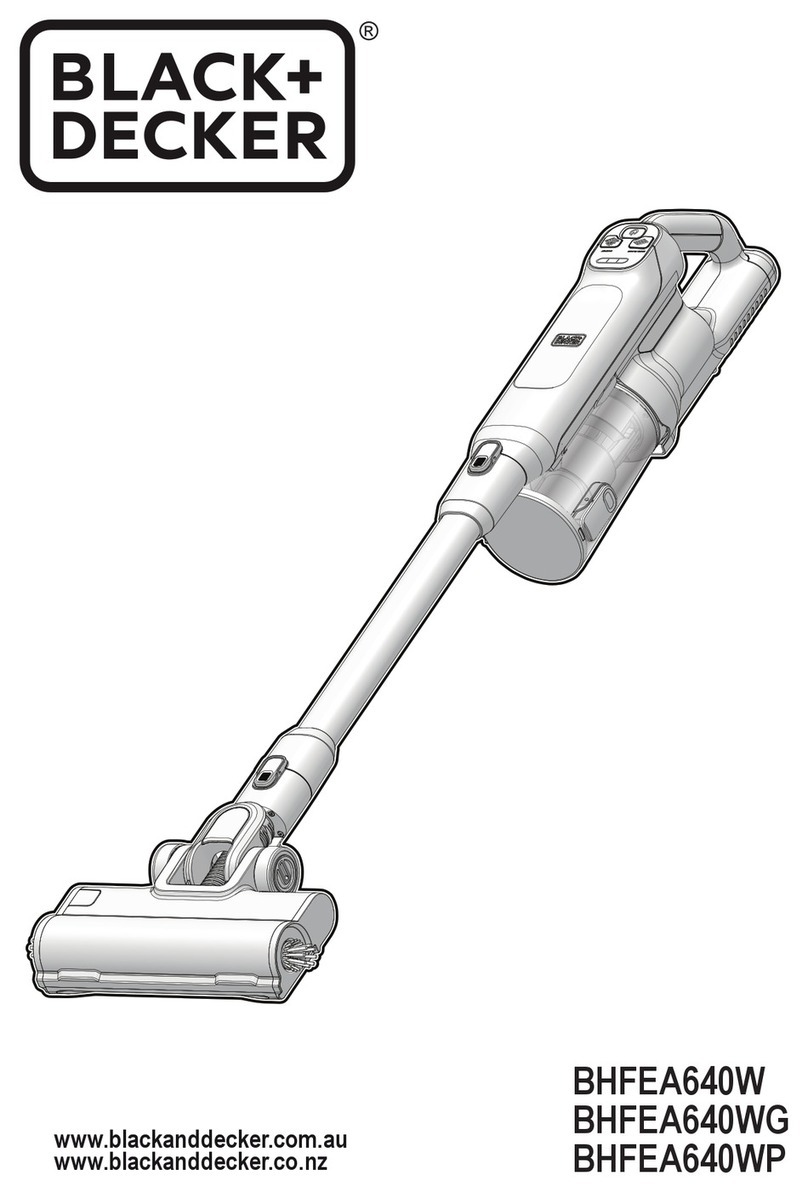
Features
This tool includes some or all of the following features.
1. On/off switch (Slide forward for On. Slide backward for
Off)
2. Bowl release button
3. Dust bowl
4. Filter
5. Battery
6. Battery release button
7. Crevice tool
7a. On board storage for crevice tool
8. Brush tool
9. Floor head
10. Extension tubes
11. Adaptor
Use
Charging the battery (Fig. A)
The standard charger provided will charge a fully depleted
battery in about 5 hours
uPlug the charger (12) into an appropriate outlet before
inserting the battery pack (5).
uInsert the battery pack (5) into the charger (12) as shown
in gure A.
uThe green LED (12a) will ash indicating that the battery
is being charged.
uThe completion of charge is indicated by the green
LED (12a) remaining on continuously. The pack is fully
charged and may be used at this time or left on the
charger.
Note: Recharge discharged batteries as soon as possible
after use or battery life may be greatly diminished.
Note: The charger and battery pack can be left connected
with the green LED glowing indenitely.
The charger will keep the battery pack fresh and fully charged.
Important charging notes
uLongest life and best performance can be obtained if
the battery pack is charged when the air temperature is
between 18°- 24°C. DO NOT charge the battery pack in
an air temperature below +4.5°C, or above +40.5°C.
This is important and will prevent serious damage to the
battery pack.
uThe charger and battery pack may become warm to touch
while charging. This is a normal condition, and does not
indicate a problem. To facilitate the cooling of the battery
pack after use, avoid placing the charger or battery pack
in a warm environment such as in a metal shed, or an
uninsulated trailer.
uIf the battery pack does not charge properly:
uCheck current at receptacle by plugging in a lamp or
other appliance.
uCheck to see if receptacle is connected to a light switch
which turns power off when you turn out the lights.
uMove charger and battery pack to a location where the
surrounding air temperature is approximately 18°- 24°C
uIf charging problems persist, take the tool, battery pack.
and charger to your local service centre.
uThe battery pack should be recharged when it fails to
produce sufcient power on jobs which were easily done
previously. DO NOT CONTINUE to use under these
conditions. Follow the charging procedure. You may also
charge a partially used pack whenever you desire with no
adverse affect on the battery pack.
uForeign materials of a conductive nature such as, but not
limited to, steel wool, aluminium foil, or any buildup of
metallic particles should be kept away from charger
cavities.
Always unplug the charger from the power supply when
there is no battery pack in the cavity. Unplug charger
before attempting to clean.
uDo not freeze or immerse charger in water or any other liquid.
Warning! Do not allow any liquid to get inside charger. Never
attempt to open the battery pack for any reason. If the plastic
housing of the battery pack breaks or cracks, return to a
service centre for recycling.
Installing and removing the battery (Fig. B)
Warning! Make certain the vac is switched off before
removing or installing battery.
To install battery pack
uInsert battery pack (5) into the vac until an audible click is
heard (Figure B). Make sure battery pack is fully seated
and fully latched into position.
To remove battery pack
uDepress the battery release button (6) as shown in Figure
B and pull battery pack out of the vac.
Operation
Warning! This product is for dry pick-up only.
uTo switch the vac on, slide the on/off switch (1) forward
(Fig. C).
uTo switch the vac off, slide the on/off switch (1) backward
(Fig. C).
Mounting accessories (Fig. D)
uThe brush tool (8) has a brush that can be used for
dusting and upholstery cleaning.
uThe crevice tool (7) allows for vacuuming in narrow and
hard to-reach places.