2
AIR CONDITIONER OR HEAT PUMP SELECTION
(SWITCH A) — Use switch A to select between air condi-
tioning and heat pump applications. A heat pump application
uses a reversing valve. Set switch A to OFF for air-condition-
ing applications (no reversing valve). Set switch A to ON for
heat pump applications (O is used to energize the reversing
valve). The factory setting is OFF.
EMERGENCY HEAT SELECTION (SWITCH B) —
Switch B is used to configure the thermostat for use with emer-
gency heat. When Switch B is set to the ON position, the
Emergency Heat mode is available on the thermostat and can
be selected by using the mode button. When Switch B is set to
OFF, Emergency Heat mode is not available. The default is
OFF.
When the Emergency Heat mode is active, the thermostat
will energize the O/W2 output when Switch A is set to
OFF (air conditioner applications). The thermostat will ener-
gize the W/W1 output when Switch A is set to ON (heat pump
applications).
OUTDOOR AIR OR REMOTE ROOM/LEAVING-AIR
SENSOR (SWITCH C) — Switch C is used to configure the
thermostat to work with either a outdoor air sensor, leaving-air
sensor, or a remote room sensor. The sensor for the application
must be connected to terminals S1 and S2 of the thermostat.
Set switch C to OFF for a outdoor air sensor or leaving-air sen-
sor. Set switch C to ON for a remote room sensor. The factory
setting is OFF.
AVERAGING OF SENSORS (SWITCH D) — Switch D is
used if a remote room sensor is being used (switch C set to
ON). The remote room sensor reading can be averaged with
the sensor reading of the thermostat. Set switch D to OFF if
averaging is not required. To average the readings of the ther-
mostat and one remote room sensor, set switch D to ON. The
factory setting is OFF. See Space Temperature Averaging sec-
tion for wiring information.
Step 3 — Install Thermostat
1. Turn off all power to unit.
2. If an existing thermostat is being replaced:
a. Remove existing thermostat from the wall.
b. Disconnect wires from existing thermostat. Do not
allow wires to fall back into the wall. As each wire
is disconnected, record wire color and terminal
connection.
c. Discard or recycle old thermostat.
NOTE: Mercury is a hazardous waste and must be
disposed of properly.
3. Open thermostat rear door (mounting base) to expose
mounting holes. See Fig. 1.
4. Route thermostat wires through large hole in mounting
base. Remove outer sheath from wires for added flexi-
bility. Standard solid or multi-conductor thermostat
wire should be used from the thermostat to the unit.
Size and length considerations are as follows: for a
maximum run length of 36 ft, use 22 AWG (American
Wire Gage) wire; for a maximum run length of 100 ft,
use 18 AWG wire.
NOTE: When a remote room sensor or outdoor-air
sensor is used, an additional conductor should be pro-
vided for grounding of the shield.
If averaging of sensors is required, see Space Temper-
ature Averaging section for more information.
5. Level mounting base against wall and mark wall
through the 2 mounting holes in base.
6. Drill two 3/16-in. mounting holes in wall where
marked.
7. Secure mounting base to wall with 2 screws and
anchors provided. Ensure all wires exit through hole in
mounting base.
8. Adjust wire length and routing to allow proper closure
of the thermostat. Strip each wire at the end no more
than 1/4-in. to prevent adjacent wires from shorting
together. Match and connect wires to terminals on the
thermostat. See Fig. 2-9.
9. Push excess wiring into wall. Seal hole in wall to pre-
vent drafts.
10. Close thermostat door.
11. Turn on power to unit. The thermostat will receive
power from the unit. The thermostat will be powered
by 24 v, nominal (18 to 30 vac) through terminal R
(+ 24 v) and terminal C (common). Power consump-
tion is 5 va at 24 vac.
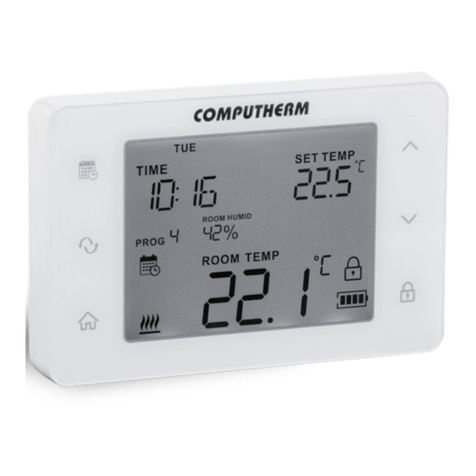
12. On power up the thermostat display shows the selected
setup mode (A2 — Air Conditioner, H2 — Heat
Pump) for a few seconds, depending on DIP switch
settings.
Step 4 — Space Temperature Averaging — Ap-
plications that require averaging using multiple space tempera-
ture sensors can be satisfied using either 4 or 9 sensors as
shown in Fig. 10. For single space temperature sensor wiring,
refer to the base unit installation instructions. Temperature sen-
sor calibration can be checked by measuring actual resistance
at a temperature with an ohmmeter and comparing to the val-
ues listed in Table 1.
NOTE: Only Carrier sensors (part no. ZONECCORRS01)
may be used for standard space temperature sensor averag-
ing. Sensors must be used singly or in multiples of 4 and 9,
with total sensor wiring not to exceed 1000 feet.
Step 5 — Set Thermostat Configuration —
Configuration options, like DIP switch settings, are intended to
be selected at installation and are not normally modified by the
user. These options are not discussed in the owner’s manual
and must be done as part of the installation. A special proce-
dure for the thermostat allows entry into the Configuration
mode. To enter Configuration mode, press and hold the Fan
button for approximately 10 seconds. The room temperature
display will disappear and the configuration option number
will be displayed on the thermostat screen. The configuration
option number will be flashing and can be changed with the
Up and Down buttons. Once the desired configuration option
Before installing thermostat, turn off all power to the
unit. There may be more than one power disconnect.
Electrical shock can cause injury or death.
Terminals S2 and C are internally connected. Do not
ground shield to terminal C of thermostat.
Be careful not to drill into wiring in wall. Electrical
shock could result.
Improper wiring or installation may cause damage to the
thermostat. Check to ensure wiring is correct before pro-
ceeding with installation of unit.