4BioSonic®Ultrasonic Scaler
• Place the dental chair in a supine position for optimal access to
both the maxillary and mandibular arches. This improves patient
comfort and increases clinician visibility.
• Position the patient’s head for optimum access to the quadrant
and tooth surface being treated. Evacuate water and debris with a
saliva ejector or high volume evacuator.
B. Ultrasonic scaling procedures
NOTE: Refer to section IV (Maintenance and Infection Control) of this
Owner’s Guide for general procedures to follow daily and between
patients.
General operating procedures:
1. Be sure the main dental oce water supply valve is open.
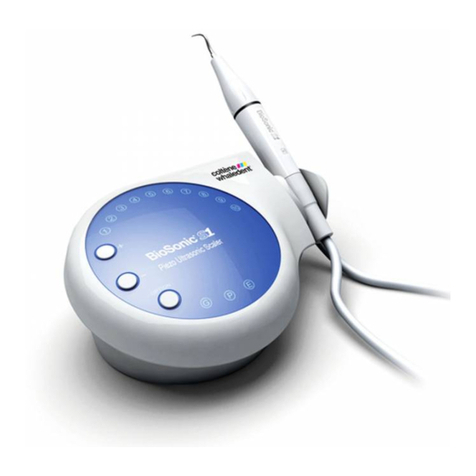
2. Turn the unit ON using the ON/OFF button.Verify that the green
LED on the bottom right hand corner of the unit is lit.
3. Set the H2O control knob clockwise to the fully
open position.
4. Hold the handpiece (without an insert installed) over a sink or
drain. Depress the foot control and ush the water line for at
least 2 minutes.
5. Select the sterilized scaler insert.
6. Lubricate the O-ring with water before placing the insert into
the handpiece. Depress the foot switch pedal while lling the
handpiece with water and slowly turning the insert until it snaps
into place. (Fig.7)
7. Set the power and H2O control knobs to your preferred
operating positions. NOTE: Use the lowest eective power
setting possible when scaling. (Scaler inserts should be
sterilized before rst use on each patient. See section IV,
part A.)
C. “Turbo”feature
• The “Turbo” button on the bottom left corner of the unit may be
depressed to switch to maximum power, without having to adjust
the preferred power setting. When the “Turbo” mode is selected,
the LED above the button will be lit.
• It is not possible to adjust the power with the power knob as long
as the “Turbo” is on.
• To turn the “Turbo” mode o, depress the button again. The LED
will not be lit.
• The “Turbo” feature is helpful to remove stubborn pieces of
calculus, and should only be used as a temporary mode of
operation.
• It may be necessary to adjust the H2O knob with the unit in“Turbo”
mode to assure adequate uid delivery to the tip and the tooth.
D. Helpful hints
• Use the lowest eective power setting possible when
scaling.
• If the handpiece becomes hot to the touch, there is either too
little water, too much power or both. Adjust power and/or water
settings accordingly.
• The rubber O-ring on the insert must be lubricated with water
before placing it in the handpiece. Not lubricating the O-ring
will make proper seating more dicult. Fully seat insert by
pushing inward while twisting until seated. DO NOT FORCE.
The handle on the insert should be ush against the handpiece.
Alternatively, lubricating the O-ring with a small amount of
petroleum jelly could prolong the life of the O-ring.
• Checkandverifythatuidisreachingtheworking endoftheinsert
tip by holding the handpiece over a sink or drain and activating
the unit. Adjust the H2O control knob to ensure adequate ow
is achieved for the selected power setting. A ne mist should be
spraying from the scaler insert tip (Fig.8).
• If water fails to ow properly, check supply line lter for
clogging. Filters are disposable. Replace if necessary. Do not
attempt to unclog used lters.
• To prevent accidental contact with the lips, tongue, and cheek,
the scaler insert should be activated just before contacting
the tooth, but after the insert has been placed in the
patient’s mouth.
• It is best to hold the handpiece in a pen grasp, using a very light
touch when scaling both supra and subgingivally. Too much
pressure of the tip against the tooth surface will decrease the
eectiveness of the insert, as tip vibration is obstructed.
• Periodically check the scaler insert for wear.
• Developanoperatingsequenceinscalingtoensurethoroughness,
and to minimize adjustments in patient and/or operator position.
E. Patient discomfort can be caused by:
• Excessive pressure. Apply the side of the scaler tip gently to tooth
surface using very little pressure.
• Incorrect tip positioning. Avoid contact of the scaler insert tip and
the tooth. Direct the tip away from root surfaces, and use side of
scaler insert only.
• Not keeping the tip in motion on tooth. The tip should always
be in motion during scaling. Use vertical, horizontal, or
oblique overlapping strokes to increase scaling eciency and
decrease discomfort.
• Ifsensitivitypersists,alternatetreatmentofsensitiveareasandless
sensitive areas and/or decrease power setting.
IV. Maintenance and Infection Control
A. Ultrasonic Insert Cleaning and Sterilization
Note: DO NOT use chemical disinfectants prior to sterilization or
rapid deterioration of the insert materials may occur.
• Remove gross debris by placing the inserts in an ultrasonic cleaner
basket and immersing them in a non-ionic, nonammoniated
cleaning solution. (recommended solutions: Biosonic®UC30 or
UC32). Operate the ultrasonic cleaner in accordance with the
manufacturers directions. Remove the inserts from the cleaner
and dry completely with an air syringe or clean paper towel.
Alternatively , inserts may be carefully hand scrubbed (using
a nylon bristle brush) with detergent and cold water to remove
debris, then rinsed and dried.
• Sterilize the Biosonic®.inserts via a gravity displacement steam
sterilizing cycle at 132°C for 15minutes with a 20 minute drying
time.
• Do not use cold sterilization, chemical disinfection, or other
methods of sterilization, including chemical vapor and dry heat
since these methods may severely damage the insert and will void
the warranty.
B. Before each patient
1. Use a sterilized ultrasonic insert for each patient. (Scaler inserts
should be sterilized before rst use on each patient.)
2. Clean and disinfect the surfaces of the cabinet, unit, power cord,
and handpiece with Alpet D2. Apply barrier sleeves to the unit
and the handpiece to reduce the risk of cross-contamination.
3. Flush the water supply lines as discussed previously in
section II.
4. Place the sterilized scaler insert into the handpiece while
maintaining proper asepsis techniques.