25
COMUNELLO ®Copyright 2019 - All rights reserved
ENGLISH
6.2.7 PHOTOCELLS:
Photocells can be powered by and connected to the control unit in accordance
with directive EN 12453.
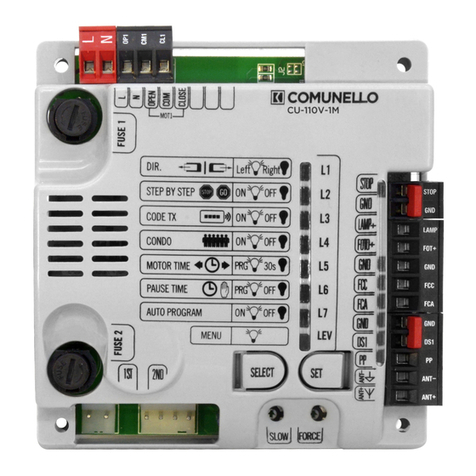
DS1 Input (NC)
Tripping of the photocells during opening is disregarded, while during closing it
causes reversal of the direction of movement.
To allow operation in compliance with EN 13849-1 Category 2 a photocell
test is performed before each movement. To be able to carry out this test, it
is essential to power each pair of photocells using the dedicated output. The
control unit enables the movement only if the test is passed; if it is not, the
control unit inhibits all movements and an alarm condition is signalled by blinking
of all the programming LEDs on transmission of any command.
Note: DS1 Input is factory bridged. To wire the photocells, remove the jumper
from the respective input.
6.2.8 OPENING AND CLOSING LIMIT SWITCHES:
The control unit allows for the connection of Opening and Closing
limit switches (N.C. inputs). Tripping in the associated operating stages causes
immediate stopping of movement for the Motor output.
Note: Do not jumper these inputs if they are not used
6.2.9 OPERATION WITH TIMER:
The control unit allows a timer to be connected in the place of the PP (step-by-
step) command button.
Example: hour 08:00 the timer closes the contact and the control unit
commands opening, hour 18:00 the timer opens the contract and the control
unit commands closing.
During the 08:00-18:00 interval, at the end of the opening phase, the control
unit disables the ashing light, the automatic closing and the radio controls.
6.3 TRIMMERS ADJUSTMENTS
SLOW FORCE
6.3.1 DECELERATION (SLOWING):
The motor deceleration function is used in the gates to prevent the mobile
doors from striking at high speed at the end of opening and closure.
When programming the Motor Time, the control unit also allows deceleration
to be programmed in the desired points (before total opening and closure).
Moreover, through the “SLOWING” trimmer it is possible to regulate the nal
intensity of the speed during the deceleration stage.
Using the “Motor time” function it is nonetheless possible to eliminate the
deceleration stage.
6.3.2 REGULATION OF MOTOR POWER (FORCE):
The electronic control unit features a “FORCE” trimmer to regulate the motor
power, entirely managed by the micro-processor.
Regulation can be made within a range from 50% to 100% of the maximum
Power.
For each movement, an initial breakaway is however provided, feeding the
motor for 2 seconds at the maximum power even if the adjustment of the
motor torque is engaged.
Note: the initial tick is automatically disabled if the Soft Start
function is enabled.
CAUTION: A variation of the trimmer “SLOW” requires the repetition of the
learning procedure, since the times of manoeuvre and slowing may vary.
6.3.3 BLACK-OUT:
In the case of a black-out and subsequent restoration of the power supply,
the rst manoeuvre will be in opening with a xed speed as set by the
trimmer “SLOWING”; when a mechanical block is encountered, in the
absence of an electrical limit switch, the doors will not be obstructed, but
will execute a STOP (version with encoder). With a subsequent command,
the doors will close again at reduced speed until completely closed. The
next manoeuvre will be at the speeds set by the trimmers.
7 DETAILED DESCRIPTION OF THE
PROGRAMMING
PROGRAMMING:
SELECT key: it determines the type of function to be memorized, as indicated
by the blinking of the LED. By pressing the key several times, it is possible to
scroll the menu and move to the desired function. The selection remains active
for 10 seconds, displayed by the ashing LED; when this interval elapses, the
control unit exits programming.
SET key: it conrms and changes the programming according to the type of
function determined by the SELECT key.
Following conrmation, the respective LED remains on / off for about 2 sec. and
then starts ashing again.
Note important:
- The function of the SET key can also be replaced by the remote control if
previously programmed (LED L3 CODE TX lit);
- Programming enabled only with the closure of N.C contacts.
7.1 MAIN MENU
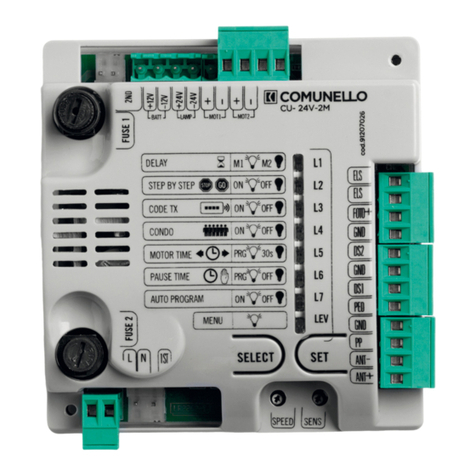
L1 DIR. Open to left Open to right
L2 STEP BY STEP Step-by-step Automatic (Open-Close)
L3 CODE TX Inserted code (PP/P.PED) No remote control stored
L4 CONDO ON OFF
L5 MOTOR TIME Complete stroke stored 30 s. (no slowdowns)
L6 PAUSE TIME With automatic closure OFF
L7 PRG AUTOM Self-learning stroke stored OFF
LEV MENU ON
7.1.1. LED L1 - OPENING DIRECTION (DIR):
The control unit in the default conguration presents the “OPEN TO RIGHT” logic;
to enable the “OPEN TO LEFT” logic, proceed as follows:
• By the key SELECT, position yourself on the blinking LED no.1;
• Press the SET key;
• The LED L1 turns off and programming will be completed.
Repeat the procedure if you wish to restore the previous conguration.
7.1.2. LED L2 - STEP BY STEP or OPEN-CLOSE:
In the default conguration the control unit is set with “Step-By-Step” operating
logic enabled; if the “Automatic Open-Close” operating logic is required (LED
no.2 OFF), proceed as follows:
• By the key SELECT, position yourself on the blinking LED no.2;
• Press the SET key;
• The LED L2 turns off and programming will be completed.
Repeat the procedure if you wish to restore the previous conguration.
7.1.3. LED L3 - CODE TX: Remote controls storage
Up to 120 remotes with different codes of either the xed or the rolling code type
can be saved on the control unit.
Remote control code programming of the total opening :
• By the key SELECT, position yourself on the blinking LED L3 “CODE TX”;
• Press key SET once to memorize the PP channel;
• Send the selected code with the remote control;
• The LED L3 will remain steady on for a second to indicate that programming
has been completed;