manuals.online logo
Brands
  1. Home
  2. •
  3. Brands
  4. •
  5. Consew
  6. •
  7. Sewing Machine
  8. •
  9. Consew 277RFS-3 Datasheet

Consew 277RFS-3 Datasheet

Other manuals for 277RFS-3

1

Other Consew Sewing Machine manuals

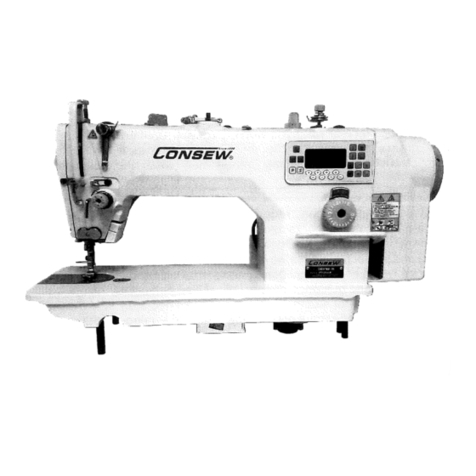
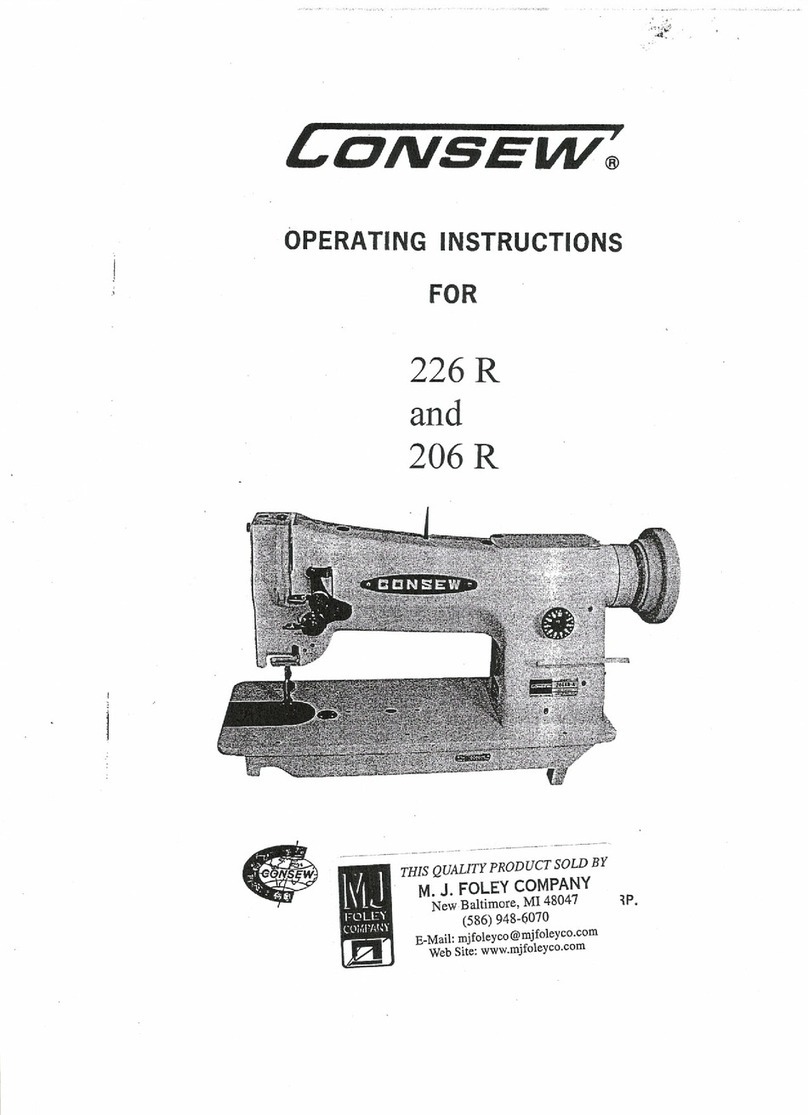
Consew 7360RA TCWL (E) User manual

Consew

Consew 7360RA TCWL (E) User manual

Consew 7360R-7DD Guide

Consew

Consew 7360R-7DD Guide

Consew 733R-5 Use and care manual

Consew

Consew 733R-5 Use and care manual

Consew 5122 User manual

Consew

Consew 5122 User manual

Consew P1541S-CC Technical manual

Consew

Consew P1541S-CC Technical manual

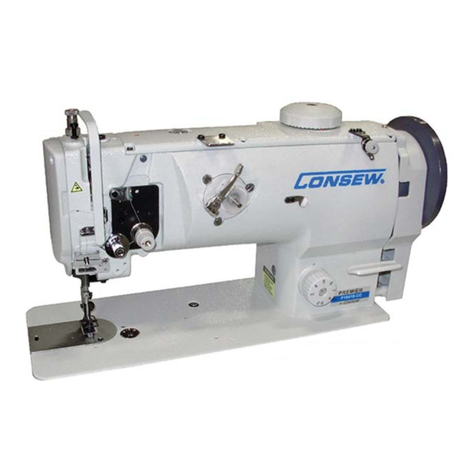
Consew Premier 1541S-CC User manual

Consew

Consew Premier 1541S-CC User manual

Consew 146RB-1A-1 User manual

Consew

Consew 146RB-1A-1 User manual

Consew 318RK-2 Datasheet

Consew

Consew 318RK-2 Datasheet

Consew P1206RB-7 Technical manual

Consew

Consew P1206RB-7 Technical manual

Consew 347R-1A-WS User manual

Consew

Consew 347R-1A-WS User manual

Consew 227r-2 Guide

Consew

Consew 227r-2 Guide

Consew 261B Manual

Consew

Consew 261B Manual

Consew 206RB User manual

Consew

Consew 206RB User manual

Consew 328RB-1 User manual

Consew

Consew 328RB-1 User manual

Consew DLS600 User manual

Consew

Consew DLS600 User manual

Consew 332R User manual

Consew

Consew 332R User manual

Consew 199R-1A User manual

Consew

Consew 199R-1A User manual

Consew 332 User manual

Consew

Consew 332 User manual

Consew 226R User manual

Consew

Consew 226R User manual

Consew 222 User manual

Consew

Consew 222 User manual

Consew 733R-5 Use and care manual

Consew

Consew 733R-5 Use and care manual

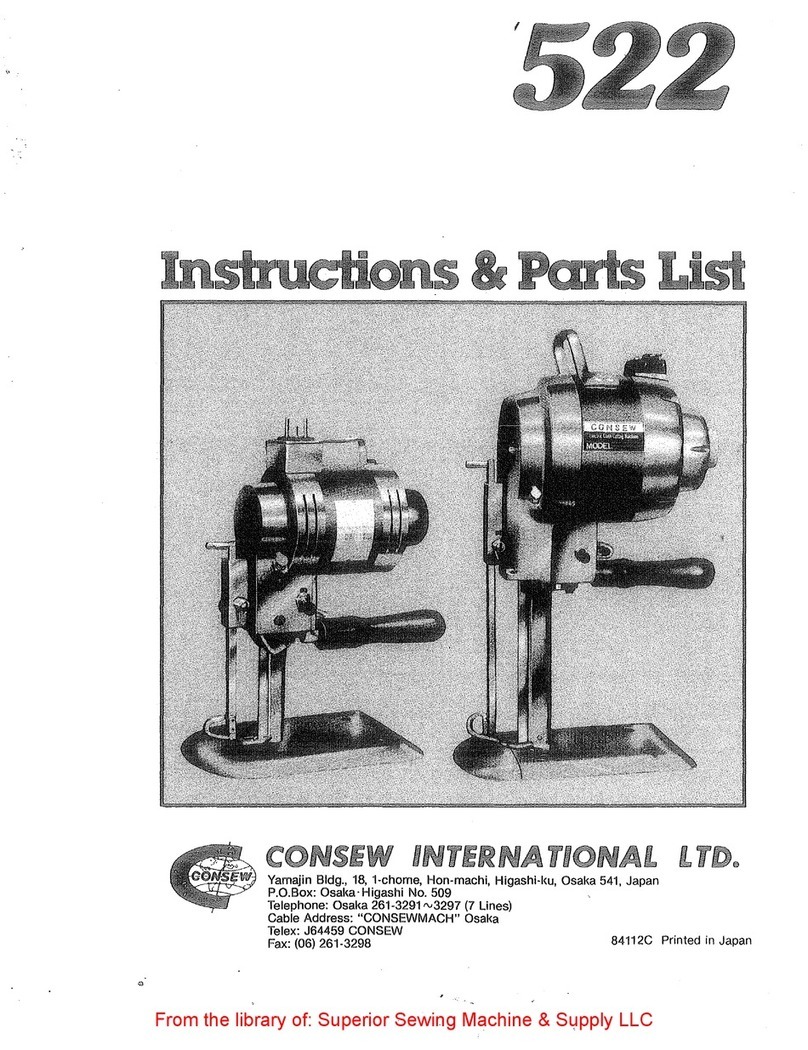
Consew 522 Operation manual

Consew

Consew 522 Operation manual

Consew 744R10-1 User manual

Consew

Consew 744R10-1 User manual

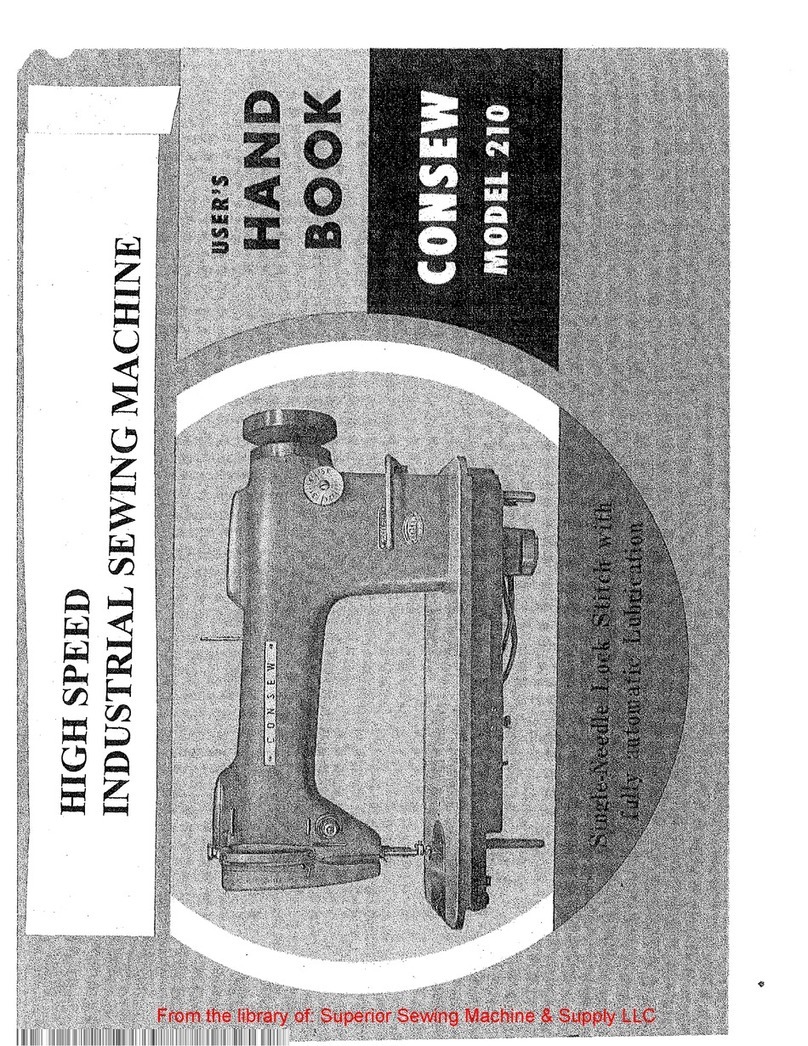
Consew 210 Instruction Manual

Consew

Consew 210 Instruction Manual

Popular Sewing Machine manuals by other brands

Brother PE-180D Service manual

Brother

Brother PE-180D Service manual

Singer 569U1100 Operator's guide

Singer

Singer 569U1100 Operator's guide

ELNA 2002 instruction manual

ELNA

ELNA 2002 instruction manual

Siruba DL7200D-NM1 Instruction book

Siruba

Siruba DL7200D-NM1 Instruction book

Silver Viscount 9500e instruction manual

Silver

Silver Viscount 9500e instruction manual

Pfaff 3588-05/020 instruction manual

Pfaff

Pfaff 3588-05/020 instruction manual

JUKI DDL-9000A instruction manual

JUKI

JUKI DDL-9000A instruction manual

Pfaff 284 Instruction book

Pfaff

Pfaff 284 Instruction book

Reliable MSK-335B Specification sheet

Reliable

Reliable MSK-335B Specification sheet

Kenmore 385. 19000 owner's manual

Kenmore

Kenmore 385. 19000 owner's manual

Brother FD4-B271 instruction manual

Brother

Brother FD4-B271 instruction manual

Brother Computerized Embroidery Machine Operation manual

Brother

Brother Computerized Embroidery Machine Operation manual

Husqvarna Viking Designer SE user guide

Husqvarna Viking

Husqvarna Viking Designer SE user guide

Singer 645 owner's manual

Singer

Singer 645 owner's manual

Riccar RL634DE user manual

Riccar

Riccar RL634DE user manual

ZOJE ZJ9800 Operation manual

ZOJE

ZOJE ZJ9800 Operation manual

Siruba C007JP Instruction book

Siruba

Siruba C007JP Instruction book

IKEA SY user guide

IKEA

IKEA SY user guide

manuals.online logo
manuals.online logoBrands
  • About & Mission
  • Contact us
  • Privacy Policy
  • Terms and Conditions

Copyright 2025 Manuals.Online. All Rights Reserved.

OP
RAT~ON
INSTRUCT~ON
&,
PARTS
l~ST
FOR
CONTENTS
i.Brief instruction...................·............................."......................................................................1
2.Main specifications.........................................."......................................................................1
3.Machine installation................................................................................................................1
4.lnstalling the motor
...........................................................................................,......................2
5.Connecting between the pedal and clutch lever..................................................................
..
S.lnstalling the presser foot lift control plate...............................................................................2
7.lnstalling the bobbin winder....................................................................................................3
8.1nstalling the thread stand.................."......" ...........................................................................3
9.0peration preparation............................"............................".................................................3
1
O.Lubrication.........................................................................................................,..................4
ii.Trial
running..........................................................." ....................................."......................4
12.lnsialling the needle....................."......................................................................................4
13.Coordination among the needle, thread and material.........................................................5
14.Threading the needle thread................................................................................................5
15.
Adjusting the tension of bobbin thread and needle thread...................................................5
is.Winding the bobbin thread and adjustment.........................................................................6
17.Stitch length, forward and backward feed..........................................................0
.................
7
is.Adjusting presser foot pressure........................................................,................................
..
19.Adjusting the amount of presser foot lift..........................................................................
..
20.Adjusting the timing of feed..................................................................................................8
21.Adjusting the timing between needle and hook....................................................................8
22.lnstalling the hook positioning bracket and
hoolc
................................................................8
i.Machine body....................................................................................................................
9~i0
2.Upper shaft and thread
take-up
mechanism..................................................................
11-12
3.Needle bar, rocking shaft, presser foot mechanism......
oo
................
oo
..............................
13-14-
4.Vertical shaft, lower shaft mechanism.............................................................................
15-16
5.Feed mechanism.............................................................................................................17-·18
6.Threading mechanism.....................................................................................................
19~20
7.Accessories ........................................0
...........................................................................
21

o E
10
I
STRUCTIO
1.
Brief
introducHon
This machine is designed with sliding lever
to
take up thread
and horizontal hook catch thread, which product lockstitch.
Upper and lower shafts are driven by bevel gears; lever type
stitch regulator, compound feed
by
feed dog, needle and
walking foot; high presser foot stroke and lifter, and long stitch
length, cylinder bed, Little running noise, it works well
what-
ever
the
surface of materials is smooth or roughness. It's easy
for sewing multi-layer leather and materials.
It's
Vlr:idely
used for binding sewing on the medium and heavy
weight materials. (such as: handbag, shoes and other cylinder
type materials binding
se\\r:ing)
Unison feed
by
binder, feed dog, presser feed and needle,
which assures fully binding.
I
3.
Machine
ins~a!!aHon
1.
Location of the machine
The machine must be located on
th~
rigid and flat floor for
ensuring. its smooth operation and reducing its vibration.
Meanwhile, a rubber mat should be inserted between the
machine stand and the floor for further reducing the running
nOIse.
2. Install the base and oil pan(Fig.
1)
First, Align the four screw holes of the machine base with
the ones
of
the table and plunge four bolts A and tighten
the nuts. Then put the oil pan on the machine base smoothly.
3. Install the machine head (Fig. 2)
First, half of the hinge should
be
made
to
engage with the
machine base, then put the machine head lightly on the
machine base, move it slightly to align the three screw
holes of the head with the ones of the hinge, insert three
screws A and tighten them.
2JViain
specifications
~lication
Medium
and
heavy
weight
materials
---
Max.sewing
speed
2500s.p.m
---
Stitch
leng~h
O~6mm
Needle
bar
stroke
33.2mm
----~
Presser
foot lift
8mm
by
hand
height
l3mm
by
pedal
._-
Hook
Horizontal hook
Needle
DPx
17
16"-18"
Lubrication
--
Oiied
by
hand
--
--
-~
Motor
power
370W
------------
--
Cylinder dia. 46mm
1
oil
pa.n
I
ta.ble
;f/
I
~
2
o o hinge
4.!nstadiing
~he
motor
(Fig.3) J
'-------~---~-
A
c~
B
Align machine balance wheel belt groove A with motor pulley
belt groove B by moving motor C leftward or rightward.
Be sure that the belt is not touched with the table.
5.Connectting bettween the pedal and the ciutch lever (lFigA)
F:-·
-==±=
E-,---I-l-
D---+-t'
C--~
B
___
-+r
A~~~
4
1.
The optimum tilt angle of pedal A against floor is approx.
15° .
2. Adjust the clutch of motor E so that the rod B and the
clutch lever C run in one line.
3. When running, the machine balance wheel G should rotate
counter-clockwise observed from opposite side of the
balance wheel. The motor D rotates in the same direction.
Thf
rotation of motor can change by reversing the plug of
the motor.
4. Adjust the tension of V
-belt
by moving motor upward
or downward, The projJer tension of V
-belt
is a slack of
1O-12mm when the V
-belt
is
depressed by forefinger.
6Jnsttamng the
presser
foot
mt
contro~
piatte (lFig.5)
---c
A
D
E
5 First, the chain
hook
A should be connected to the presser
foot lift lever
C,
then put the pedal assembly D on the stand,
move the control plate E leftward or rightward until the chain
becomes on one line, Tighten the bolts
and
nuts, finally,
connect the chain hook to the control plate.
7J
ns~ai~ing
the
bobbin
V\f~nder
(FiQ].
6)
Align pulley B of the bobbin
V<linder
with the outside of the
V-
belt
C,
and there should be a proper clearance between them;
so
that pulley B can be touched with the V
-belt
when latch
thumb lever A is depressed, thereby the V
-belt
can drive the
pulley Bwhile the machine running.The bobbin winder should
be parallel with belt slit E of the table, then fasten
two
wooden
screws
D.
The thread stand should be located
on
the right backside of
the table. Threading should be smooth when sewing.When the
machine head is turned backward, it should not be touched
with the thread stand, thentighten the nut
C.
1.
Clearing the machine
Before the head is packed, all of the parts of the machine are
coated with anti-rustgrease,meanwhile the grease can harden
and the dust can cover the machine surface during long time
storage and shipment, so, the dust and grease must be cleared
by clean cloth with gasoline.
2. Examination
Although every machine is conformed
by
strict inspection and
test before delivery, the parts of the machine may
be
loose and
deformed afterlong distance transportation with jolt.Athorough
examination must be performed. Turn the balance wheel
slightly by hand to check ifthere is running obstruction, parts
collision, uneven resistance and abnormal noise.
If
any of
these exist, adjustment must
be
made accordingly before
running.
-3-
C-----"'0~
8----\\\\\0
7
'"
"
Ii>
o 0
-~,:-
I ,
b
1
O.lubrication
(Fig,B) J
'------'---
Before running, the machine must be oiled at the places
by
arrow shown.
If
the machine continues in operation, it should
be oiled not less
two
times
per
shift. Please use HA
-8
sewing
machine
oil
or
TJ-70
machine
oiL
11
.Tria! running
Trial running is required when new machine is put into use or
use again after storing quite long time. Please lift the presser
foot
and run the machine at a low speed of
1000-1500
s.p.m
for
30
minutes, then increase the speed gradually.
9
@Jnstamn
g
the
needie
(Fig,9)
-4-
Tum
the balance wheel to lift the needle
bar
to
its highest
position, loosen the
needle
sei screw, and make the needle
groove to the left side of the operator, then fully insert the
needle shank until to the bottom of the needle
bar
socket,
tighten the set screw. (Fig 9a)
Note:lnsufficient insertion (Fig. 9b)or the needle groove facing
to
the operator (Fig. 9c) is incorrect.
13,
rdination
among
the ne Ie,
thread
and
maieria~s
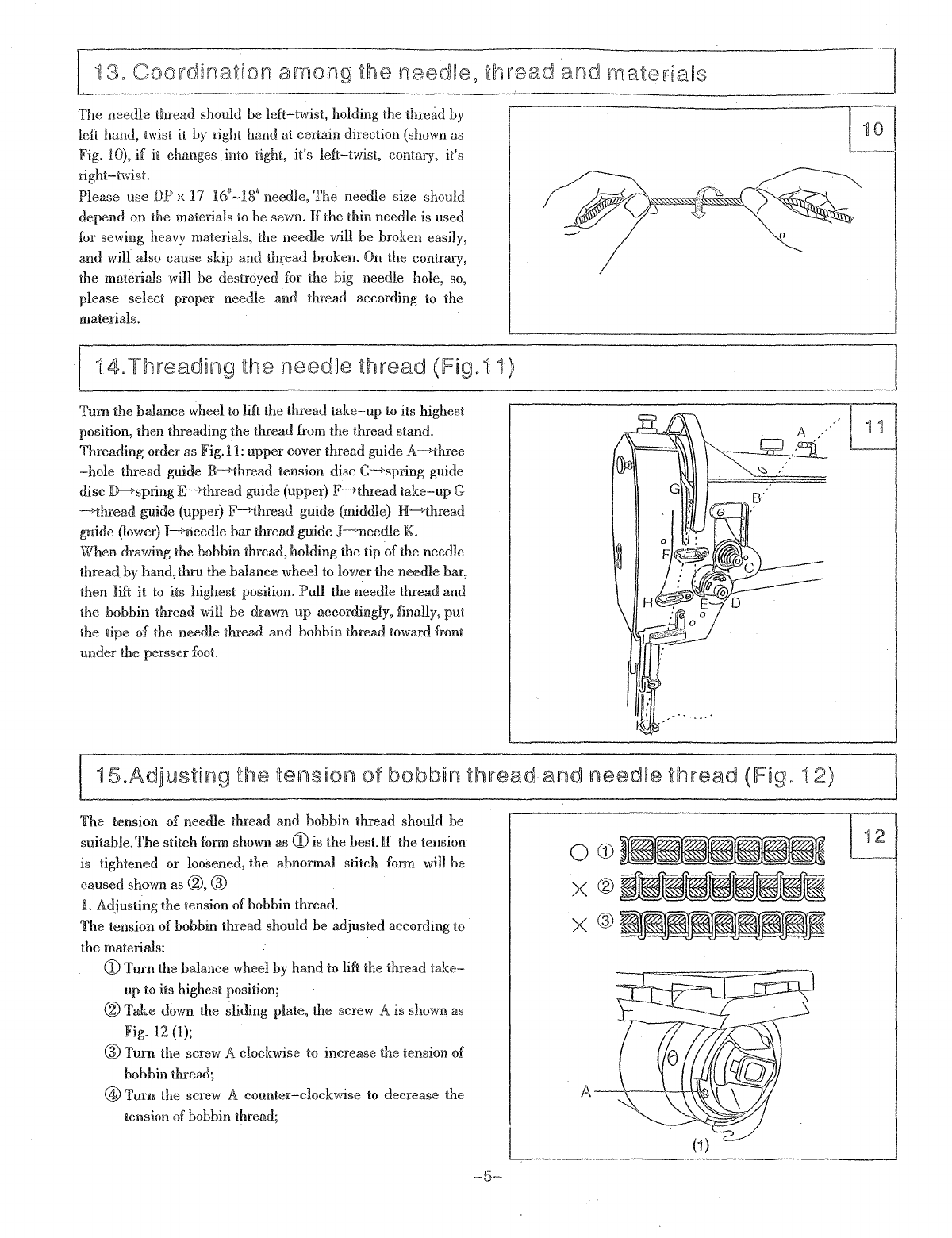
The needle thread should be left-twist, holding the thread by
left hand, twist it by right hand at certain direction (shown as
Fig. 10),
if
ii changes .into tight, it's left-twist, contary, it's
right-twist.
Please
use
DP x
17
16"
~
18"
needle, The needle size should
depend on the materials to
be
sewn.
If
the thin needle is used
for sewing heavy materials, the needle will be broken easily,
and will also cause skip and thread broken. On the contrary,
the materials will be destroyed for the big needle hole, so,
please select proper needle
and
thread according
to
the
materials.
14.Threading the
need~e
thread (Fig.11)
Tum
the balance wheel to lift the thread
take-up
to
its highest
position, then threading the thread from the thread stand.
Threading order as Fig.11: upper cover thread guide
A-lihree
-hole
thread guide
B-lihread
tension disc C-l>spring guide
disc D-l>spring
E-lihread
guide (upper) F-l>thread
take-up
G
-lihread
guide (upper)
F---->cj:h.read
guide (middle) H-l>thread
guide
Qower)
K-l>needle
bar
thread guide J-l>needle
K.
When
drawing the bobbin thread, holding the tip ofthe needle
thread by hand,thru the balance wheel to lower the needle bar,
then lift
it
to
ias
highest position.
Pull
the needle thread and
the bobbin thread
'will
be
drav\Tfi
up
accordingly, finally, put
the tipe
of
the needle thread
and
bobbin thread toward front
under
the persserfoot.
15.Adjusting
the
tension
of
bobbin
thread
and
needle
thread
(Fig.
12)
The tension of needle thread
and
bobbin thread should be
suitable.
The
stitch form shown as
CD
is the best.
If
the tension
is tightened or loosened, the abnonnal stitch form will be
caused shown as
(2),
®
1.
Adjusting the tension of bobbin thread.
The
tension of bobbin thread should be adjusted according to
the materials:
CD
Turn the balance wheel by
hand
to lift the thread
take-
up to its highest position;
(2)
Take down the sliding plate, the screw A is shown as
Fig.
12
(1);
® Turn the screw A clockwise to increase the tension of
bobbin thread;
@
Tum
the screw A counter-clockwise
to
decrease the
tension of bobbin thread;
OeD
X®~~~~~~~
)<@~~~~~~~
11
12
(3)
(2)
Standard clearance Bmm
II/fl---f..--
A
,.,M'----I--
B
2. Adjusting the tension
of
needle thread
(1)
Adjusting the pressure on the thread tension disc:
Adjusting the pressure
on
the thread tension disc
to
change
the tension of needle thread.
As
Fig. (2), turn the nut A
clockwise
10
increase the pressure, on the contrary, to
decrease the pressure.
(2)
Adjusting the tension of spring
Light materials 20g
Normal materials 25g
Heavy materials 30g
The method ofadjustment as Fig.
(3):
Loosen the nut
A,
turn the spring shaft counter-clockwise to
increase the tension, contrary,
to
decrease the tension. Please
use a screwdriver
to
rotate the spring shaft
to
get the
required tension.
(3)
The swing range
of
the spring
The spring must be able
to
swing, when the thread
take-up
is at its highest position, the normal swing range ofthe thread
take-up
spring should be:
Light materials
Normal materials over 8mm
about8mm
Heavy materials less 8mm
The method ofadjusting swing range: as Fig (4)
(j)
Loosen the presser foot lifter;
(2)
Loosen the screw
A;
®
Tum
the disc B counter-clockwise to increase the
swing range, contrary, the swing range decrease.
(j;; Tighten the screw
A.
i
rELWinding
the
bobbin
thread and
adjustment
(Fig. 13)
13
A
D
E
The bobbin thread should be neat and tight.
If
the thread
is weak, please increase the tension of the thread tension
disc
A;
if
the thread is not neat, please move the bracket C
to
adjust it. First, loosen the screw B, if the thread is wound
to one side as Fig
(2),
move the bracket rightward;
if
it is as
Fig
®,
please move the bracket leftward until the thread is
wound neatly
as
Fig.
CD,
then lighten the screw.
Cote: Nylon or polyester thread should be wound under ligbt
tension in particular,otherwise the bobbin D might be broken
or deformed.Please don't overfill the bobbin thread,otherwise
the thread will loosen dovm from the bobbin. The optimum
capacity of bobbin thread is
fill
about
80%
of bobbin outside
diameter, and this can be adjusted by screw K
,
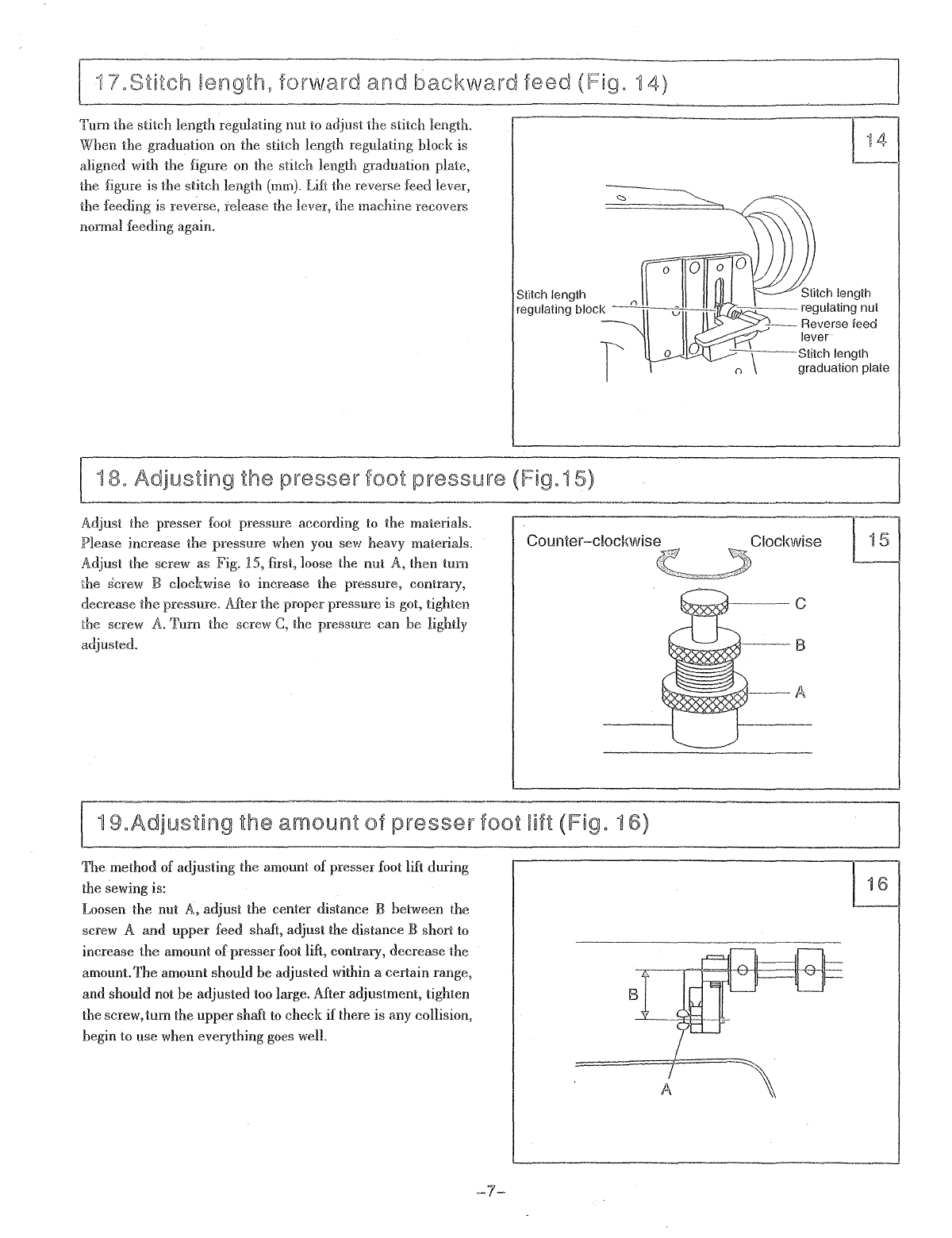
forward
and
backwa
Tum
the stitch length regulating
nut
to
adjust the stitch length.
When
the
graduation on the stitch length regulating block is
aligned with the figure
on
the stitch length graduation plate,
the figure is the stitch length
(mm).
Lift the reverse feed lever,
the feeding is reverse, release the lever, the machine recovers
normal feeding again.
ed (Fig" 14)
14
ro 0 0
Stitch length
Cl
Stitch length
regulating block
--~ifWw<:::t:::---
regulating nut
f o
--
Reverse ieed
lever
-,---';----Stitch
length
graduation plate
18"
Adjusting
the
presser
froot
pressure
(Fig"15)
Adjust the presser foot pressure according to the materials.
Please increase
the
pressure when you sew heavy materials.
Adjust
the
screw as Fig. 15, first, loose the nut A, then
tum
the
SCl'ew
B clockwise to increase the pressure, contrary,
decrease
the
pressure. After the proper pressure is got, tighten
the screw
A.
Turn
the screw
C,
the pressure can be lightly
adjusted.
Counter-clockwise Clockwise
P.·".'.
'.
..
~,
..
,
~
19"Adjusting
the
amount
of
presser
foot iiH (Fig. 1S)
The method of adjusting the amount of presser foot Mt during
the sewing is:
Loosen the nut A, adjust the center distance B between the
screw A and
upper
feed shaft, adjust the distance B short to
increase
the
amount
of
presserfoot lift, contrary,
decrease
the
amount.The amount should be adjusted within a certain range,
and should not be adjusted too large. After adjustment, tighten
the screw,turn the
upper
shaft
to
check if there
is
any collision,
begin to use when everything goes well.
-7-
B
/
A
15
16