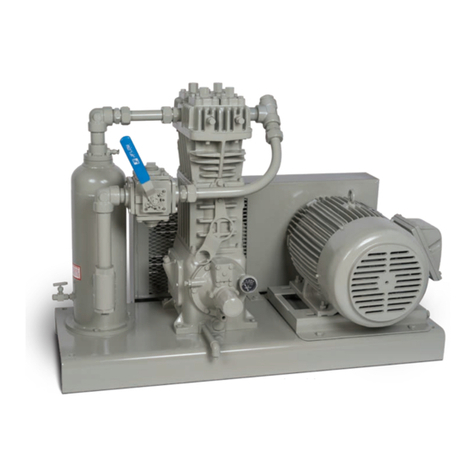
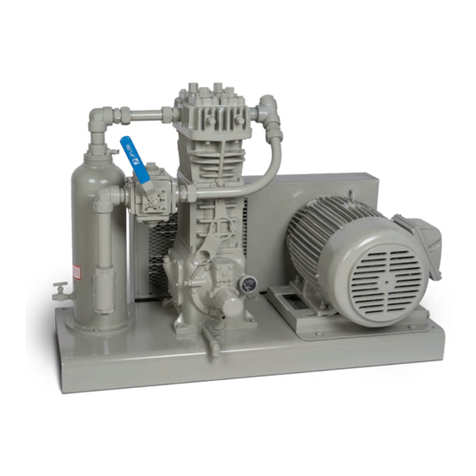
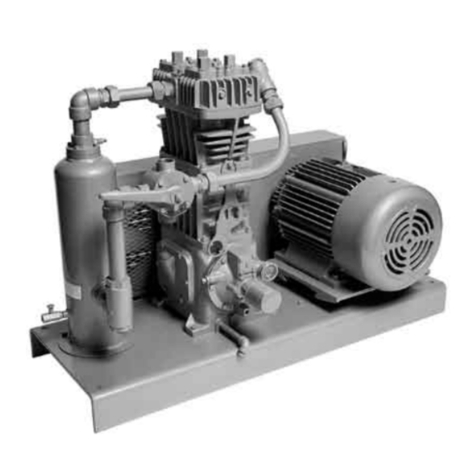
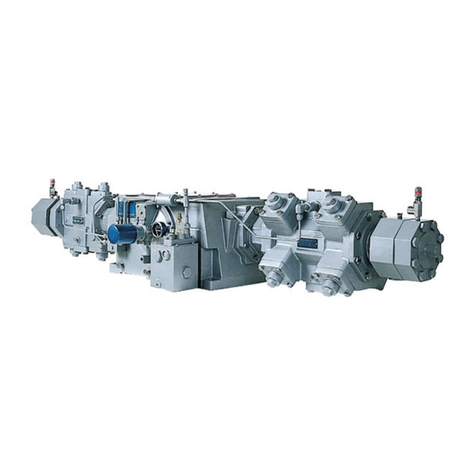
Figure 1.4: ASME automatic liquid trap
Corken’s liquid trap provides the most thorough liquid
separation (see figure 1.4) and is ASME code stamped.
It contains two level switches, one for alarm and one
for shutdown. In some cases the alarm switch is used
to activate a dump valve (not included with trap) or
sound an alarm for the trap to be manually drained by
the operator. This trap also contains a mist pad. A mist
pad is a mesh of interwoven wire designed to remove
fine liquid mists. The ASME code trap is standard in
the 109B and 107B mounting configurations.
NOTE: The liquid level switch MUST be removed from
the trap before grounding any welding devices to
the trap or associated piping! Failure to do so will
damage the switch contacts.
If your compressor is equipped with a liquid trap not
manufactured by Corken, make sure it is adequately
sized; otherwise it may not be able to remove the liquid
entrained in the suction stream.
1.5 Driver Installation/Flywheels
Corken vertical compressors may be driven by either
electric motors or combustion engines (gasoline, diesel,
natural gas, etc.).
Note: Never operate a reciprocating compressor without
a flywheel.
Drivers should be selected so the compressor operates
between 400 and 900 RPM. The unit must not be
operated without the flywheel or severe torsional
imbalances will result that could cause vibration and
a high horsepower requirement. The flywheel should
never be replaced by another pulley unless it has a
higher wk2 value than the flywheel.
Humid climates can cause problems with explosion
proof motors. The normal breathing of the motor and
alternating between being warm when running and cool
when stopped can cause moist air to be drawn into the
motor. This moist air will condense, and may eventually
add enough water inside the motor to cause it to fail. To
prevent this, make a practice of running the motor at least
once a week on a bright, dry day for an hour or so without
the V-belts. During this period of time, the motor will
heat up and vaporize the condensed moisture. No motor
manufacturer will guarantee their explosion proof or totally
enclosed (TEFC) motor against damage from moisture.
For installation with engine drivers, thoroughly review
instructions from the engine manufacturer to assure the
unit is properly installed.
1.6 Crankcase Lubrication
To ensure proper lubrication of the crankcase parts
before startup, the crankcase should be filled through the
nameplate inspection opening.
For vapor recovery applications, be certain to install
a check valve on vapor lines discharging to the liquid
space of the tank.
All piping must be in accordance with the laws and codes
governing the service. In the United States, the following
codes apply:
For LP Gas—The National Fire Protection Association
Pamphlet No. 58, Standard for the Storage and Handling
of Liquefied Petroleum Gases.
For Ammonia—The American National Standards
Institute, Inc., K61.1-1989, Storage and Handling of
Anhydrous Ammonia.
Copies of these are available from NFPA, 60 Baterymarch
Street, Boston, Mass, 02110 and ANSI, 1430 Broadway, New
York, N.Y., 10018. Install, use and maintain this equipment
according to Corken instructions and all applicable federal,
state, and local laws and previously mentioned codes. Other
laws may apply in different industries and applications.
1.4 Liquid Trap
Compressors are designed to pressurize gas—not to
pump liquids. The entry of even a small amount of liquid
into the compressor will result in serious damage.
On liquefied gas applications, a liquid trap must be
used to prevent the entry of liquid into the compressor.
6