2
Technical data CSA0893A
EATON www.eaton.com
1370-15-D
1370-30-D
1380-15-D
1380-30-D
• Montieren Sie den Kern auf das Gehäuse; achten Sie dabei
darauf, daß die Bohrung zur Bezugnahme mit dem entsprechen-
den Stift übereinstimmt. Eine nicht vorschriftsmäßige Montage
kann eine Beschädigung der Einheit sowie den Verfall der
Garantieleistungen zur Folge haben.
• Ziehen Sie den Kern auf dem Gehäuse fest ( 9N/m ), und bauen
Sie anschließend die Auslösetaste wieder ein.
• Setzen Sie das Gehäuse auf die dafür vorgesehene Öffnung und
befestigen Sie es in der gewünschten Position (3N/m) (Abb. 2).
Zu beachten: Fremdkörper, Schmutz und Unreinheiten beein-
trächtigen die Haltekraft und führen zu einer Verminderung der
Schließkraft.
Funktionstest
Versorgen Sie den Elektromagneten mit Strom, und drücken Sie ihn
leicht gegen die auf die Tür montierte Kontaktplatte, so daß beide
Teile angezogen werden. Bei den Modellen 1370 und 1380 muß
zur unmittelbaren Entsperrung der beiden Teile die Stromzufuhr
unterbrochen werden. Bei den Modellen 1370 und 1380 wird das
gleiche Ergebnis erzielt, indem die Auslösetaste gedrückt wird. Um
die vorschriftsmäßige Funktion zu gewährleisten, sollten Sie beide
Einheiten in regelmäßigen Abständen mit einem weichen Tuch (ohne
Wasser) abwischen.
Technische Daten
Baumaterial Aluminium / Stahl
Anschluss Klemmen
Stromversorgung 24 Vdc
Stromaufnahme 52mA (1,2W) [1370] - 100mA (2,4W) [1380]
Schliesskraft 50Kg - 490N [1370] - 100Kg – 981N [1380]
Beschreibung
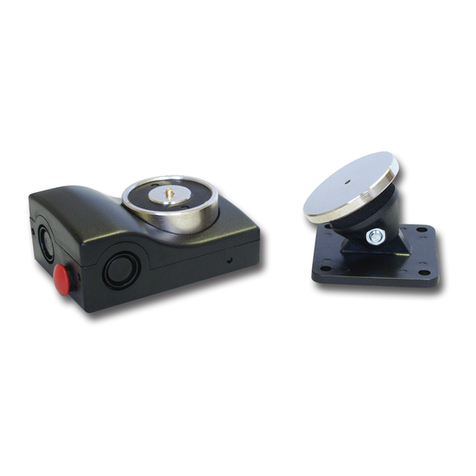
Die Elektromagneten der Baureihen 1370 - 1380 werden
eingesetzt, um Brandschutztüren und Durchgänge offen zu
halten und im Falle eines Brandes automatisch zu schließen.
Der Haltemagnet kann achsial oder im 90° Winkel zur
Halterung montiert werden. Es ist Wand-, Decken- oder
Fußbodenmontage möglich: Ein auf einem Aluminiumträger
montierter Elektromagnet, eine Stahlbuchse, eine Gehäuse
zur Abdeckung der Unterplatte aus Thermoplast, eine
Kontaktplatte und eine Taste zur Entsperrung.
Installation
• Benutzen Sie die Grundplatten als Schablone; achten
Sie darauf, daß der Kern des Elektromagneten und der
Plattenteller in einer Achse montiert werden.
• Führen Sie die zur Installation des Elektromagneten
erforderlichen Bohrungen aus; achten Sie bei der
Befestigung darauf, daß die Kontaktplatte mit nach oben
gerichteter Schrift “TOP” installiert wird, so daß eine
Verdrehung bzw. Beschädigung der Kontaktplatte auch
nach längerem Einsatz ausgeschlossen wird.
• Befestigen Sie das Unterteil zur Montage des
Elektromagneten und ziehen Sie die Kabel durch die
dafür vorgesehene Öfnung.
• Gehen Sie je nach Installationsart (achsial oder senkrecht
zur Buchse) wie folgt vor:
• Bauen Sie die Auslösetaste ab, indem Sie den
Gewindekranz vom
• Aluminiumträger abschrauben.
-Schrauben Sie mit dem mitgelieferten 6 mm-Inbuss-
chlüssel den Kern ab (Abb. 1);
- achten Sie dabei darauf, daß die Feder und der
Druckstift nicht verlorengehen.
D
• Tighten the nucleus to the support (9N/m) then return the
release button to its position.
• Insert the support on the bracket and lock it in place at the
height required, tightening the screws with the 3 mm key
(3N/m) (fig. 2).
N.B. Even the tiniest impurities or dents due to accidental shock
between the nucleus of the electromagnet and the counter-plate
surface will prevent a perfect joint, and lead to considerable, propor-
tional reduction of the declared holding force
Testing
Power the electromagnet and apply light pressure to bring it into line
with the counter-plate. You will note the attraction exerted between
the two parts. Press the release button to separate the two parts.
For ideal operation, clean from time to time with a soft cloth (use no
water).
Technical Specications
Material Aluminum / Steel
Connection Terminal Block
Power Supply 24Vdc
Consumption 52mA (1.2W) [1370] - 100mA (2,4W) [1380]
Holding Force 50Kg - 490N [1370] - 100Kg – 981N [1380]
Description
The series 1370 and 1380 electromagnets are used to keep
the re or transit doors open and release them automatically
in the event of re. The xing bracket enables them to be
oor, ceiling or wall mounted, in both axial and perpendicular
position. The electromagnets are made up of the following
parts: the electromagnet mounted on a aluminum support, the
steel bracket, the base cover in thermoplastic and the counter-
plate. They are tted with release buttons.
Installation
• Use the bracket and counter-plate as fixing template.
Make sure the nucleus of the electromagnet and the
counter-plate surface are in axis.
• Drill the holes and fix the two parts in place, making
sure the counter-plate is fitted with the word TOP facing
upwards, to avoid bending that could damage or break it
in the course of time.
• To install the electromagnet, fix the base to the floor or
ceiling, threading the cables through the tube.
• Fit the base cover.
• Depending on the type of installation required (axial or
perpendicular to the bracket):
- Remove the release button by undoing the lock-nut from
the aluminum support.
- With the 6 mm work screw supplied undo the nucleus
(fig. 1), taking care not to lose the spring and the thrust
pivot.
• Fit the nucleus to the support, making sure the reference
hole coincides with the reference pivot. The imprecise
mounting of this could cause breakage and render the
guarantee invalid.
GB