9
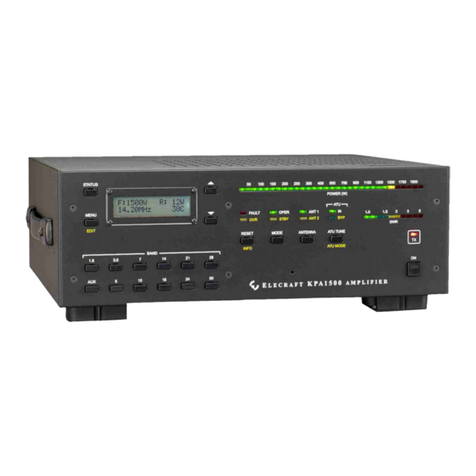
Positioning the KPA1500 RF Deck and Power Supply
Provide at least 4”(10 cm) clearance behind the RF Deck fans and above the Power Supply top cover. Allow at
least 1”(2.5 cm) clearance around the top and sides of the RF Deck and around the sides of the Power Supply
for normal cooling air flow.
The supplied cables allow the Power Supply and RF Deck to be placed up to 66” (167 cm) apart. The Power
Supply can be operated remotely so there is no need for it to be within the operator’s reach. The fans operate
whenever the KPA1500 is on, so you can place the Power Supply under the operating desk or elsewhere to
minimize fan noise.
Cabling –Power Supply
Be sure the POWER ON switch is off before connecting any cables to the Power Supply or RF Deck.
An AC power cable with the popular NEMA 6-20 connector is supplied attached to the Power Supply. The
NEMA 6-20 connector is compatible with NEMA 6-20R receptacles. Replace the connector if you need a
different connection to your mains supply. Elecraft recommends a 200/240 volt AC, 20 amp circuit for proper
operation of the KPA1500.
Connect the Power Supply to the RF Deck with the supplied 66” (167 cm) cable. Plug the Anderson
PowerPole® connector into the HV Supply connector on the RF Deck rear panel (Figure 1, page 7) and the
corresponding connector on the Power Supply , Figure 2, page 8. Observe the polarity; match the colors on
the plug with the connectors.
The 75A PowerPole connectors click twice when inserted. There is no electrical connection until the
second “click.”
Connect the 15-pin connector to the Power Supply and the Control connector on the RF Deck rear panel.
Ensure the captive screws securing the connectors are tight and the connectors are fully seated.
Cabling –RF Deck
Always turn the KPA1500 off via the rear panel switch/circuit breaker on the Power
Supply before attaching or removing cables.
The KPA1500 may be used with the Elecraft K3S, K3, K2 or any HF/6 meter transmitter with a keying output
meeting the requirements shown under note 4 below. Interconnections with transceivers are shown in Figure 4,
page 11, Figure 5, page 12 and Figure 6, page 13. The driving transceiver must provide at least 50 watts of RF
for full output and the output power must be adjustable as described under Transmitting on page 16.
1. Connect your station ground to the GND terminal (see Figure 1. page 7). A good station ground is
important for safety and to minimize local radio frequency interference (RFI).
2. Attach the RF INPUT to the output of your driving transceiver or transmitter using a 50 Ω coaxial
cable with a PL-259 connector on the KPA1500 end.
3. Attach a suitable load with an SWR of less than 1.5:1 to the ANT 1 or ANT 2 connector A 50 Ω
1500 W dummy load is recommended for initial testing. Be sure to select the correct ANT connector
using the front panel ANTENNA switch before transmitting.
4. The driving transmitter must ground the KEY IN line circuit during transmit while sinking up to 5 mA.
This is compatible with virtually all amateur transmitters and no key line buffer is required. If the
transmitter Key Output is not a contact closure or equivalent, it must be at a level between +4 and +16
VDC during receive.