3. Test the power supply voltage output as follows:
•Connect the mains supply cable to {15} on the rear panel and plug the cable into the mains outlet.
(At this point this may be the only cable connected to the rear panel.)
•Position the rear-panel power switch to On (I).
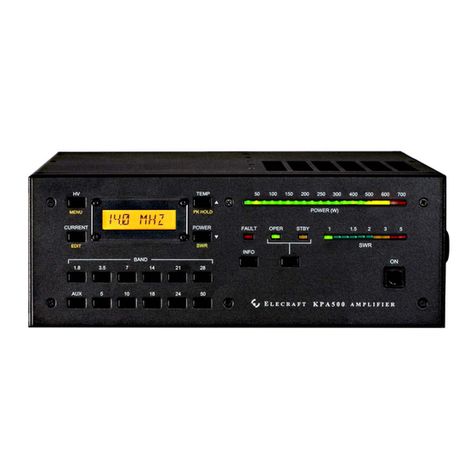
•Tap the front panel
ON
switch. The LCD should light.
•Tap the
HV
switch ({3} on Figure 2) and note the voltage displayed on the LCD. It must be between
65 and 80 volts. If it is outside of this range, immediately tap the
ON
switch to turn the KPA500 off,
and position the rear panel power switch to Off (O). Open the top cover again and select a different
transformer tap. If the voltage was too low, select a tap further up the list in the above table. If the
voltage was too high, select a tap further down the table.
NOTE: If the red FAULT LED lights when you tap the
ON
switch, that indicates the
power supply voltage is above the upper limit. Use a power transformer tap lower on the
above table and retry the test.
Cabling
1. Connect your station ground to the
GND
thumbscrew {10}. A good station ground is important for
safety and to minimize local radio frequency interference (RFI).
2. Attach the
RF INPUT
{11} to the output of your driving transceiver or transmitter using a 50 ohm
coaxial cable with an PL-259 male connector on the KPA500 end. The driving transmitter must supply
up to 40 watts for full output from the KPA500.
3. Attach the
RF OUTPUT {1}
to a suitable load with an SWR of less than 1.5:1. A dummy load is strongly
recommended for initial testing.
4.
Connect the PA KEY
{8} to the driving transmitter Key Output. This line must be grounded to transmit,
and 1 mA of current is sourced. The KPA500 PA KEY jack is pulled up to 5VDC when not
transmitting.
5. Optional: If the driving transceiver is an Elecraft K3, connect
AUX1
{5} to the AUX connector on the
K3 using the optional cable. This cable is not required to operate your KPA500. It allows full use of the
control functions on the K3. Note: This is not a common VGA computer cable.
6. Optional:
RS232 (PC)
connects the KPA500 to your personal computer with a standard 9-pin serial
cable. Required for updating the KPA500 firmware.
7. Optional:
RS232 (XVCR)
connects the KPA500 to a Kenwood transceiver using a standard 9-pin serial
cable.
8. Optional:
ALC OUT
{6} provides level information to control the driving transmitter RF level. The
output is negative-going from -4 VDC to -9VDC.
IMPORTANT: Position the amplifier so there is at least 2 inches (5 cm) clearance behind and
above the amplifier for proper air flow.