- 15 -
advanced protection of windows in premises and shops. When installing the detectors
respective manual instructions must be followed.
It is highly recommended that before permanent installation of detectors or control
panel operating range tests should be undertaken to confirm reliable communication of
the devices with the CB32 panel. The RF range test allows evaluation of operation
range of wireless devices. This function available in Service Settings menu (item 3.4)
and may also be helpful in detecting any interfering radio signals. If signals received by
the control panel are weak, there may be a need to relocate installation places of some
detectors or the control panel. In extreme cases, it is recommended that Elmes TRX
transceiver (repeater) be used to ensure proper communication in the alarm system.
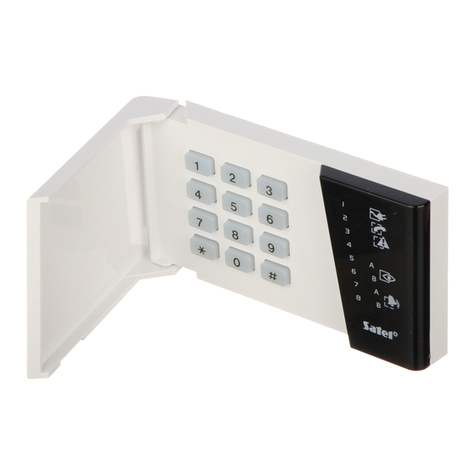
Installation place of detectors is determined individually. Access to the control panel
should meet specific needs of protected premises but it is not recommended to place the
panel next to the door or in place easily accessible. Recommended way of disarming the
alarm system is to activate entry delay from outside of the premises with the use of a
remote control transmitter. It allows safe opening the entrance door, accessing the panel
keypad and disarming the system with password code. The entry delay programmed by
an installer or a user should allow convenient access to the control panel keypad.
The CB32 control panel may also be installed in place such as bedroom or study room,
allowing complete elimination of the entry/exit delay time. In that case, arming and
disarming of the alarm system from the outside of the premises can be made with the
use of a remote control only. It will be audibly signaled by sirens or optically by LED or
a lamp connected to an output configured to arming/disarming signaling.
The panel features also the option of arming alarm system in the night mode with
selected rooms excluded from supervision (e.g. bedroom, corridor), as well as the day
mode in which only the selected rooms (e.g. cellar, basement, garage) are supervised.
All options and functions of alarm system designed with CB32 control panel are user
selected and programmed in the Service Settings menu of the panel.
POWER SUPPLY SOLUTIONS
AC power supply connection to the CB32 panel should start with screwing in wires of
the included AC power pack to +/- terminals of the board. Plugging the pack to AC
outlet back lits the LCD panel and displays software version followed by initial date
(day_month), time (hour: minute: seconds:) and status: “disarmed”. Flashing
“ALARM” LED signals batteries absence. Two AA size NiMH type rechargeable
batteries could be installed now observing correct polarity (+/-) marked in their
compartments. After initial charging “ALARM” LED will stop flashing.
CAUTION! Use AA size NiMH type rechargeable batteries only with recommended
capacity of 1500 to 2000mAh. The use of other types of batteries with AC power supply
pack connected (battery charging) is not permitted and may cause damage.
The use of batteries with lower capacity than recommended could not guarantee 72
hours of emergency operation. After initial 25-30 hours of panel operation (batteries
first charging) the power pack should be disconnected, and the batteries discharged by
powering the panel from the batteries only. Discharged batteries will be recognised by
the LCD panel cease to display any message. The AC power pack should be mains
- 16 -
plugged again to restore panel operation and recharge the batteries. This forming
operation will allow maximum capacity of the batteries.
Operating in wired alarm environment with system backup battery Elmes CB32 control
panel may be powered from 12-14 VDC detector line voltage. In that case however,
batteries cannot be installed in the CB32 and the “AKU failure signaling” should be set
to off (item 8.6 of Service Settings). The wired system backup battery acts as
emergency power supply to entire alarm including the CB32 panel. It is also
recommended to set off alarming on the internal siren of the panel (item 8.5 of S.S.).
Same settings should be made when the panel and outdoor devices (siren, dialer, etc.)
are powered by an external buffered power pack with own backup battery, as on Fig. 2.
NOTE: By default the manufacturer delivers the control panel with the anti-sabotage
zone 32 disabled and the anti-sabotage of OUT1 output set off allowing connection of
external siren and power supply to the CB32 panel without activating sabotage alarm.
After making these connections, inserting the batteries and closing the panel cabinet, the
anti-sabotage protection in zone 32 should be enabled, i.e. set disabled zone 32 to (N).
ALARM SYSTEM WITH ELMES CB32 CONTROL PANEL
Designed alarm system may be less or more complex depending on individual needs.
Simplest alarm may consist of only few detectors and the control panel with internal
siren for audible signaling, while complex alarm system would have a range of detectors
in addition to internal and external signaling devices and GSM phone notification.
The diagram presented on the next page shows an example of a complex alarm system
with the use of Elmes PTX50 wireless motion detectors, Elmes CTX3H and Elmes
CTX4H magnet contact (open & close signaling function) detectors, GBX glass break
detector, Elmes UBM100H remote control for activating entry delay and panic alarm,
wired external siren, phone dialer or GSM phone and Elmes CB32 control panel. The
system should be power supplied from a dedicated buffered power pack with integral
backup battery. Other advisory examples of alarm configurations based on Elmes CB32
wireless control panel are presented on Fig.1 and Fig.2.
Connecting external equipment such as sirens, AC power supply or phone dialer to the
CB32 control panel terminals, wiring should be made through large installation whole
and a cable groove in the bottom part of the cabinet. Suggested installation of the
control panel is in vertical position, e.g. on the wall at the height of approx. 1.20 to
1.40m, allowing convenient entering keypad commands. The configuration procedure
for an exemplary alarm system described further assumes that the user will use a remote
control to activate the entry delay. It is recommended to make basic settings, learn
detectors and carry out the first tests in one workshop place (e.g. on a table) before
permanent installation in the rooms. Following are some basic essential steps to be
taken at first wireless alarm system configuration setting:
1
1
1.
.
.
Unpack the CB32 control panel; first connect the included AC power pack and
then insert rechargeable batteries according to polarity (+/-) marked inside the
control panel cabinet.
2
2
2.
.
.
Enter the Service Settings menu by pressing and holding down the OK button
(initial password: 0000), and set current date and time (item 6.1 of Service