06 07 08 09 10
Functions
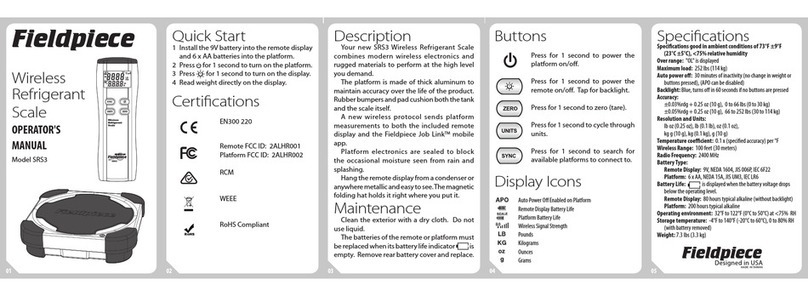
Weight Measurement
Your SRS3 scale is designed to measure
refrigerant tanks weighing up to 252 lbs.
Placing items over 252 lbs on the scale may
damage the scale.
1 Remove the scale from the padded case and
place the platform on solid, level ground.
2 Press for 1 second to turn on the platform.
3 Press for 1 second to turn on the display.
4 Press UNITS for 1 second to cycle through
LB OZ, LB, OZ, KG G, KG, and G.
5 Press ZERO for 1 second to tare the scale.
6 Set your tank on the platform and zero again
to view only the change in refrigerant.
7 View the change in weight in real-time when
charging or recovering refrigerant.
Backlight
Tap to turn on the blue backlight on the
LCD. This is useful when the sun is going down
on late day jobs or any dark situation. The back-
light uses extra battery power than standard
use.
Auto Power Off (APO)
If the weight is unchanged for 30 minutes,
the platform will automatically power off.
To disable APO, while power is on tap twice
on the platform. The LED will briefly blink red
and APO will not be shown on the display.
To enable APO, while power is on tap twice
on the platform. The LED will briefly shine red
and APO will be shown on the display.
Syncing a Display to a Platform
The included remote display is setup to view
the platform at the factory. You shouldn't ever
need to re-sync them. You can sync two SRS3
remote displays (SRS3R) to a single SRS3 plat-
form (SRS3P) if desired.
1 Press SYNC for 1 second.
2 The ID# of a detected platform will show.
(This ID# is printed on the platform.)
3 TapSYNCtocyclethroughanyotherplatforms
detected.
4 Press SYNC for 1 second to select a platform.
Using the Job Link® system app as a display:
Go to Measurements and favorite the SRS3
platform (SRS3P) to the tool manager in the
app.
Tech Tips
Respect the Environment
Always use hoses with ball valves or low-loss
fittings to minimize harmful refrigerant gases
entering the atmosphere.
Account for Your Hose Weight
Connect the hoses to the system and tank
before zeroing the scale. After charge/recovery
is finished and the system is stable, note the
weight before removing hoses.
Use Your Appropriate G-Value
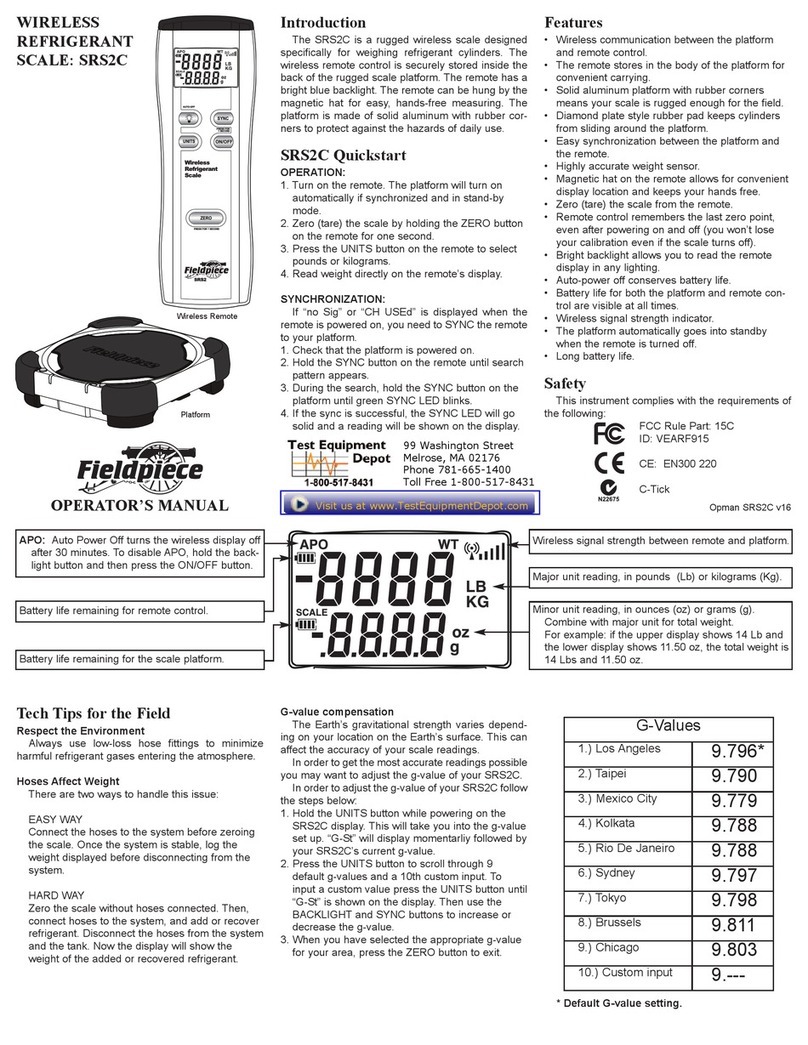
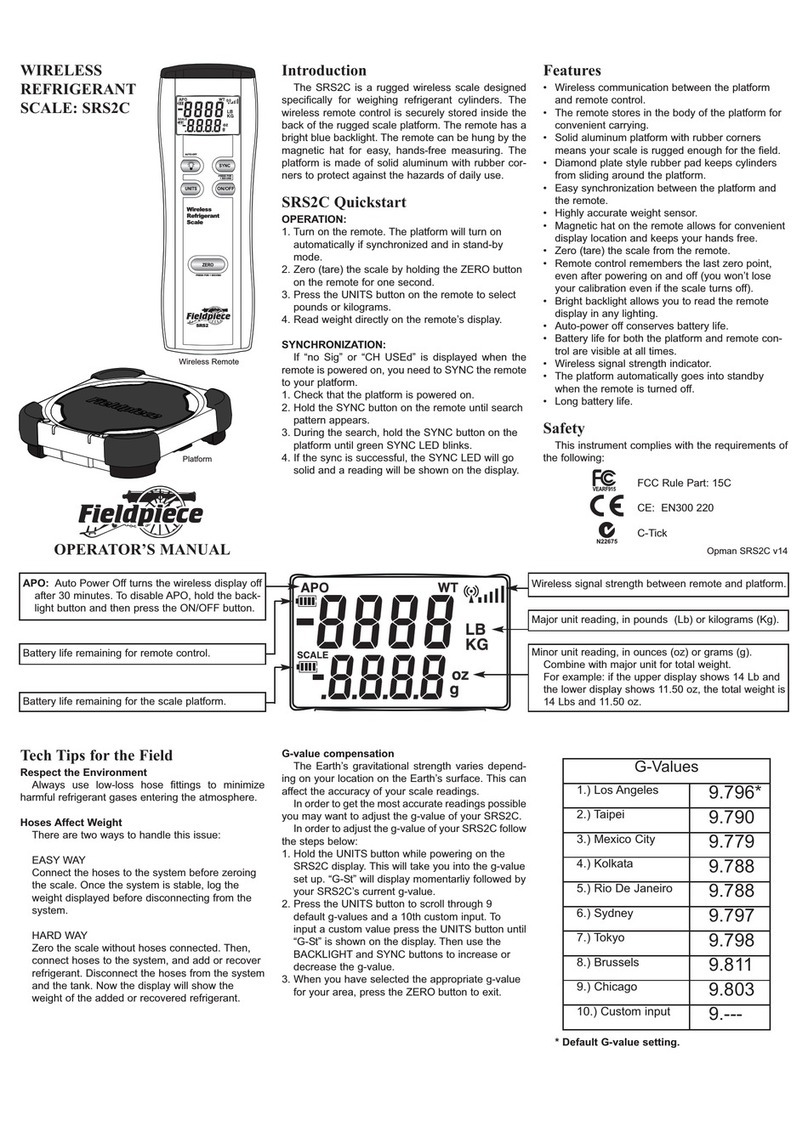
Acceleration due to gravity in m/s2(G-Value)
varies slightly depending on your altitude and
location. Here are few cities' examples:
Los Angeles (default) 9.796
New York City 9.802
Paris 9.809
Sydney 9.797
Denver 9.798
1 Hold UNITS while powering on display.
2 With the current G-Value showing, tap SYNC
toincreasevalue.TapUNITStodecreasevalue.
3 Tap ZERO to save and exit.
Safety First!
For use only by qualified and certified technicians in the safe use,
handling, and transporting of refrigerants. Please refer to flammable
refrigerant safety guides, regional codes and legislation for more
information.
WARNINGS – failure to heed these hazards and actions
can result in serious injury or death
1. Always use a grounded outlet
2. Always wear Proper Protective Equipment (PPE), which includes
gloves and safety glasses
3. Know proper safety and handling requirements of the refrigerant
in the Safety Data Sheet (SDS)
4. Avoid breathing refrigerant and oil vapors
5. Handle hoses and equipment carefully as refrigerant is under
high pressure and can cause frost bite
6. Do not operate in or near explosive atmospheres
7. Perform leak detection in accordance with recommended prac-
tice to verify working environment is free from leaking refrigerant
as it can be toxic and or flammable
8. Only work in well-ventilated areas (minimum of 4 air exchanges
per hour)
9. Ensure power and extension cords are in good working condition
to prevent shock and spark hazards
Additional safety instructions for recovering A2L
refrigerants (e.g. R-32, R-1234yf, R-1234ze):
1. Adhere to local occupational safety codes and possess detailed
knowledge and skills when handling mildly flammable
refrigerants
2. Have emergency, evacuation, and fire protection plans
3. Designate and monitor aTemporary Flammable Zone with a
3-meter perimeter
4. Identify and disable all possible ignition sources within this Zone
5. Monitor air with a flammable refrigerant leak detector within
this Zone
6. Use a ventilation fan to maintain 5 air exchanges per hour within
this Zone
7. Make power connection of the recovery machine and other
equipment outside of the Temporary Hazard Zone
8. Bond the recovery machine outlet port to the recovery tank’s
unpainted fitting with a grounding strap to dissipate static elec-
tricity buildup during recovery process
9. Ensure area around machine is free of debris that could enter air
vents and fan and cause accidental sparking
10. Always remain in attendance and observant when the machine
is running
11. Do not mix flammable refrigerants with air
12. Use an evacuated DOT recovery tank
13. If system has a suspected leak, stop recovery at 0 psig/bar to
prevent air from entering the recovery tank
14. After recovery, purge system with 100% nitrogen before opening
system for repair
CAUTIONS – failure to heed these conditions can cause
equipment damage.
1. Ensure that recovery machine, hoses, tank and other equipment
are in good working condition
2. Avoid overfilling recovery tanks by following refrigerant manu-
facturer’s filling instructions and using a weight scale
3. Avoid cross contamination by not mixing refrigerants