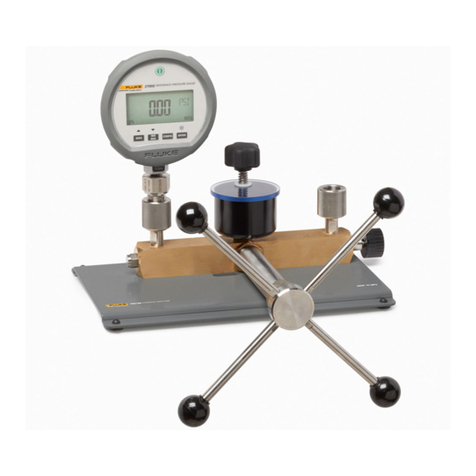
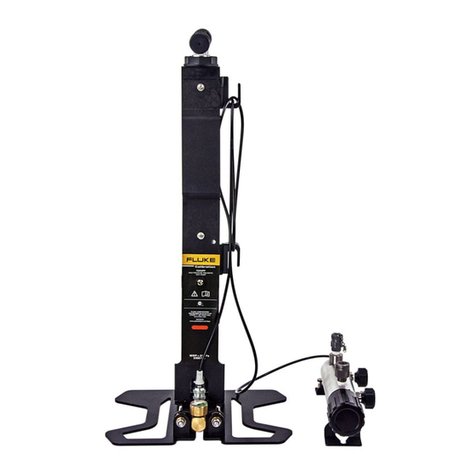
P5513
Users Manual
2
Compressed Gas
Use of compressed gasses can create an environment of propelled foreign matter.
Pressure system safety precautions apply to all ranges of pressure. Care must be taken
during testing to ensure that all pneumatic connections are properly and tightly made
prior to applying pressure. Personnel must wear eye protection to prevent injury.
Personal Protective Equipment
Wear eye protection approved for the materials and tools being used.
WWarning
If the equipment is used in a+ manner not specified by the
manufacturer, the protection provided by the equipment may be
impaired.
Symbols Used in this Manual
In this manual, a Warning identifies conditions and actions that pose a hazard to the user.
A Caution identifies conditions and actions that may damage the Pneumatic Comparison
Test Pump.
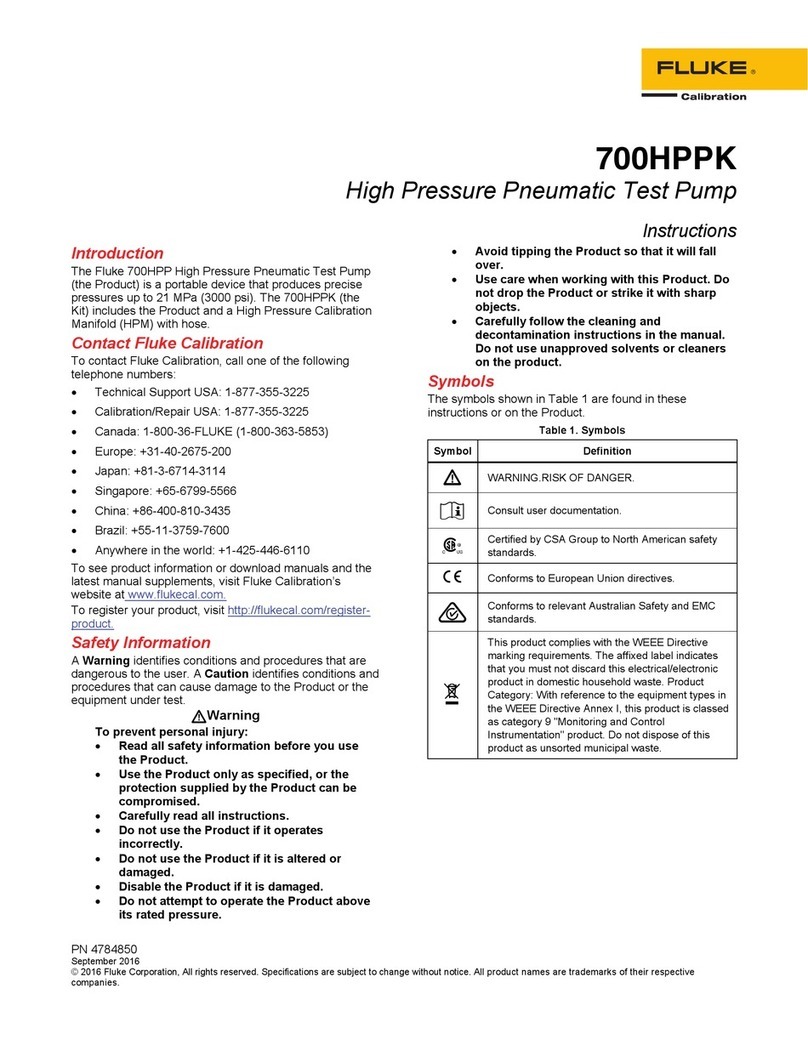
Symbols used on the Pneumatic Comparison Test Pump and in this manual are explained
in Table 1.
Table 1. Symbols
Symbol Description
BAC (Alternating Current)
JEarth Ground
WImportant Information: refer to manual
~Do not dispose of this product as unsorted
municipal waste. Go to Fluke’s website for
recycling information.
Preparation
The comparison test pump should be placed on a stable workbench or similar surface.
Operating Range
The P5513 must be connected to an external gas supply through the ¼ NPT port in the
rear of the instrument case. Typically, dry Nitrogen from a commercially available
compressed gas cylinder is used.
The external pressure supply must be regulated to either the maximum range of the
comparison test pump (3000 psi / 210 bar), or 10% above the maximum pressure required,
whichever is the lower. DO NOT OVER-PRESSURIZE THE COMPARISON TEST
PUMP.
Model Max. Working Pressure
P5513 3000 psi / 210 bar