3
Description of the water treatment system
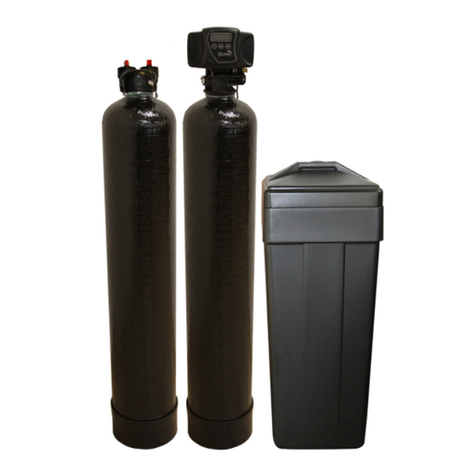
This stacked combo filter / softener system includes a brine (salt) tank, a carbon filter media tank and a softener
resin tank with a backwashing control valve. Incoming water flows into the control valve and is directed down
through the carbon and then the ion exchange softening resin. The carbon absorbs chlorine to remove taste
and odor and to protect the softener resin. The softener resin exchanges the hardness ions for softer ions. The
softened water then returns to the control valve where it is directed into the service lines. The PSCF1 Series
carbon filter / water softener is designed to be installed on chlorinated water supplies.
Periodically the control valve will go through a regeneration cycle. The frequency of this regeneration process
will depend on the incoming water quality and amount of water used. Prior to regeneration the control valve will
then put water into the salt tank to make brine for the upcoming regeneration. The backwash cycle of
regeneration is factory preset to begin at 2:00 A.M. At this time the control valve will draw the brine solution out
of the salt tank and flush both the accumulated hardness and excess salt to the drain.
Location Considerations
The proper location to install the softener will ensure optimum performance and satisfactory water quality. The
following factors should be considered in selecting the location of this system.
1. The softener must be installed after the pressure tank (private well system only) or water meter.
2. The softener should be installed after any iron filter and/or other backwashing filter.
3. A cartridge type sediment filter is optionally recommended to be installed following the PSCF1.
4. The system must not be subject to freezing temperatures
5. The system should be installed as close as possible (preferably within 15’) to an adequate floor or
laundry drain capable of handling the backwash cycle volume and flow rate (refer to unit
specifications on pages 12 - 13). An air gap should be provided between the drain line and
plumbing drain.
6. All water conditioning equipment should be installed at least 10’ prior to the water heater. Water
temperatures exceeding 100°F can damage the internal components of the control valve and
mineral tank. An expansion tank may need to be installed in the line to the water heater, in order to
allow for thermalexpansion and comply with local plumbing codes.
7. Appliances requiring extended periods of continuous or high flow water use (i.e. geothermal heat
pumps, swimming pools, lawn irrigation, outside hose bibs, etc.) should bypass all water
conditioning equipment unless the equipment has been specifically designed for that purpose.