2
0388EN July 2015
Metering systeMs
Volumetric thermal energy meters
ge552 series
ISO
14001
0032A/3
OHSAS
18001
0064L/1
ISO
9001
0006/7
Warning.
The installation must be carried out by qualied personnel.
This technical information sheet must be read carefully and in full
before installing the device.
Installing the volumetric part
• Ball valves must be installed upstream and downstream from the volumetric part.
• Check the correct flow direction (shown by an arrow on the side).
• The use of devices that modify the flow direction is forbidden!
• Install the tool horizontally or vertically, not diagonally or upside down!
• Install in horizontal or descending/ascending flow pipes.
• Do not install in the highest part of the line, in order to avoid the formation
of air pockets.
• Bear in mind the dimensions of the meter. The distance between two EAS
cabinets must be at least 135 mm.
• Keep a distance of at least 1 metre between the meter and any
electromagnetic sources such as switches, motors or pumps.
• Keep a distance of at least 20 cm from electric cables.
• Leave a space of at least 3 cm around the device.
Installing the heating/cooling meter
• Carefully rinse the system out before installing the meters.
• Close the valves upstream and downstream, and depressurise the system.
• Remove the tools or“standby templates”from the line.
• Use only new gaskets; clean their surfaces and check them for signs of wear.
• Install the new tool in the correct flow direction.
• Turn the electronic part to the required reading position.
Installing the temperature probes
• Do not remove the return probe installed during the production phase, and do
not remove the standard protection seals either.
• The probe cables are identified by their colours (red=delivery; blue=return).
• The cables cannot be folded, lengthened or shortened!
• It is forbidden to damage the seal on the probe.
• Fully remove any caps and gaskets from the ball valve.
• Correctly position one O-ring (the second O-ring is a spare part) using the pin,
rotating it slightly to insert it in the installation point (in accordance with DIN
EN 1434).
• Correctly position the O-ring using the other end of the pin installation kit.
• Insert the two halves of the plastic adaptor in the three probe stops, and press
them against each other.
• Use the installation and positioning support.
• Insert the probe in the installation point, then tighten it by hand until it is
resting against the piece with 12 sides (torque moment 3-5 Nm).
• Seal the probe installation point (which you may choose to integrate in the
flow sensor).
• As soon as the probes have been installed, fix the seals to prevent any tampering
by unauthorised persons.
Installing the adaptor
Pulse inputs
The pulse value of the three inputs can be called up on the display.
Technical data
• Max. load: 30V DC / 20 mA
• I/O 1, 2, 3: Open Drain, canal n FET
• Key ratio: 1:1 (out) 1:5 (in)
• Input frequency: max. 1 Hz
• Cable length: 1,5 m
• Cable diameter: 3,8 mm (4 wires)
Connections
Colour Connection Meaning
White I/O 1 Input / Output 1
Yellow I/O 2 Input / Output 2
Green I/O 3 Input / Output 3
Brown GND Common earthing for I/O 1, 2, 3
In 1, 2, 3
GND
Ingresso
M-Bus interface
The integrated M-Bus interface complies with regulation UNI EN 1434-3 and
transmits information at a speed of 2400 baud. In addition to information on
the heating/conditioning energy consumption, the interface can transmit
data picked up by the three additional inputs.
Technical data
• Cable length: 1,5 m
• Cable diameter: 3,8 mm (2 wires)
Connections
Colour Connection Meaning
Brown M-Bus 1 M-Bus line 1
White M-Bus 2 M-Bus line 2
Installation
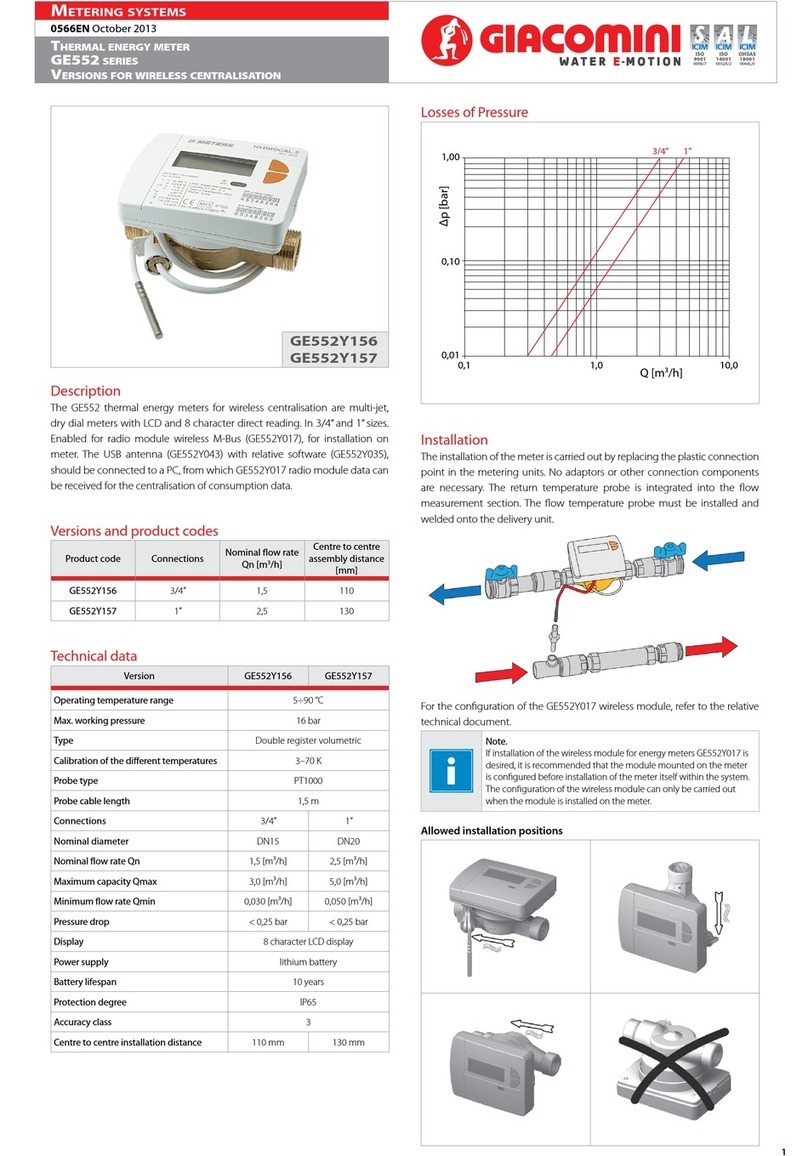
The installation of the flow rate measuring section is carried out by replacing
the plastic dummy meter connection point. No adaptors or other connection
components are necessary. The return temperature probe is integrated into
the flow measurement section.
Warning.
The maximum temperature of the water in the volumetric part must
not exceed 90 ºC. During assembly, make sure no hot water leaks
out - risk of burns.
All current laws and regulations must be respected, in particular EN 1434 parts
1 and 6.
Since the GE552 meter incorporates an M-Bus communication interface and
can therefore form part of a network for transmitting data, it must also comply
with the regulations for the installation of electronic devices.
Input