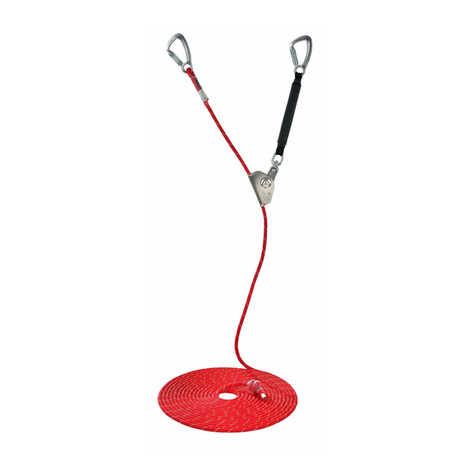
USER MANUAL
INSTRUCTIONS FOR USE
All users should read and understand
these instructions. All users should be
suitably trained to use this equipment.
This documentation issued with this
product (instructions, record card) should
be kept with the product.
Chemical Attack — The product should
be kept away from acids, alkalines,
chemicals, sharp edges and anything
which may cause damage to it.
Storage and Transport — This product
must be transported and stored in a dry
cool place. Wet or damp equipment should
be allowed to dry naturally.
Inspection —This product must be
inspected at regular intervals by a
competent person. The frequency of the
inspection is dependant on the type of
usage and any prevailing conditions.
Obsolescence — provided that the
product is inspected and maintained in
accordance with manufacturer’s
recommendations, the maximum lifespan
of the product is 10 years from date of first
purchase. The type of use and the
conditions will affect the lifespan of a
product.
Cleaning — Wipe webbing with a damp
cloth. If the dirt is more ingrained, wash in
water up to 40°c. Use mild detergent.
Rinse in clean water. Hang up to dry.
Avoid direct heat source when drying.
Before Use — The user should make a
visual inspection of the product. Look for
damage to webbing, particularly under and
around buckles and attachment points.
Check webbing for abrasion, cuts, wear,
deformation and chemical contamination.
Check stitch patterns for broken or loose
stitches, cuts and pulling. Check the
correct operation of any moving parts. If
there is any doubt about the condition of
the product it must be removed from
service. A further inspection should then
be carried out by a competent person or
the manufacturer. A rescue plan should be
in operation.
Warning — No repairs, alterations or additions
should be made to this equipment without
consultation with the manufacturer. The
equipment should not be used outside its
limitations, or for any purpose for which it is not
intended. If equipment is to be used as part of a
system, consult with the manufacturer. Only full
body harnesses with a tested attachment point
should be used as part of a fall arrest system.
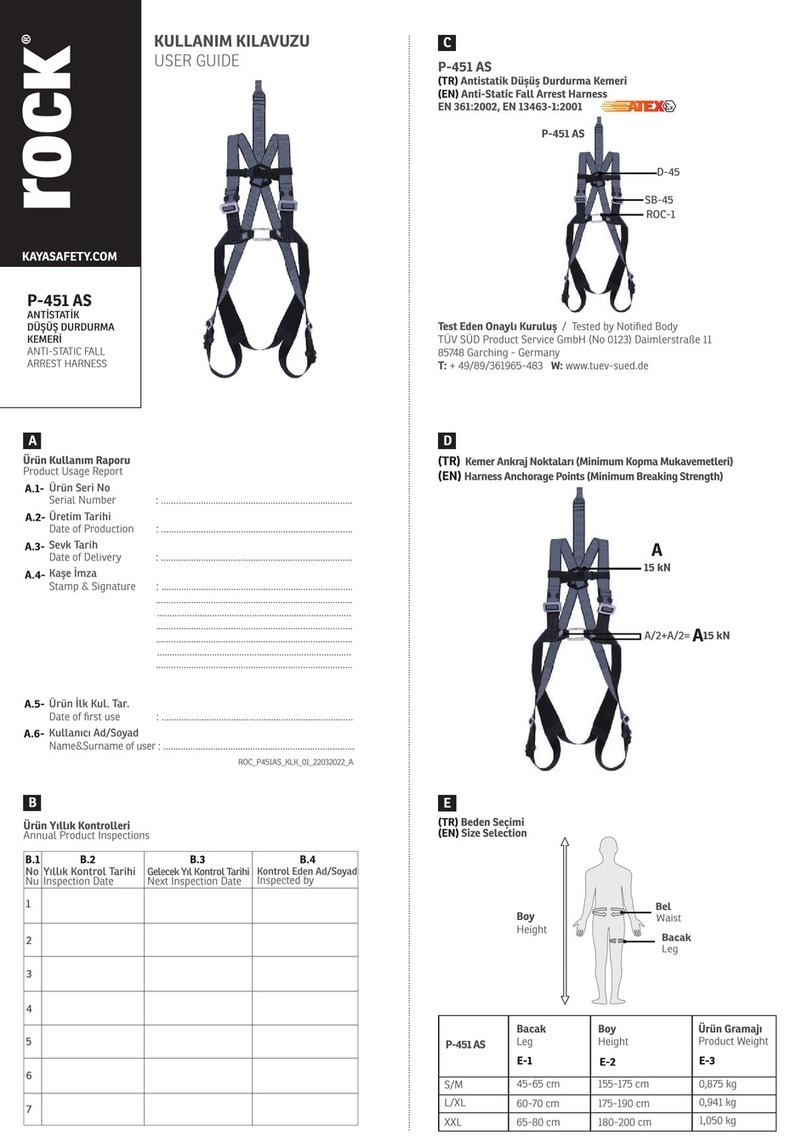
Attachment Point — The fall arrest attachment
point of the harness will be marked with an ‘A’.
Where the user should attach two points
together, both attachment points are marked
‘A/2’. Attachment points for rescue, confined
access and egress are labelled accordingly.
WORK RESTRAINT
Technical Definition: A personal fall protection
system that uses a body holding device
connected to a reliable anchor to prevent a
person from reaching zones where the risk of a
fall exists.
Principle: Work restraint— if you are able to fall
it is fundamentally not work restraint.
Note: Shock absorbing lanyards may be used for
work restraint if they are the correct length.
Anchor Points: When used in fall arrest
systems, the anchor point should, where
possible, be above the user. The anchor point
should hold 12kN or conform to EN795. Only use
an approved connector to the anchor point.
Globestock Ltd.
Mile Oak Industrial Estate
Maesbury Road
Oswestry, Shropshire
SY10 8GA. UK
+44(0)1691 654 966
www.globestock.co.uk