43
e. The outside diameter and thickness of your backing plate must be within capacity
rating of your power tool. Incorrectly sized accessories cannot be adequately guarded
or controlled.
f. Threaded mounting of accessories must match the power tool’s spindle thread. For
accessories mounted by flanges, the arbor hole of the accessory must fit the locating
diameter of the flange. Accessories that do not match the mounting hardware of the
power tool will run out of balance, vibrate excessively and may cause loss of control.
g. Do not use a damaged accessory. Before each use inspect the accessory such as
the backing plate for cracks or tears. If power tool or accessory is dropped, inspect
for damage or install an undamaged accessory. After inspecting and installing an
accessory, position yourself and bystanders away from the plane of the rotating
accessory and run the power tool at maximum no-load speed for one minute. Damaged
accessories will normally break apart during this test time.
h. Wear personal protective equipment. Depending on application, use face shield,
safety goggles, or safety glasses. As appropriate, wear dust mask, hearing protectors,
gloves, and a workshop apron capable of stopping small abrasives or flying fragments.
The eye protection must be capable of stopping flying debris generated by various
operations. The dust mask or respirator must be capable of filtrating particles
generated by your operation. Prolonged exposure to high-intensity noise may cause
hearing loss.
i. Keep bystanders a safe distance away from work area. Anyone entering the work
area must wear personal protective equipment. Fragments of material or pieces of a
broken accessory may fly away and cause injury beyond the area of operation.
j. Hold power tool by insulated gripping surfaces only, when performing an operation
where the accessory may contact hidden wiring or its own cord. A spinning accessory
contacting a “live” wire may make exposed metal parts of the power tool “live” and
shock the operator.
k. Position the cord clear of the spinning accessory. If you lose control, the cord may be
cut or snagged and your hand or arm may be pulled in causing injury.
l. Never lay the power tool down until the accessory has come to a complete stop. The
spinning accessory may grab the surface and pull the power tool out of your control.
m. Do not run the power tool while carrying it at your side. Accidental contact with the
spinning accessory may snag clothing, pulling the accessory into your body.
n. Regularly clean the power tool’s air vents. The motor’s fan will draw the dust inside
the housing and excessive accumulation of powdered metal may cause electrical
hazards or overheating.
o. Do not operate the power tool near flammable materials. Sparks could ignite these
materials.
p. Do not use accessories that require liquid coolants. Using water or other liquid
coolants may result in electrocution or shock.
6. KICKBACK AND RELATED WARNINGS
Kickback is a sudden reaction to a pinched or snagged rotating wheel, backing plate,
brush, or any other accessory. Pinching or snagging causes rapid stalling of the
rotating accessory which in turn causes the uncontrolled power tool to be forced in the
direction opposite of the accessory’s rotation at the point of the binding. For example,
if a pad is snagged or pinched by the trim, the edge of the pad that is entering the pinch
point can dig into the surface of the material causing the wheel to climb out or kick out.
The tool may either jump toward or away from the operator, depending on direction
of the pad’s movement at the point of pinching. Rotating accessories may also break
under these conditions. Kickback is the result of tool misuse and/or incorrect operating
procedures or conditions and can be avoided by taking proper precautions as given
below:
a. Maintain a firm grip on the power tool and position your body and arm to allow you to
resist kickback forces. The operator can control torque reaction or kickback forces, if
proper precautions are taken.
3. PERSONAL SAFETY
a. Stay alert, watch what you are doing, and use common sense when operating
power tool. Do not use power tool while you are tired or under the influence of drugs,
alcohol, or medication. A moment of inattention while operating power tool may result
in serious personal injury.
b. Use personal protective equipment. Always wear eye protection. Use of protective
equipment such as a dust mask, gloves, or hearing protection under appropriate
conditions will reduce the chance of personal injury.
c. Prevent unintentional starting. Ensure the switch is in the “Off” position before
connecting to power source, picking up, or carrying the tool. Carrying power tools
with your finger on the switch or energizing power tools that have the switch “On”
invites accidents.
d. Remove any adjusting key or wrench before turning the power tool on. A wrench or
a key left attached to a rotating part of the tool may result in personal injury.
e. Do not overreach. Always keep proper footing and balance. This enables better
control of the power tool in unexpected situations.
f. Dress properly. Do not wear loose clothing or jewelry. Keep hair, clothing, and
gloves away from moving parts. Loose clothes, jewelry, or long hair can be caught in
moving parts.
g. Do not let familiarity gained from frequent use of power tools allow you to become
complacent and ignore tool safety principles. A careless action can cause severe
injury within a fraction of a second.
4. POWER TOOL USAGE AND CARE
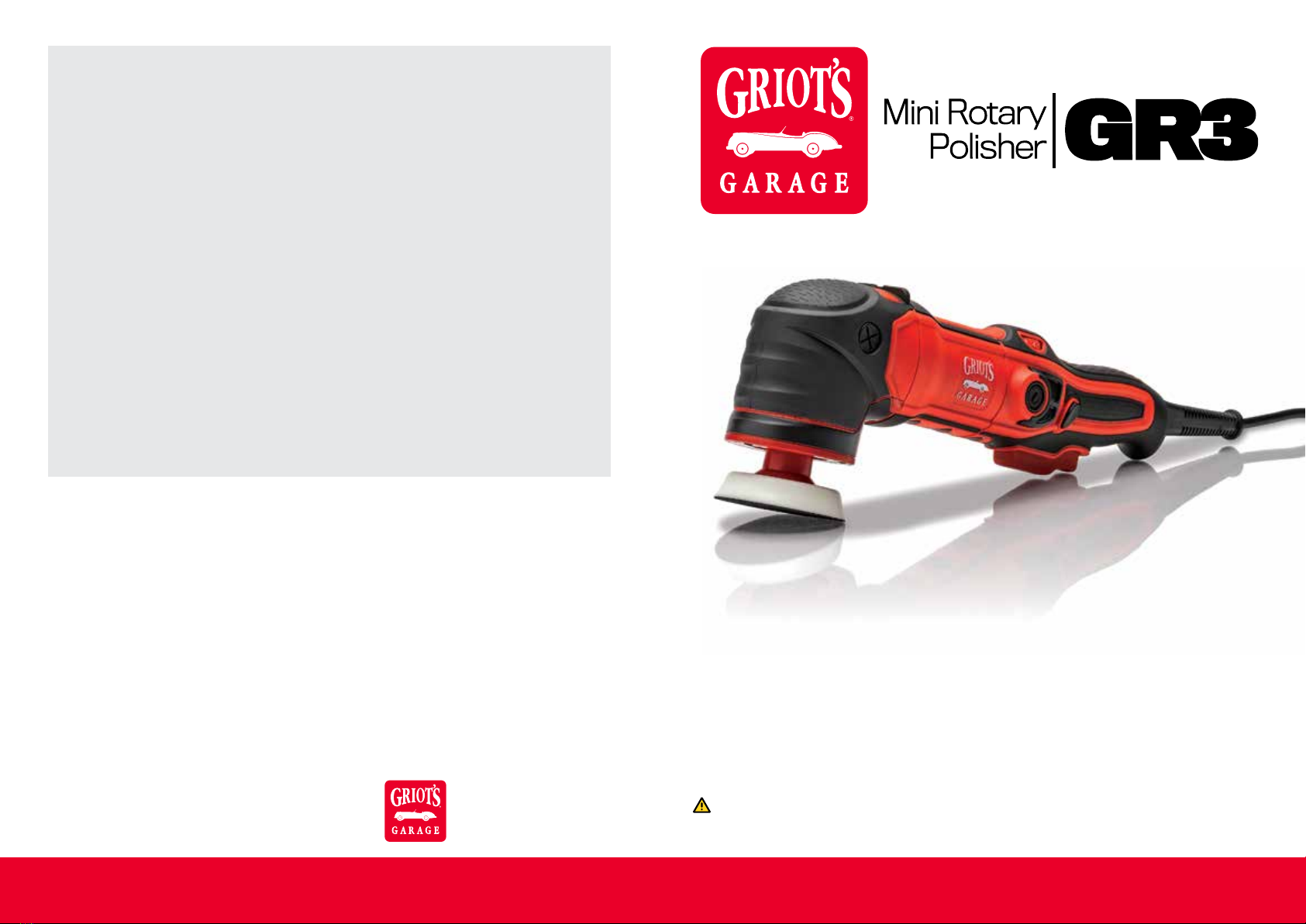
a. Do not force the power tool. Your GR3 Mini Rotary Polisher is intended to function
as a buffer, polisher, and wax/sealant application tool.
b. Do not use the power tool if the switch does not turn it on and off. Any power tool
that cannot be controlled with the switch is dangerous and must be repaired.
c. Disconnect the power tool plug from the power source before making any
adjustments, changing accessories, or storing power tool. Such preventive safety
measures reduce the risk of starting the power tool accidentally.
d. Store idle power tools out of the reach of children and do not allow persons
unfamiliar with the power tool or these instructions to operate the power tool. Power
tools are dangerous in the hands of untrained users.
e. Maintain power tools. Check for misalignment or binding of moving parts, breakage
of parts, and any other condition that may affect power tool operation. If damaged,
repair power tool before use. Many accidents are caused by poorly maintained
power tools.
f. Use the power tool and accessories, in accordance with these instructions,
considering the working conditions and the task to be performed. Use of the power
tool for operations different from those intended could result in a hazardous situation.
5. SAFETY INSTRUCTIONS FOR POLISHING
a. This power tool is intended to function as a polisher. Please read all safety warnings,
instructions, illustrations and specifications provided with this power tool. Failure to
follow all instructions listed herein may result in electric shock, fire, and/or serious
injury.
b. Do not use this power tool to perform work such as roughing, fine sanding, brushing,
or abrasive cutting. Operations for which the power tool was not designed may create
a hazard and cause personal injury.
c. Never use accessories that were not specially developed and designed for this
power tool. Just because an accessory part can be fitted on your machine does not
guarantee safe or optimum performance.
d. The rated speed of the accessory must be at least equal to the maximum speed
communicated on the power tool. Accessories that rotate faster than the permissible
level can break and fly apart.